In an isolated energy band, semiclassical motion satisfies and . The band is periodic in crystal momentum, so a constant force sweeps the state through equivalent points of the Brillouin zone. Its velocity repeats rather than increasing without bound. For an electron in a constant electric field, , and the Bloch oscillation period isFor , and integration gives a bounded position oscillation of amplitude about its mean. A filled band has no corresponding net transport oscillation after summing uniformly over all .
Observation requires scattering times longer than and negligible interband tunnelling. Ordinary crystals often scatter too rapidly before a full zone traversal; larger-period structures and clean atom-optical lattices help. In the cold-atom Bloch oscillation experiment, accelerating a standing-wave lattice supplied a controlled force, and releasing the atoms at different times revealed an oscillating momentum distribution.[ref]
Bloch Oscillations of Atoms in an Optical Potential by Maxime Dahan and others. Physical Review Letters 76, 4508–4511 (1996), lattice acceleration and momentum measurements
A field-effect transistor uses a gate voltage to control the conducting channel between source and drain. In a MOSFET, the gate is insulated from the semiconductor: an electric field changes the channel carrier population with little steady gate current. An n-channel device creates an semiconductor inversion layer when the gate sufficiently attracts electrons to a p-type surface. The drain supply provides the output power; the gate controls that flow.
The long-channel MOSFET current law follows from the gradual-channel approximation. With gate capacitance per area , threshold voltage , channel width , length , constant charge carrier mobility and , the local sheet charge magnitude is . Integrating the drift current along the channel givesAt , the drain end reaches pinch-off. The ideal long-channel saturation current is ; this assumes negligible channel-length modulation. A junction field-effect transistor instead changes the channel width through a reverse-biased depletion region.
Experimentally, measure against at fixed drain bias to see gate control, and against at several fixed gate biases to distinguish the approximately linear and saturation regimes. Simultaneously checking gate leakage tests the insulated-gate assumption.
A Wigner crystal is an ordered electron arrangement favored when repulsion overwhelms the kinetic cost of localization. In a three-dimensional electron gas with a neutralizing background, define a mean spacing and effective Bohr radius . The Coulomb-to-kinetic energy ratio of an electron gas scales asThus low density favors the crystal in the degenerate quantum model. Translational symmetry is broken, and excitations include collective lattice vibrations. The melting criterion depends on dimension, screening, disorder and quantum fluctuations, so this scaling argument does not supply a universal numerical transition density.
The electron crystallization on liquid helium experiment provides an important related observation: a dilute two-dimensional electron sheet above liquid helium crystallized on cooling. It was a classical electron system, with thermal rather than Fermi motion competing with Coulomb energy; its coupling parameter is . It therefore illustrates Coulomb ordering without being a direct measurement of the zero-temperature three-dimensional quantum transition.[ref]
Evidence for a Liquid-to-Crystal Phase Transition in a Classical, Two-Dimensional Sheet of Electrons by C. C. Grimes and others. Physical Review Letters 42, 795–798 (1979), abstract: classical sheet, density range and melting temperatures
In the quantum Hall effect, a two-dimensional electron system at low temperature in a strong perpendicular magnetic field has transverse conductivity of quantized magnitude . On a plateau with negligible longitudinal conductivity, quantum Hall conductivity tensor inversion gives and ; the Hall sign depends on the carrier and orientation convention. The filling factor is when all spin-resolved states are counted.
For the integer quantum Hall effect, filled Landau levels and a mobility gap give integer . Disorder-localized states allow the density or field to vary without changing the number of extended occupied channels, producing a quantum Hall plateau rather than quantization only at isolated fields. Quantum Hall edge states provide an equivalent transport picture. In a Hall bar, separate voltage leads measure transverse and longitudinal voltages while a known current flows; sweeping the field reveals both the plateau and the resistance minimum. The von Klitzing-Dorda-Pepper quantum Hall experiment established this integer quantization.
The fractional quantum Hall effect requires electron correlations within a partially filled Landau level. An incompressible correlated state can occur at fractions such as ; a noninteracting partially filled level does not account for the associated gap. The Laughlin wavefunction at , odd , contains a factor , suppressing close electron approaches while retaining fermionic antisymmetry. Its charged collective excitations can carry magnitude ; the constituent electrons still have charge . The Tsui-Störmer-Gossard fractional Hall experiment observed the fractional Hall feature together with a longitudinal-resistance minimum, providing the experimental distinction from an arbitrary rational filling of an ordinary conducting state.
An intrinsic semiconductor has negligible electrically active impurity doping, and thermal excitation across its band gap produces equal electron and hole densities . In an extrinsic sample, semiconductor doping supplies donor impurities or acceptor impurities, so one carrier species dominates over a range of temperatures. Doping does not remove the possibility of low-temperature dopant freeze-out or high-temperature intrinsic behavior.
Assume parabolic isotropic band edges, spin degeneracy two, a single valley, thermal equilibrium and nondegenerate carriers. Write for the Fermi level, and measure conduction-band energy by . Counting momentum states gives the density of states per unit volumeThe low-occupation Maxwell–Boltzmann statistics givesThe substitution and give the coefficient. Similarly and . Multiplication eliminates , proving the semiconductor mass-action lawHere the supplied effective masses are treated as the masses entering the effective density of states. A detailed multivalley silicon model would require the appropriate valley degeneracy and density-of-states masses consistently; adding an extra factor without changing the stated model would alter the requested expression.
A pentavalent arsenic impurity supplies a weakly bound excess electron. In the hydrogenic donor state approximation, dielectric screening reduces the Coulomb attraction and the band effective mass replaces the free mass. Hence the donor binding energy isThis is the effective-mass estimate, without a material-specific central-cell correction.
For the temperature plot use donor density and no acceptors. The charge neutrality with partial donor ionization model puts and includes the twofold spin degeneracy of an occupied donor:These equations give three regimes. At low temperature, is negligible and strong dopant freeze-out gives . At intermediate temperature, the donors are almost ionized and intrinsic holes remain rare, so . At high temperature, . Thus the log-density plot against inverse temperature has a steep intrinsic segment on the left, a nearly horizontal extrinsic plateau, and a freeze-out decline on the right; the and factors give slight curvature.
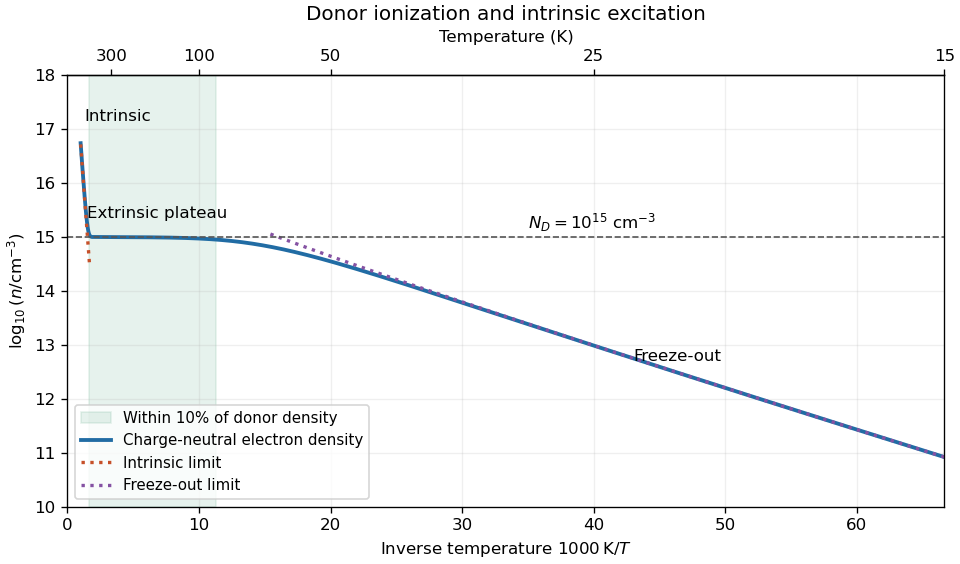
Carrier freeze-out, extrinsic plateau and intrinsic excitation in the specified donor model
. Original charge-neutral calculation using , constant , the supplied single-valley effective masses and donor degeneracy factor two. Dotted lines show limiting expressions where they apply; the shaded temperature interval uses a stated ten-percent plateau tolerance. Details.
To quantify “approximately constant”, require . At , the specified model gives , and . The full neutrality equations give the ten-percent plateau intervalThe lower boundary is set by donor ionization and the upper boundary by intrinsic electron-hole production. The large ratio allows substantial donor ionization even when ; using only would incorrectly exclude much of the plateau. The quoted interval depends on the chosen tolerance and the constant-gap band model, rather than being an exact measured range for arsenic-doped silicon.
For a lattice-periodic potential, Bloch's theorem permits energy eigenfunctions , where for every lattice translation . The crystal momentum is , defined modulo a reciprocal lattice vector. A reciprocal vector satisfies , so is lattice-periodic.
Expand the Bloch wave as plane waves in one momentum class, with . Substitution into the Schrödinger equation, using , gives a kinetic coefficient and potential coefficient . Independence of the plane waves therefore givesThis uses for the paper's running plane-wave index, to distinguish it from the fixed reduced Bloch wavevector.
For , the sine potential has coefficients , . At the Brillouin zone boundary, the free states and are degenerate. Keeping these two resonant waves in the nearly-free electron model givesThe determinant is , so the two energies are , separated by . With , the lower combination has coefficients and density proportional to ; the upper has and density . The lower wave places less weight where the potential is positive. Coupling to nonresonant plane waves gives higher-order corrections beyond this two-wave approximation.
The first Brillouin zone of a primitive cubic lattice is the cube . Its boundary along is the face center , while along it is the corner . ThereforeA spin-degenerate band accommodates two electrons per cell. To be a band insulator, the filled first band must be separated from the second at every wavevector; a direct local splitting alone is insufficient. Under the paper's uniform-boundary-gap estimate, take the lower edge as and the upper edge as . The highest lower edge is and the lowest upper edge is . Thus the indirect gap in a uniformly split zone-boundary model isEquality gives touching rather than a positive gap; for smaller , overlapping energy bands prevent a band insulator. This final threshold is the stated uniform-splitting band-edge estimate. A quantitative three-dimensional potential mixes several plane waves at corners and requires its full band structure rather than assuming the two-wave sine calculation remains exact there.
Articles by others on the same topic
There are currently no matching articles.