In spacetime dimensions, and a dimensionless action requires . Since , the canonical kinetic term fixes . The cubic and quartic terms then giveThese brackets denote mass dimensions. The cubic coupling is dimensionless at , whereas the quartic coupling is dimensionless at . Hence there is no single dimension in which both nonzero couplings are dimensionless. For example, at the cubic coupling still has mass dimension one.[ref]
Let be the free Feynman propagator, and abbreviate , . Expand the normalized Dyson series, so vacuum bubbles cancel between numerator and denominator, and retain the connected correlation function. Wick's theorem yieldsThese are respectively the free line, the quartic tadpole diagram, the two-cubic-vertex bubble diagram, and an tadpole contribution to a cubic-theory two-point function, attached by a bridge to the vertex carrying both external legs. The last graph is connected but is a one-particle-reducible Feynman diagram; removing its bridge disconnects it. It must be included when all connected graphs are requested. It disappears if an additional vanishing-one-point-function renormalization condition and its corresponding tadpole subtraction are imposed; that convention was not specified here.
The factors can be counted directly. The quartic term has attachments for the two labelled external legs, divided by . At second order in the cubic interaction the expansion denominator is . There are 36 Wick contractions for the bubble, and 36 for the attached-tadpole graph, giving for each. Thus each loop topology shown has symmetry factor . Disconnected products of one-point functions and vacuum bubbles are not part of .[ref]
Quantum Field Theory by David Tong. Sections 3.3–3.4, Wick contractions and diagrammatic perturbation theory
The one-loop cubic-quartic scalar vertex classification follows without truncating arbitrarily in powers of the couplings. A connected graph with external legs, cubic vertices, quartic vertices and loop number satisfiesFor , the only possibilities are or , exactly those just listed.
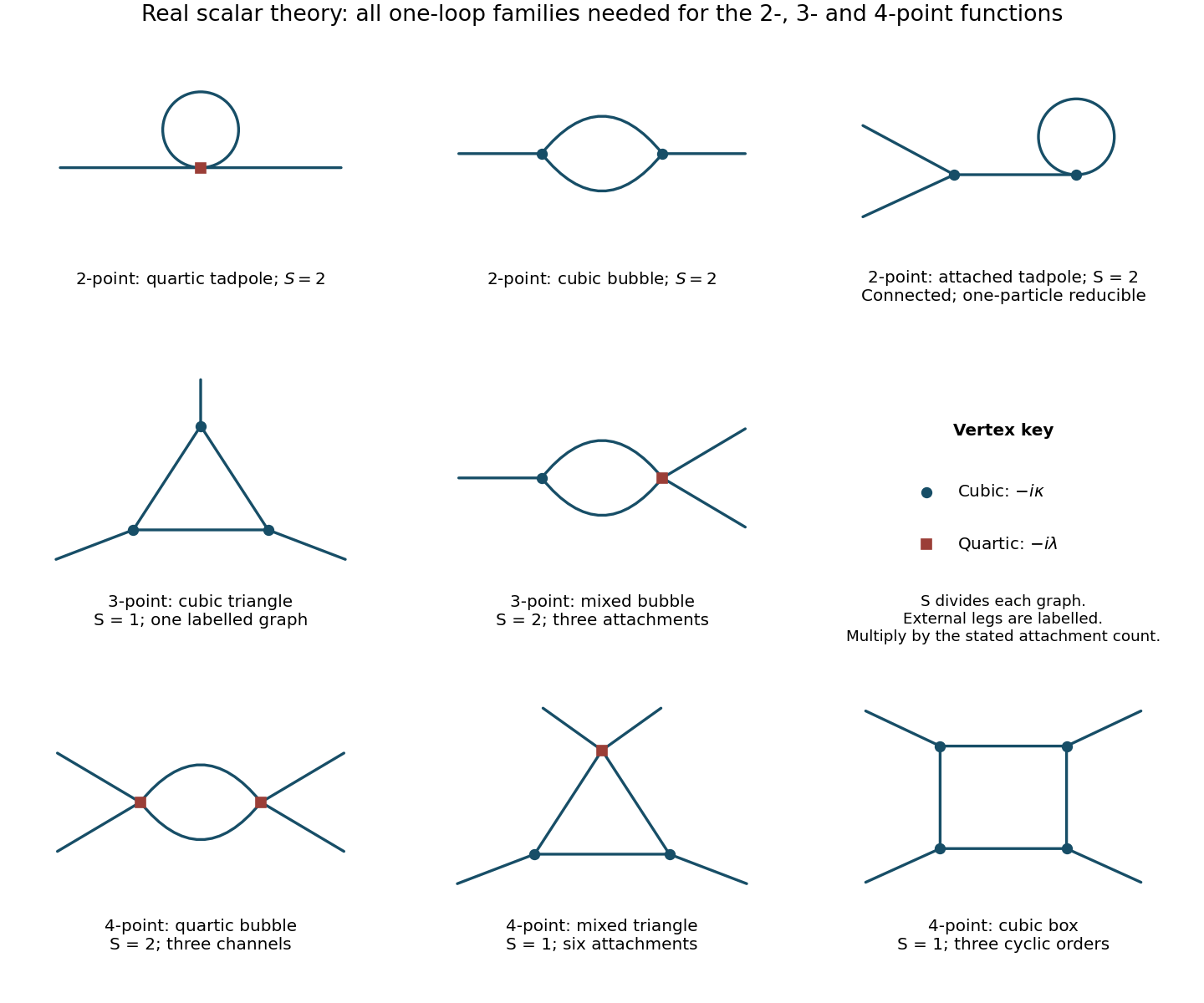
One-loop Feynman diagrams in the real cubic-plus-quartic scalar field theory, with symmetry factors and channel multiplicities
. Details. 
For the amputated one-particle-irreducible vertex, every internal bridge is forbidden. Define the Feynman integralsFor , the counting identity in part b gives . The only one-particle-irreducible Feynman diagrams are a triangle of three cubic vertices and a two-propagator bubble joining one cubic and one quartic vertex. Write for the amputated Feynman vertex, including its overall factor of . With all external momenta incoming,The triangle has for labelled external legs. The mixed bubble has because its two internal lines may be interchanged. There are three distinct terms, according to which external leg is attached to the cubic vertex; the other two attach to the quartic vertex. No tadpole attached by a bridge is one-particle irreducible.
The requested position-space three-point correlation function is obtained by restoring the external propagators and a Fourier transform:The tree-level contribution would replace the last factor by . This explicitly distinguishes the amputated vertex from the correlation function while giving all loop integrations in momentum space.
Let denote the amputated Feynman vertex, with tree term . A one-loop one-particle-irreducible Feynman diagram has , allowing three families: two quartic vertices, two cubic vertices and one quartic vertex, or four cubic vertices. DefineUsing from part c and writing , the complete one-loop result isIn each term of the middle sum, are the two complementary indices. Their order does not change the integral after a loop-momentum redefinition.
The first line contains three bubble channels, one for each partition of the four labelled external legs into two pairs. Each has from interchanging its two identical internal lines. In the second line, the quartic vertex carries a chosen pair of external legs, giving mixed triangles. Each has . In the last line, cyclic orderings of four labelled external legs are identified under rotation and reversal, leaving boxes, again with each. The figure in part b shows one representative of each family and its multiplicity. External-leg corrections and tadpoles connected by bridges are excluded because is a one-particle-irreducible vertex. All integrals are left unevaluated, as appropriate here.
Articles by others on the same topic
There are currently no matching articles.