Source bundle pages 100–103. The cover establishes Hilary Term 2022 despite the attachment's 2021 filename. Throughout, use and the Minkowski metric with signature .
A dimensionless action in six spacetime dimensions requires the Lagrangian density to have mass dimension six. The kinetic term then fixes , and each field interaction term must have the same mass dimension. ThereforeEquivalently, in powers of a length unit , has units , has units , and has units . Thus literal length exponents would be ; the 's in the supplied superficial degree of divergence formula must instead mean mass dimensions, namely . This distinction resolves the wording's convention mismatch.
To check the convention independently, let count internal lines, cubic interaction vertices, quartic interaction vertices, and independent loop momenta. A connected Feynman diagram obeys and . Hence its superficial degree of divergence is , agreeing with the supplied formula only with the mass dimensions above.
In momentum space, the Feynman rules for the real scalar field areEach interaction vertex supplies , with all its momenta counted inward. Impose momentum conservation, integrate each independent loop momentum with , and divide by the Feynman-diagram symmetry factor. For a connected amputated scattering amplitude, remove the external scalar propagators and retain a single overall momentum conservation factor. These signs follow by expanding ; the factorials in the Lagrangian density cancel the corresponding attachments in the Wick theorem. The Feynman i-epsilon prescription specifies the scalar propagator poles.
Set and . The superficial degree of divergence is then , independently of the number of cubic interaction vertices. After subtracting ultraviolet subdivergences, the divergent part of a one-particle irreducible Feynman diagram is a local polynomial in external momenta of degree at most . Lorentz invariance and momentum conservation leave the following possibilities:
- : a constant vacuum energy density.
- : a linear tadpole counterterm. The single external momentum is zero, so derivatives cannot generate further independent terms.
- : a mass counterterm and a wave-function renormalization, since the polynomial has the form .
- : a constant cubic interaction vertex.
- : no overall ultraviolet divergence, although ultraviolet subdivergences still require their lower-point counterterms.
Thus a finite set of counterterms closes under perturbation theory. In terms of renormalized coefficients, writeHere is a coefficient of squared mass, rather than a correction to itself. The tadpole counterterm fixes the chosen expansion point, for example ; it cannot be omitted merely because the original Lagrangian density lacks a linear term. The vacuum energy density term cancels out of normalized Green functions, but is required if the unnormalized vacuum functional is also to be renormalized. This establishes perturbative renormalizability; the unbounded scalar potential of a real cubic scalar field theory does not by itself define a stable nonperturbative vacuum state.
Continue with the cubic scalar field theory of c, and use precisely its counterterm signs. Take to separate ultraviolet divergences from infrared divergences. Make a Wick rotation and impose the rotationally invariant cutoff regularization . PutFor example, spherical coordinates give . Polynomial division and then differentiation with respect to give the divergent partsThe derivative relations are and ; differentiation also generates finite terms, which are irrelevant here. The first supplied integral identity is consistent with these divergent parts after Wick rotation.
The second supplied expansion is incorrect. Write . Direct multiplication of the two denominators gives , so the correct Taylor expansion isA concrete counterexample is , , : the exact expression is , whereas the printed expansion gives . We therefore compute the self-energy without that identity.
For Euclidean external momentum , define the scalar bubble integralA Feynman parameter combines its denominators into one squared denominator with . Applying the radial result above and integrating yieldsOne can instead expand with the ultraviolet cutoff fixed on the unshifted loop momentum: the coefficient of the integrand is , using rotational averaging in six dimensions. Its leading radial term is , giving the same logarithm. Shifting a sharp integration boundary changes finite terms in this scalar bubble integral, and does not change the displayed divergent coefficients.
To fix all signs and symmetry factors together, expand the one-loop Euclidean effective action around a background scalar field:These terms are the tadpole diagram, the two-point bubble diagram, and the triangle Feynman diagram. The tadpole diagram has factor ; the two-point bubble diagram also has factor after two differentiations with respect to the background scalar field. The local three-point interaction vertex is . Thus their divergent contributions to the one-, two-, and three-point Euclidean one-particle irreducible vertices are respectivelyThe Euclidean counterterm Lagrangian is . Cancelling each divergent one-particle irreducible vertex therefore givesFor example, the two-point sum is and its divergent coefficients cancel separately. Finite counterterms depend on the chosen renormalization conditions. The zero-mass limit can use a positive subtraction scale in the logarithms after infrared regularization.
If unnormalized vacuum functionals are retained, specify the determinant measure byExpanding its radial integrand at large fixes the additional vacuum energy density counterterm:The purely mass-independent terms depend on the determinant normalization. Normalized Green functions eliminate this entire constant.
The auxiliary field has quadratic kernel and no kinetic term. Inverting that kernel, rather than introducing an artificial scalar mass, gives the momentum space Feynman rulesThe auxiliary-field propagator is independent of momentum; in position space it is . At each interaction vertex attach for momentum conservation. Integrate independent loop momenta with , respect fermion flow, include the closed fermion loop sign , and use the appropriate symmetry factor. Incoming and outgoing fermions carry and ; incoming and outgoing antiparticles carry and . Exchanging external fermions introduces the fermionic sign. Here is Feynman slash notation.
For a dimensional check, , , in mass dimensions. Eliminating consequently produces a four-fermion interaction of negative coupling mass dimension, not a propagating scalar degree of freedom.
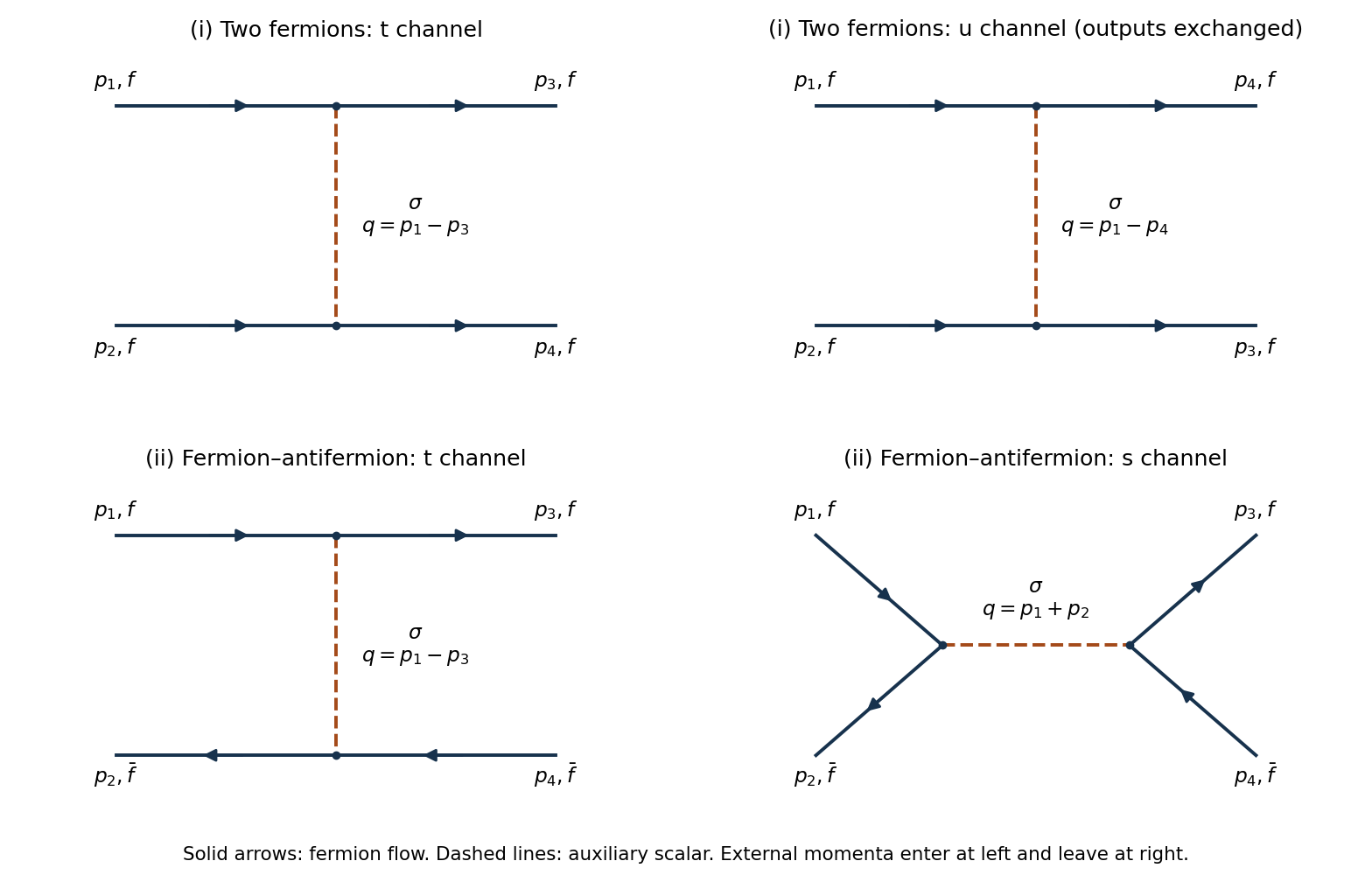
Original tree diagrams with external momentum labels and fermion-flow arrows. The upper row gives two-fermion t and u exchange; the lower row gives fermion–antifermion t exchange and s annihilation. Dashed lines denote the auxiliary scalar.
Details. 
Label the incoming fermion momenta and outgoing fermion momenta , with . There are two tree-level Feynman diagrams: the channel connects to and to , with exchanged momentum ; the channel connects to and to , with . Both internal lines are auxiliary-field propagators. The upper row in the figure gives these labelled connections; the outgoing labels are exchanged in its second panel to avoid a visually unnecessary crossing.
Each tree-level Feynman diagram contains two factors and one factor , giving . The exchange of the two identical outgoing fermions gives the relative fermionic sign. Up to a common external-state phase, the corresponding scattering amplitude isThere is no annihilation channel: both incoming particles carry the same fermion number, whereas a interaction vertex couples one fermion to one antiparticle when both are incoming.
Use incoming fermion and antiparticle , outgoing fermion and antiparticle . The two tree-level Feynman diagrams are the channel, with , and the channel, with . They occupy the lower row of the figure. In the channel the fermion flow follows and ; in the channel it follows at the incoming interaction vertex and at the outgoing interaction vertex.
The two contractions again have a relative fermionic sign. With the same harmless common-phase convention as i, their sum isThe auxiliary-field propagator is the same constant in both channels. There is no channel preserving the external fermion number assignments.
Write and . With , chooseThe relative minus sign is fixed by the canonical anticommutation relations, not by the Mandelstam variables. It follows by crossing symmetry from the identical-fermion scattering amplitude in i, or directly by the two inequivalent external contractions of . For an explicit sign check, fix incoming state order and outgoing order . The direct contraction contains , whose coefficient in the ordered product is ; the annihilation contraction has coefficient . The common sign can change with the external-state convention, while their relative minus sign cannot.
Let . The external particles are on shell, so andUse the supplied spin sums and gamma matrix trace identities. The two diagonal terms in the initial spin average areFor the interference term, the spin sum is a single Dirac trace:Terms with an odd number of Dirac gamma matrices vanish. Expanding the remaining terms givesSubstituting the Mandelstam variables reduces this toIt is real. The initial spin average therefore yieldsThe displayed answer in the source is false. At threshold, , hence and . Then , while the spin sums give . The printed expression instead gives . This is also a counterexample in the continuous threshold limit from physical nonzero incoming momenta. At there is a further discrepancy: the correct result is , rather than the printed . Changing a common phase of the scattering amplitude cannot change either comparison.
The requested symmetry nevertheless holds for the correct answer. Crossing symmetry exchanges the two ways of pairing the four external fermion lines; the momentum-independent auxiliary-field propagator supplies no channel-dependent denominator. The relative fermionic sign can reverse the crossed scattering amplitude, but disappears in its squared modulus. With , the boxed expression is manifestly symmetric under . This is an analytic crossing relation, not a statement that positive physical and negative physical have interchangeable scattering kinematics.
Set , a Grassmann-even Dirac scalar bilinear. Completing the square givesIntroduce external Grassmann sources for the Dirac field, but no source for . The generating functional isAt a finite regulator the change of variable has unit Jacobian: it translates a bosonic integration variable by a Grassmann-even expression independent of that variable. Its oscillatory Gaussian integral can be defined with a convergence prescription and then continued. It is a constant independent of . ThusThe factor cancels in . Every normalized Green function with only external fermion lines is a Grassmann source derivative of this same normalized generating functional, soThis is an exact Hubbard–Stratonovich transformation in reverse, rather than just an approximation based on tree-level Feynman diagrams. At the diagrammatic level the contact auxiliary-field propagator collapses each exchanged line into the same local four-fermion interaction. The equality uses a common regulator and does not assert perturbative renormalizability of that four-dimensional four-fermion interaction.
For arbitrary linear operators, expansion of the anticommutators givesNow use the commutator product rule , with , twice. The result isNo grading assumption is needed for these algebraic identities.
For the Dirac field, supplement the supplied equal-time canonical anticommutation relations with . Define the fermion number density . In the preceding identity take , , , and sum over . Only its first and last anticommutators survive, givingThis is an identity of operator-valued distributions. Point splitting, or smearing with test functions, gives a precise meaning to coincident bilinears. Normal ordering only subtracts a constant from the density and does not alter this commutator.
Define the constant Dirac gamma matrix combinations and . The Hamiltonian operator isEvaluate its commutator with using the bilocal result in a. The mass term cancels immediately when , because its two Dirac delta distributions coincide. For the derivative term first keep the two points distinct:The terms in which the derivative acts on cancel against each other; the derivative of the second Dirac delta distribution remains. ThusThe last equality is integration by parts, or the defining derivative rule for a distribution. Consequently the literal conserved current whose divergence equals isBecause a commutator of two Hermitian operators is anti-Hermitian, this includes . The physical Hermitian Dirac current is instead , so . The Heisenberg equation of motion now givesThis establishes the continuity equation directly from the required commutator, without assuming the Dirac equation or invoking the Noether theorem as a substitute for the computation.
The Hamiltonian operator is invariant under the constant global phase symmetry , . The Noether current of this unitary group is the Dirac current obtained in b. For fields with vanishing flux at infinity, or periodic boundary conditions, the divergence theorem and that continuity equation implyThe canonical anticommutation relations also give and , hence . Reversing the parameter sign recovers the stated phase convention. Thus generates the global phase symmetry. With normal ordering, counts fermions minus antiparticles, rather than the sum of both populations. Its conservation law is Dirac fermion number conservation. A position-dependent phase produces derivative terms in this free Hamiltonian operator; the symmetry under discussion is global.
Combine the two equal-mass Dirac fields into . A constant unitary matrix acting on this flavour index commutes with the common Dirac Hamiltonian, so gives the unitary flavour symmetry of degenerate Dirac fields . Its real Lie algebra has dimension four. A convenient Hermitian generator basis is , , , where are the Pauli matrices.
For each generator the canonical anticommutation relations giveThe calculation is exactly the one in b, since commutes with both the Dirac gamma matrices and the common fermion mass matrix. ThusExplicitly their densities areThe two off-diagonal conserved currents are why counting only the individual fermion numbers misses two generators. The singlet generates ; the other three generate special unitary group . Unequal masses would break the off-diagonal conservation laws.
Scope of the count. Four is the count of currents of the displayed form. The completely free system also has an enhanced internal symmetry of free Dirac fields if mixing with charge-conjugate fields is admitted. For , write its two Dirac fields as four equal-mass Majorana spinors . Their orthogonal group rotations have six continuous generators, with conserved currents proportional to for ; the four currents form a subgroup. This larger count is relevant if “similar” means all local internal currents of the free system, without preserving a chosen fermion number. If , the usual number-preserving chiral flavour symmetry of massless Dirac fields is with eight currents; allowing charge conjugation mixing enlarges it to with sixteen. These counts concern internal currents, excluding spacetime Noether currents.
Articles by others on the same topic
There are currently no matching articles.