Use the computational basis in the stated order and let the rightmost operation act first. The controlled phase gate is . From the rotation definition,The control-zero block remains the identity, and the control-one block becomes . ThusThis proves the relation for arbitrary superpositions, rather than only for computational-basis probabilities.
For the second relation write . Its central block is , with , . Because , and , direct multiplication givesMeanwhile . Multiplying these diagonal matrices and the overall factor givesThe supplied is indeed a square root of the SWAP gate: exchanges and while fixing the other basis states. It acts as one on the triplet subspace and as on the singlet subspace.
For an isotropic exchange interaction with Hamiltonian , define . Triplet and singlet energies differ by , soAn exchange pulse with therefore implements . Two such pulses, interspersed with the specified local rotations, implement the controlled phase gate; the initial and final target rotations then turn it into a CNOT gate. Their common overall phase has no effect on an isolated gate's outcome probabilities; a subsequently controlled version must keep track of conditional phases.
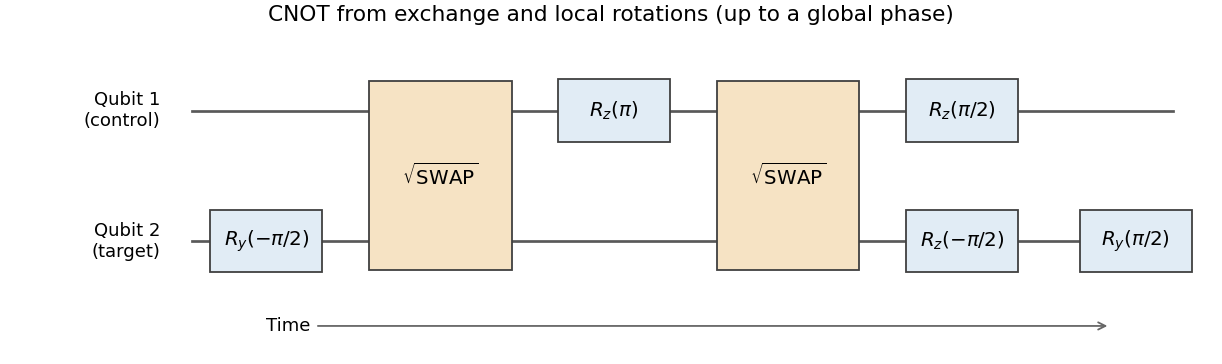
CNOT synthesis from two square-root-of-SWAP exchange pulses and local rotations, with time running left to right
. Details. 
The construction converts a physically available two-spin interaction into a standard entangling gate, which together with arbitrary one-qubit rotations supplies universal quantum computation. Practical operation needs calibrated exchange pulse area and timing, individually controllable rotations, and reproducible phase references. Charge noise can change ; magnetic-field gradients add unwanted single-spin evolution, and anisotropic exchange modifies the assumed Hamiltonian. Pulses must suppress leakage into unwanted orbital states while finishing before excessive decoherence. Readout, preparation, cross-talk and the extra operations in this decomposition all affect the achieved quantum gate fidelity. The algebraic identity alone does not establish a fault-tolerant quantum computation implementation.
Include Alice's detector and environment before taking a partial trace. Ideal measurement produces the global stateOrthogonality of the two record states removes their cross terms from the reduced state of the particles:This nonselective quantum measurement has changed the initially entangled singlet into a separable, classically anticorrelated reduced state. Its entropy is one bit, although the full particles-plus-records state is still pure under the assumed unitary dynamics. The reduced density matrix is an improper mixture; tracing the environment does not by itself assert a literal collapse of that global state.
The Born rule gives Alice outcomes zero and one with equal probability. Conditional on a recorded result, the selective quantum measurement assigns or to the particles. The unitary measurement coupling and orthogonal records explain decoherence in this basis; they do not supply an additional rule selecting a unique outcome. That is part of the measurement problem. In a collapse postulate the individual outcome is stochastic; other interpretations account for outcome experience differently while retaining these operational probabilities.
When Bob makes the same kind of measurement, the global state becomesTracing both laboratories gives the same reduced matrix, . Bob has added a correlated record, not restored the lost reduced coherence. If Alice's outcome is known, Bob's opposite outcome is certain in this ideal common basis. Without that record, his marginal is , so his outcome remains equiprobable. Alice cannot choose her random result or use this correlation for faster-than-light signalling, consistently with quantum no-signalling.
These common-basis measurements alone do not distinguish quantum predictions from a local source sending opposite preassigned bits. To test that explanation, prepare fresh singlets and let the observers independently choose among incompatible measurement axes before recording each result. For singlet spin measurements along unit vectors , quantum mechanics predicts . The CHSH inequality bounds for Bell-local models with measurement-independent settings. Choosinggives . A suitable Bell test constrains that class of explanations. Independently chosen settings, control of detection bias and separation of the measurement events matter when interpreting an actual experiment.
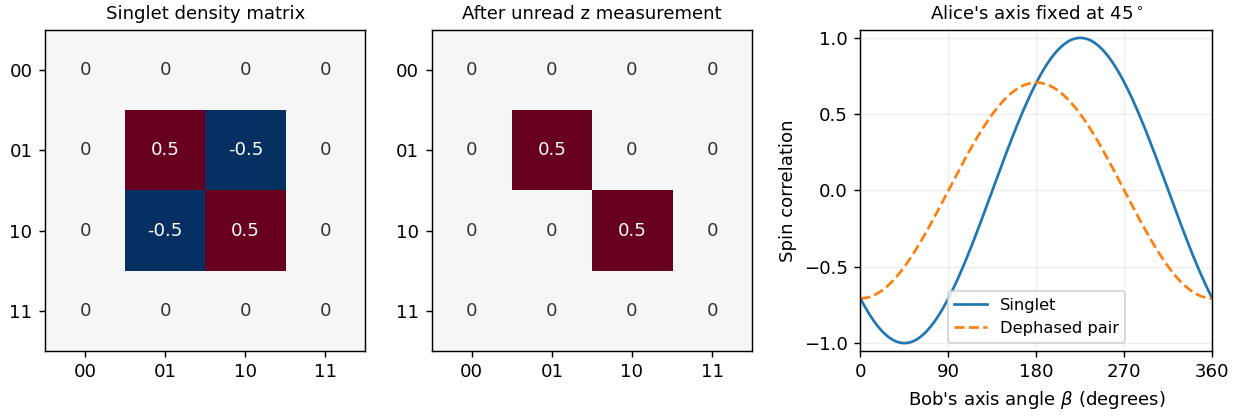
Singlet coherence is lost from the reduced density matrix after a local unread measurement; common-axis anticorrelation survives
. Details. 
If Alice first performs the fixed-axis irreversible measurement described above, the resulting mixed state has and cannot supply that singlet violation. The incompatible settings must belong to the Bell measurement itself. Moreover, Bell violations do not choose among all interpretations of quantum mechanics: interpretations sharing the Born predictions remain observationally equivalent for this experiment. Objective-collapse modifications could instead require additional interference tests with specified departures from unitary dynamics.
A positive operator-valued measure consists of positive semidefinite effects with . Its outcome probabilities are , which are nonnegative and sum to one. Unlike a projective measurement, its effects need not be mutually orthogonal projections, and there can be more outcomes than the system's Hilbert-space dimension.
For example, choose three equatorial Bloch vectors separated by and set . Each effect has eigenvalues zero and , and the vectors sum to zero, so the three effects sum to . This trine qubit POVM gives for input Bloch vector . It cannot be a three-outcome orthogonal projective measurement on that qubit.
A physical implementation can couple the system to an ancilla and projectively measure the enlarged system. More generally, operators implement an outcome with ; the normalized conditional state is . Thus a POVM does not determine the post-measurement state: different measurement instruments can have the same outcome probabilities and different disturbance. Generalized measurements are useful for state discrimination and realistic detection, including explicitly modeled inconclusive outcomes.
Quantum cryptography includes quantum key distribution, which establishes a shared secret key rather than transmitting an arbitrary plaintext directly. In BB84, Alice randomly prepares one of the two computational-basis or two complementary-basis qubit states; Bob randomly measures in either basis. They announce bases over an authenticated classical channel and retain the positions where their choices agree, about half in the ideal unbiased case. They test a subset for errors, reconcile the remaining strings, and apply privacy amplification to remove a bounded eavesdropper's information. A protocol can abort when the observed data do not support a secret key.[ref]
Quantum cryptography: Public key distribution and coin tossing by Charles H. Bennett and Gilles Brassard. 1984 protocol; authors' later upload of the original proceedings contribution
Nonorthogonal states cannot be perfectly copied by a state-independent device, by the no-cloning theorem. An intercept-resend attacker who measures each signal in a random BB84 basis chooses the wrong basis half the time. On those sifted positions Bob has a one-half error probability, giving the ideal BB84 intercept-resend error rate . This simple calculation demonstrates detectable disturbance for that attack; it is not a complete security proof for arbitrary attacks.
Authentication is essential: otherwise an adversary can impersonate both participants. Error correction reveals information that must be included in the privacy budget, and losses, finite sample sizes, multiphoton emission and detector behavior belong in the security model. Entanglement-based variants can use Bell correlations, but observing some entanglement or a Bell violation alone does not replace a quantitatively specified key-distillation protocol. The final key can subsequently be used in a suitable classical encryption scheme.
For quantum teleportation, Alice holds an unknown input and one member of a shared pair; Bob holds qubit 3. Alice applies a CNOT gate from 1 to 2 and a Hadamard gate on 1, then measures both in the computational basis. Expansion gives the Bell-basis teleportation identityEvery outcome pair has probability , independently of the input. Alice sends these two classical bits, and Bob appliesThe order of the two corrections matters only by a global sign for the doubly nonzero outcome. The transformation also transfers entanglement with an untouched reference, because the identity is linear in the input amplitudes.
Before receiving the bits, Bob must average over all four Pauli-related states, obtaining for any input. Thus teleportation requires classical communication and does not send information faster than light. The original input is consumed by Alice's measurement, so no second copy remains and the no-cloning theorem is respected. Ideal qubit teleportation consumes one shared Bell pair and two classical bits, as well as local gates and measurements. Imperfect entanglement, gate error, detection error or lost classical records reduce practical fidelity; teleportation transfers the quantum state, not the underlying material particle.
Articles by others on the same topic
There are currently no matching articles.