Original public paper: Physical PDF pages 835–838. All three questions and all alternatives in question 3 are answered. Entropies use logarithms to base two.
An eigenvalue of an observable in a known corresponding eigenstate is a simple example satisfying the Einstein–Podolsky–Rosen criterion of reality: its value is predictable with certainty. For example, a spin angular momentum component in a prepared spin-up eigenstate has a definite predicted value. For a distant system, Albert Einstein, Boris Podolsky and Nathan Rosen invoked locality: a measurement performed on a sufficiently separated, noninteracting partner should not disturb that system. In the relativistic version here, the measurement events have spacelike separation.
The Pauli matrices obey , soTheir nondegenerate eigenstates are incompatible: an eigenstate has equal probabilities for the two outcomes, and conversely. Thus no single quantum state has both components sharply determined. The Robertson uncertainty relation gives , but its right-hand side may be zero; that alone is not a proof that simultaneous zero uncertainties exist. The absence of a common eigenstate supplies the stronger conclusion for this spin-half pair.
For the specified Bell state, Bob obtains or with probability when he measures . Conditional on his result, Alice obtains the same sign with certainty if she measures . Under the EPR locality premise, this certainty supplies an element of reality for her ; it is a conditional prediction after Bob learns his own random result, not a premeasurement prediction of its sign.
The normalized eigenstates are and . Expanding their tensor products givesConsequently the same Bell state has equal, perfectly correlated outcomes. Bob's two outcomes again each have probability , and the same locality-and-certainty argument applies separately to Alice's .
The disputed step is to combine predictions conditional on two incompatible choices into two simultaneous, measurement-independent pre-existing values. Quantum theory provides the two conditional ensembles, not a joint sharp assignment of and . This is quantum steering. Bob cannot measure both incompatible observables sharply on the same member of the pair. Nor does conditional steering allow signalling: ignoring his result leaves Alice's reduced density matrix equal to for either measurement choice, by the no-communication theorem.
To test the stronger claim of a local hidden-variable theory, Alice needs several correlation settings, not just perfect agreement along the two common axes. For the CHSH inequality, choose observables with outcomes :In the given Bell state, and the crossed correlations vanish. Henceexceeding the local bound . The bound assumes Bell local causality and measurement independence, with the appropriate treatment of sampling and settings.
Experimental Bell tests support violations rather than that local assignment. The Aspect switching experiment changed analyzer settings during separated photon flights, while leaving sampling and switching limitations. By the time of this examination, the Delft electron-spin Bell test had used electron spins at stations apart, efficient spin readout and rapid random basis choices. The combination addressed both detection and locality loopholes, providing evidence against the tested local model class.[ref]
Experimental loophole-free violation of a Bell inequality by Bas Hensen and others. 2015 abstract: separated electron spins, efficient readout and fast random settings
This does not prove that every conceivable notion of reality is false, or that noncommutation alone rules out every hidden-variable theory. A nonlocal theory can evade the local premise. What Alice can challenge is Bob's claim that locality, measurement-independent simultaneous values and all observed correlations can be retained together. An ordinary measurement disturbance at Bob's lab is not by itself a local explanation of Alice's conditional ensemble.
Use the thin singular value decomposition , with , unitary and nonnegative. Expanding its entries givesThe columns of and of are orthonormal, establishing the Schmidt decomposition. Bob's basis uses the complex-conjugated columns of . Omitting that conjugation would not reproduce the coefficient matrix. The squared Schmidt coefficients are the eigenvalues of ; equivalently and . The two reduced density matrices are and , which have the same nonzero eigenvalues.
The printed coefficient slightly rounds a normalized state: each squared norm is . Normalize before calculating an entropy. For the two states, the resulting Gram matrices are approximatelyFor a trace-one two-dimensional Hermitian matrix with diagonal entry and off-diagonal entry , its eigenvalues areSort them decreasingly and take square roots:The Von Neumann entropy is . is more entangled: its Schmidt weights are closer to equal and its reduced-state entropy is larger. Neither state is a product state or maximally entangled on its two-dimensional support.
By Nielsen's pure-state conversion theorem, deterministic LOCC conversion requires the input vector of squared Schmidt coefficients to be majorized by the output vector. Here and both sums are one, so . Therefore is possible deterministically; is not. Entanglement can be discarded by local operations but cannot increase deterministically for these pure inputs. Probabilistic concentration is a separate question and is allowed below.[ref]
Conditions for a class of entanglement transformations by Michael A. Nielsen. 1999 primary theorem: deterministic pure-state conversion and majorization
There is a dimensional qualification in the proposed measurement. Write . The two supplied measurement operators obeyThus their effects form a POVM on the occupied support, where is the identity. Alice's full space is three-dimensional, so these two operators alone do not sum to . A full-space completion is . It has zero probability on either input, so it changes none of the requested outcomes. Strictly, the POVM consists of the effects ; the specified additionally fix a quantum instrument and therefore the conditional states.
In the appropriate Schmidt basis for either input, write . The two outcomes have probabilitiesand normalized conditional statesThese formulas give both outcomes for each state by substituting its row of the table. For example,The two inputs have different Schmidt bases; the primed measurement basis is adapted separately to the state, as the question specifies, not one common unexamined laboratory basis.
For the outcome to be a maximally entangled state, its two amplitudes must be equal. HenceThe requested numerical results areThus has the larger success probability, consistent with its greater initial entanglement. The branch cannot be balanced in the allowed angle range for either nonmaximal input: it would require .
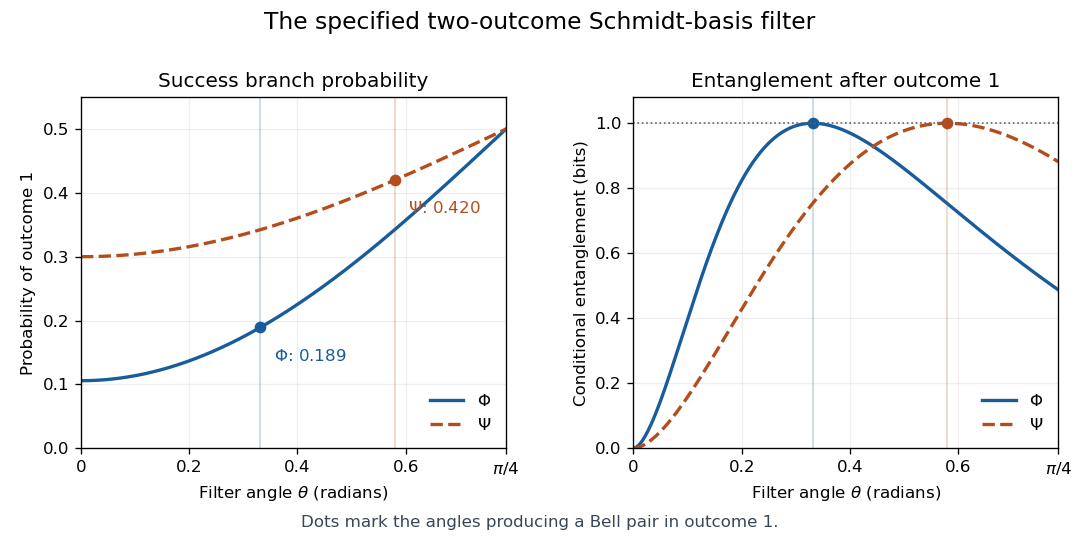
Success probability and conditional entanglement for the specified Schmidt-basis filter
. Original calculation with normalized printed coefficients. Each marked angle makes outcome 1 maximally entangled. Curves refer to the specified two-outcome instrument, not the optimal unrestricted concentration protocol. Details.
The success probabilities belong to this particular binary Schmidt filter. They are not the optimum over every possible quantum instrument. The diagonal success operator instead gives the standard single-copy entanglement concentration probability . Postselection can increase entanglement in the retained branch, while the outcome-averaged entanglement cannot increase under LOCC.
A weak measurement couples an observable only weakly to a meter, so the pointer distributions associated with its different eigenvalues overlap strongly. One trial supplies little information and a small disturbance; an ensemble is needed to estimate a small mean shift. It is not an exact determination of a previously hidden eigenvalue with no disturbance.
For pointer position and conjugate momentum , a short von Neumann measurement interaction has unitary . An eigenvalue translates the pointer by . The weak regime requires those translations to be small relative to the pointer width. Without postselection the first-order mean displacement is for an initially uncorrelated, suitably centered meter.
If the system is prepared in and postselected in , the unnormalized meter state isFor a real centered Gaussian pointer with no position–momentum correlation, the conditional position shift is ; the imaginary part affects the conjugate momentum distribution. The weak value can be complex or have a real part outside the observable's eigenvalue interval, because it is a conditional transition-amplitude ratio, not an eigenvalue.
An example apparatus uses photon polarization as the two-level system, a weak polarization-dependent transverse displacement as the interaction, and an output polarizer for postselection. Repeated position detections estimate the selected beam's displacement. Nearly orthogonal selection can make the conditional shift large, but also reduces the accepted sample and eventually invalidates the first-order expansion. The original weak-value proposal emphasized preselection, a weak coupling and postselection, rather than an anomalous result from an ordinary sharp spin measurement.[ref]
Weak values by Yakir Aharonov, David Z. Albert and Lev Vaidman. 1988 primary paper: preselected and postselected spin ensemble and conditional weak value
Weak coupling limits quantum measurement backaction per trial; it does not abolish the information–disturbance tradeoff. Repeating weak observations can accumulate substantial backaction, and discarding rejected trials cannot automatically improve the information available per prepared system. Conditional pointer amplification and a statistically improved parameter estimate are distinct claims.
Quantum teleportation transfers an unknown qubit state using a previously shared Bell pair, local operations and two classical bits. It requires no description of the unknown complex amplitudes and produces no extra copy.
Let the input be , and let Alice and Bob share . Alice applies a controlled-NOT gate from to , then a Hadamard gate to . Expanding the circuit gives the Bell-basis teleportation identity in computational-output form:Her projective measurement yields each bit pair with probability . She sends the two classical bits, and Bob applies to recover . The order is the inverse of the displayed conditional operator; interchanging these Pauli corrections changes only an irrelevant global phase when both bits are one.
Before receiving the bits, Bob hasThus teleportation respects the no-communication theorem and cannot transmit the usable unknown state faster than the classical message. Alice's input has been measured, and the shared entanglement resource has been consumed, in agreement with the no-cloning theorem. The protocol transfers the state, not the material particle initially carrying it.
A physical implementation must distribute and preserve an entangled pair, implement a Bell-basis measurement and transmit its result to a controllable output system. Imperfect entanglement, lost outcomes and noisy corrections reduce quantum fidelity; a heralded probabilistic experiment must report its success probability separately from conditional fidelity. Ideal deterministic teleportation assumes every Bell outcome can be identified and corrected.
Quantum error correction encodes a logical qubit into a larger Hilbert space, diagnoses a specified error family with an error syndrome, and reverses it without learning the protected logical amplitudes. It must preserve arbitrary superpositions, not just distinguish two classical codewords.
The bit-flip repetition code encodesMeasure the commuting stabilizer generators and using ancillary qubits. Their outcomes reveal the parity relations, with the three-qubit bit-flip syndrome tableBoth codewords have the same parity checks, so the syndrome does not reveal or . For example, the error produces ; applying restores the encoded superposition. A coherent combination of correctable errors is also recoverable after the syndrome is recorded in an ancilla, by linearity.
This three-qubit code corrects one bit flip, not every one-qubit error. A physical changes the relative logical phase without a nontrivial bit-flip syndrome. General single-qubit noise is a linear combination of ; protecting arbitrary single-qubit errors therefore needs a code such as the Shor code, the Steane code or the five-qubit code, with the corresponding enlarged syndrome structure.
The general exact-recovery criterion is the Knill--Laflamme condition. For code projector and error operators , there must be constants such thatIt expresses that the syndrome information can depend on the error but not on the logical state. Encoding entangles several physical qubits; it does not create independent copies of an unknown input, so it respects the no-cloning theorem. Fault-tolerant implementations must also prevent noisy syndrome extraction and recovery gates from spreading an initially correctable error into an uncorrectable one.
Articles by others on the same topic
There are currently no matching articles.