The Hartree-Fock method approximates the ground state wavefunction by a single Slater determinant, minimizing the expectation value of the Hamiltonian over its occupied orbitals. It retains fermionic exchange symmetry exactly within that determinant but omits electron correlation beyond a single Slater determinant.
The periodic boundary condition requires , so there are exactly independent wavevectors in a Brillouin zone:The inverse discrete Fourier transform, with the sign convention of the paper, isFourier orthogonality gives the tight binding dispersion relation . For the interaction, first use the canonical anticommutation relations at distinct sites to write . Summing its discrete Fourier transform over enforces crystal momentum conservation, givingEvery wavevector is reduced modulo . The phase comes from the displacement of the second site by one lattice spacing. Equivalently replace by : exchanging the two incoming and the two outgoing fermions changes to with two cancelling fermionic signs. Thus the usual interaction vertex is accompanied by the factor .
For each spin let contain the lowest tight binding energy levels, and set and . The normalized trial Slater determinant isIts nearest-neighbour one-body density matrix is . By Wick's theorem, fermionic exchange symmetry subtracts the squared off-diagonal one-body density matrix from the direct contributionThis formula also specifies the finite- answer exactly, including partially filled terminal energy levels through the chosen occupied set. For consecutive allowed wavevectors, ; its phase locates the centre of that occupied interval.
Write . In the large- limit the Fermi sea is centred at for and for , with Fermi wavevector measured from . ConsequentlyThe subtraction due to fermionic exchange symmetry is essential: replacing by would discard the suppression of neighbouring equal-spin occupation. A completely filled spin band has zero kinetic energy and interaction energy , as the formula also shows.
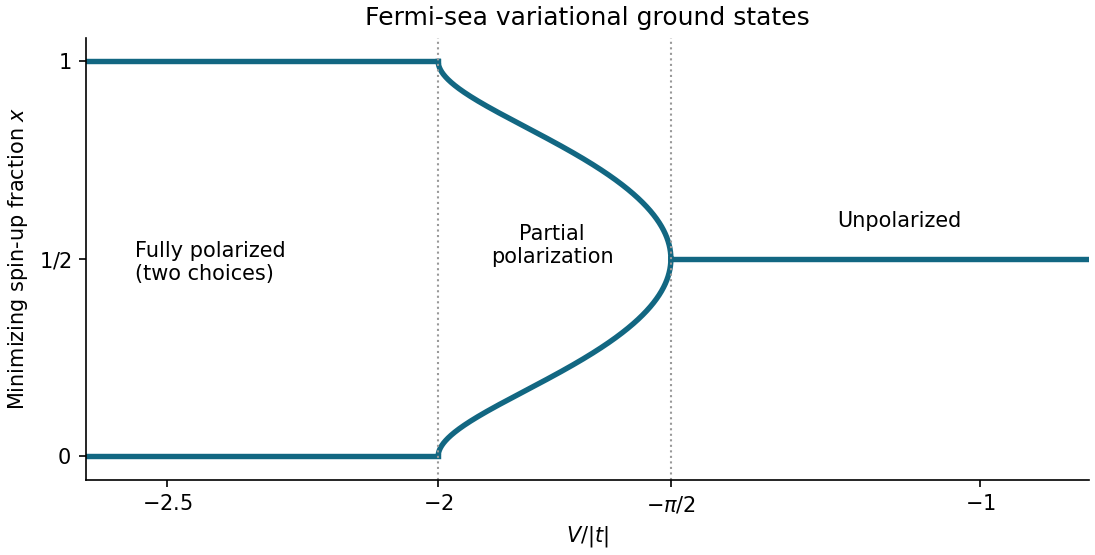
At , the two spin occupations per site are and . With , the trial energy per site isIts derivative is . Since is a boundary point, its local minimum test is one-sided: . At , where this derivative vanishes, its Taylor series begins for small positive . HenceThe same applies to by spin interchange.
The symmetry makes a stationary point for every . Here , so the second-derivative test settles all cases except equality. Writing , at the Taylor series is . ThusThe minimizing branches interpolate continuously. To find all of them, put on . An interior stationary point obeysThe right side decreases strictly from to , sinceThe positivity follows from . There is therefore exactly one such stationary point on each side of when . The signs of show that both are global minima, whereas is then a local maximum. The complete answer isThe pair merges through a supercritical pitchfork bifurcation at . Comparing only and would miss the intervening ground states with partial spin polarization.

For , the leading objective is to avoid adjacent electrons of the same spin. The unpolarized Fermi sea, although optimal within the preceding restricted family, has interaction energy per site . Its cost grows linearly with , while states with no forbidden neighbouring pairs have zero interaction energy.
There are two independent spinless fermion t-V chains, one for each spin. On an even ring, avoiding all neighbouring pairs allows at most particles in each chain. Since the total is , both bounds must be saturated, and each chain must alternate occupied and empty sites. Their two independent choices give four limiting occupation patterns:The first two are Néel states with one electron per site; the last two are charge density waves alternating doubly occupied and empty sites. Opposite-spin double occupation costs nothing in this particular Hamiltonian. Each species has alternating occupation in all four patterns.
These are the exact zero-interaction ground states at , and the limiting ordered configurations as . At large finite , virtual hopping admixes configurations with forbidden pairs, producing an energy correction of order . A finite ring can have superpositions of the ordered configurations, with possible quantum tunnelling splittings; four exactly degenerate product ground states are not implied at finite hopping. The four ordered choices describe the strong-coupling thermodynamic limit, with spontaneous symmetry breaking understood.
Articles by others on the same topic
There are currently no matching articles.