Source PDF: mmathphys.physics.ox.ac.uk/sites/g/files/vzsiac2991/files/mmathphys/documents/media/a1853381.pdf
TODO: establish the year coverage of the lecturer’s prior-exam collection: www-thphys.physics.ox.ac.uk/people/SteveSimon/QCM2025/quantummatter.html.
The Hartree-Fock method approximates the ground state wavefunction by a single Slater determinant, minimizing the expectation value of the Hamiltonian over its occupied orbitals. It retains fermionic exchange symmetry exactly within that determinant but omits electron correlation beyond a single Slater determinant.
The periodic boundary condition requires , so there are exactly independent wavevectors in a Brillouin zone:The inverse discrete Fourier transform, with the sign convention of the paper, isFourier orthogonality gives the tight binding dispersion relation . For the interaction, first use the canonical anticommutation relations at distinct sites to write . Summing its discrete Fourier transform over enforces crystal momentum conservation, givingEvery wavevector is reduced modulo . The phase comes from the displacement of the second site by one lattice spacing. Equivalently replace by : exchanging the two incoming and the two outgoing fermions changes to with two cancelling fermionic signs. Thus the usual interaction vertex is accompanied by the factor .
For each spin let contain the lowest tight binding energy levels, and set and . The normalized trial Slater determinant isIts nearest-neighbour one-body density matrix is . By Wick's theorem, fermionic exchange symmetry subtracts the squared off-diagonal one-body density matrix from the direct contributionThis formula also specifies the finite- answer exactly, including partially filled terminal energy levels through the chosen occupied set. For consecutive allowed wavevectors, ; its phase locates the centre of that occupied interval.
Write . In the large- limit the Fermi sea is centred at for and for , with Fermi wavevector measured from . ConsequentlyThe subtraction due to fermionic exchange symmetry is essential: replacing by would discard the suppression of neighbouring equal-spin occupation. A completely filled spin band has zero kinetic energy and interaction energy , as the formula also shows.
At , the two spin occupations per site are and . With , the trial energy per site isIts derivative is . Since is a boundary point, its local minimum test is one-sided: . At , where this derivative vanishes, its Taylor series begins for small positive . HenceThe same applies to by spin interchange.
The symmetry makes a stationary point for every . Here , so the second-derivative test settles all cases except equality. Writing , at the Taylor series is . ThusThe minimizing branches interpolate continuously. To find all of them, put on . An interior stationary point obeysThe right side decreases strictly from to , sinceThe positivity follows from . There is therefore exactly one such stationary point on each side of when . The signs of show that both are global minima, whereas is then a local maximum. The complete answer isThe pair merges through a supercritical pitchfork bifurcation at . Comparing only and would miss the intervening ground states with partial spin polarization.
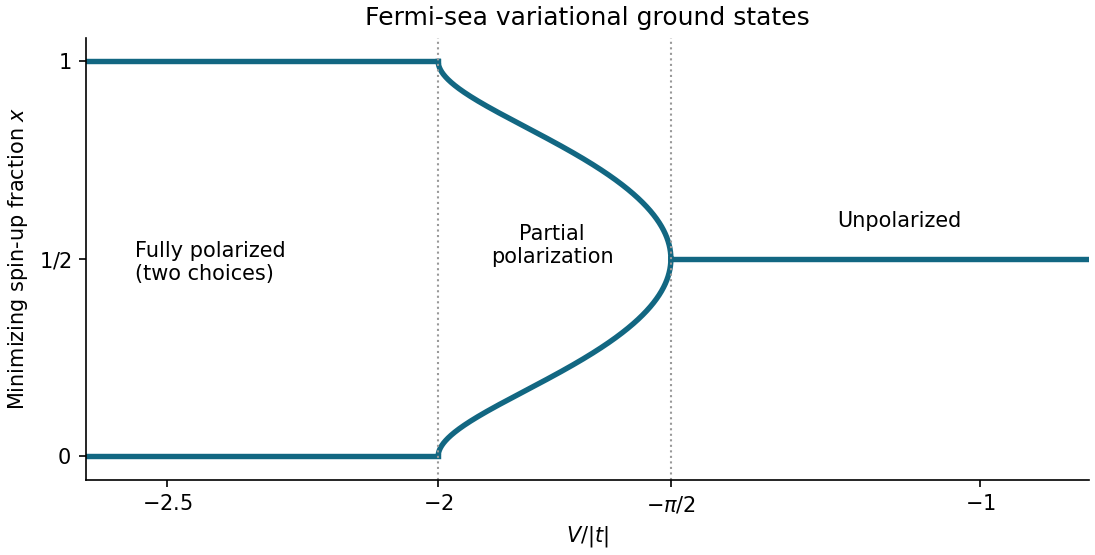

For , the leading objective is to avoid adjacent electrons of the same spin. The unpolarized Fermi sea, although optimal within the preceding restricted family, has interaction energy per site . Its cost grows linearly with , while states with no forbidden neighbouring pairs have zero interaction energy.
There are two independent spinless fermion t-V chains, one for each spin. On an even ring, avoiding all neighbouring pairs allows at most particles in each chain. Since the total is , both bounds must be saturated, and each chain must alternate occupied and empty sites. Their two independent choices give four limiting occupation patterns:The first two are Néel states with one electron per site; the last two are charge density waves alternating doubly occupied and empty sites. Opposite-spin double occupation costs nothing in this particular Hamiltonian. Each species has alternating occupation in all four patterns.
These are the exact zero-interaction ground states at , and the limiting ordered configurations as . At large finite , virtual hopping admixes configurations with forbidden pairs, producing an energy correction of order . A finite ring can have superpositions of the ordered configurations, with possible quantum tunnelling splittings; four exactly degenerate product ground states are not implied at finite hopping. The four ordered choices describe the strong-coupling thermodynamic limit, with spontaneous symmetry breaking understood.
Measure single-particle energy from the quantum harmonic oscillator ground state energy , and write . The Bose-Einstein distribution and the supplied density of states giveThis excited-state population increases with the chemical potential and has the finite saturation valueAny additional particles must occupy the ground state: this is two-dimensional harmonic-trap Bose condensation. The critical temperature and the condensate fraction are thereforeHere is the total particle number, the integral of the inhomogeneous number density over the trap; there is no fixed uniform area in which itself is a number density. Equivalently relates the trap population to the critical temperature. Harmonic confinement changes the low-energy density of states and permits this saturation in two spatial dimensions.
These formulas are leading large- results with . A sharp transition belongs to the trapped-gas thermodynamic limit , at fixed ; a finite trap has finite-size rounding. In particular, finite requires , approaching zero in the condensation limit.
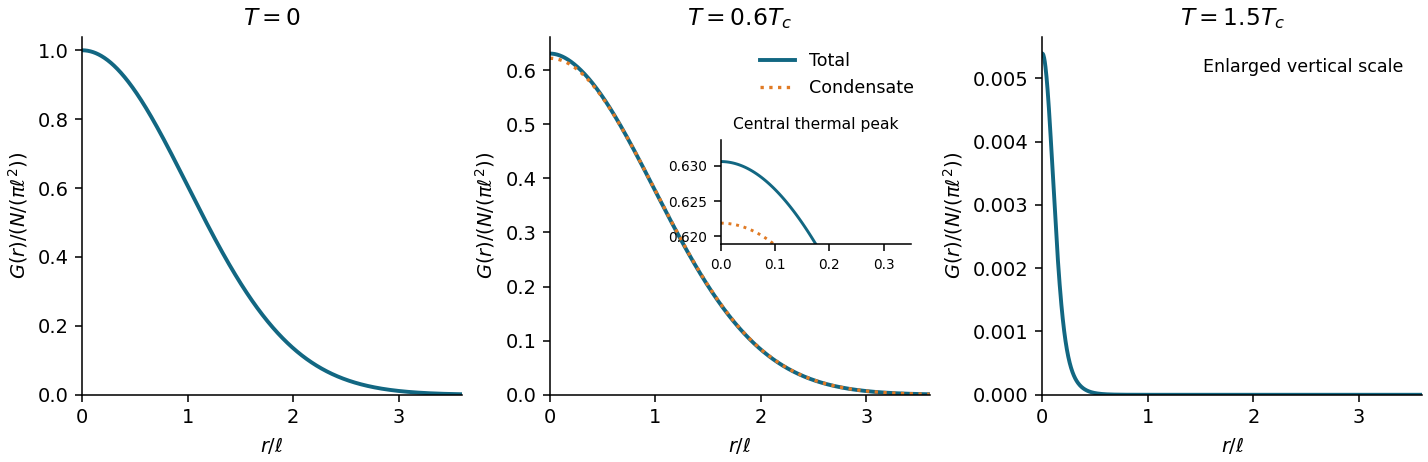
Write , , and . At zero temperature all particles occupy . Expanding the bosonic annihilation operator in single-particle orbitals givesThis one-body density matrix is a Gaussian function of width ; it contains one wavefunction evaluated at , so its exponent is half that of the spatial number density . In particular,the total number density at the trap centre, including condensed and noncondensed particles.
At positive temperature, with occupations of the trap energy eigenstates, the exact ideal-gas decomposition isFor , the sketch has a broad Bose-Einstein condensate component on scale and a narrower thermal peak near the origin. On approaching the broad component loses its weight , while the thermal part remains. Above there is no macroscopic broad Bose-Einstein condensate component; close to , low energy levels can still give a shoulder, so a single narrow Gaussian function is only a high-temperature description. At individual excited energy levels matter and the two-scale description need not apply.
For the Maxwell-Boltzmann distribution applies. The leading off-diagonal one-body density matrix isHere is the Gaussian function width defined by , and is the thermal de Broglie wavelength. The thermal cloud itself extends over the much larger spatial scale ; this is a correlation width, not the cloud radius.

For a normalized orbital , the symmetric Hartree product state and its equivalent Fock space form areThere are exactly interacting pairs, so the expectation value of the grand Hamiltonian is the functionalAt fixed the term is constant. Enforce wavefunction normalization separately by varying with respect to . The resulting stationary Gross–Pitaevskii equation for the normalized orbital isThe Lagrange multiplier enforces the norm; fixed- variation cannot identify it with the independently inserted chemical potential merely by differentiating the constant .
For the standard large- convention put , so and , and replace by . Varying the resulting grand energy functionalwith unrestricted givesEquivalently, at fixed this same is chosen as the normalization Lagrange multiplier. This is the chemical potential convention used below. The contact interaction coupling has dimensions of energy times area in two dimensions.
In the large- Gross–Pitaevskii equation, dropping the kinetic energy gives . The physical nonnegative Thomas–Fermi approximation for a condensate is thereforewhere and is the cloud radius. Its particle number isThus the two-dimensional Thomas–Fermi condensate obeysHere is a total particle number. Keeping the exact pair count in the fixed- Hartree product state would replace by in these formulas expressed in terms of .
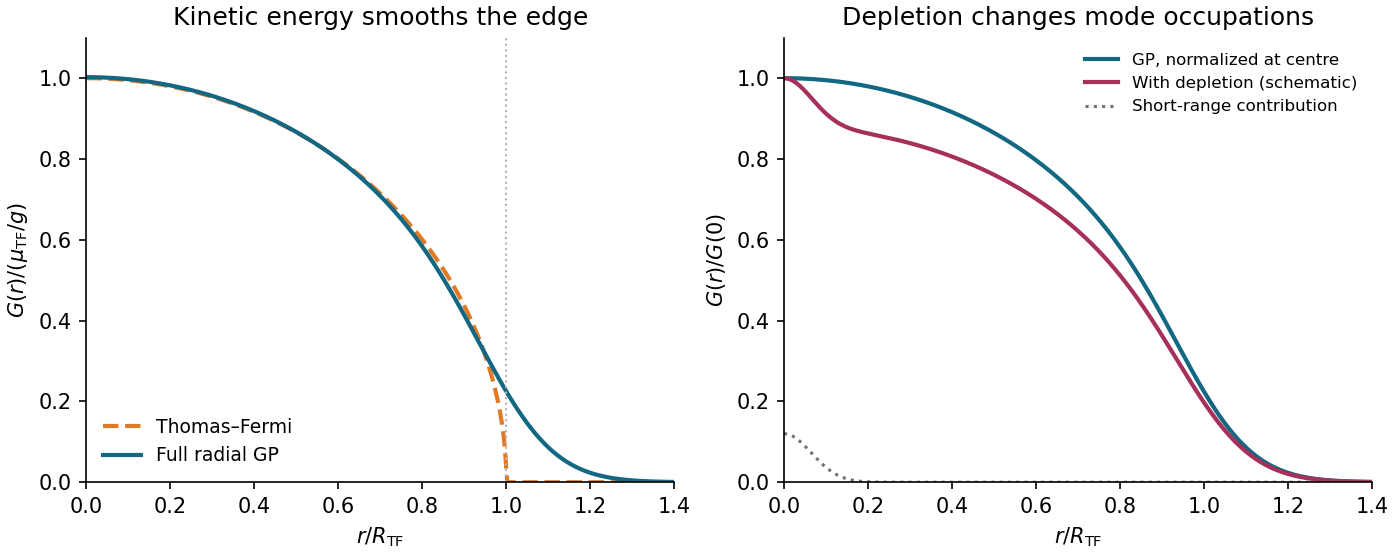
The approximation is best at the centre, , and worst near the edge, . For example its omitted quantum pressure of a condensate, evaluated on the interior profile, isIt is smallest at the centre and diverges at the artificial sharp edge. The central healing length is much smaller than when , since . This is the bulk validity condition; the full Gross–Pitaevskii equation smooths the edge and gives a decaying tail outside .
The Hartree product state underlying the Gross–Pitaevskii equation has the factorized one-body coherence of a Hartree condensate. Choosing its nodeless ground state orbital real givesIn particular, the Thomas–Fermi approximation for a condensate from part (d) predictsThe curve starts at , decreases with zero slope at the origin, and reaches zero with an infinite slope at . Restoring the kinetic energy in the full Gross–Pitaevskii equation rounds that edge and produces a nonzero tail. This corrects the Thomas–Fermi approximation for a condensate, but the resulting one-body density matrix still factorizes.
The additional missing physics is quantum depletion. Interactions scatter pairs of bosons into orbitals outside the Bose-Einstein condensate even at zero temperature. In terms of the true Bose-Einstein condensate orbital the exact one-body density matrix decomposes asThe single-orbital Hartree product state sets and omits altogether. In a weakly interacting Bose gas, Bogoliubov theory adds a comparatively short-range noncondensed contribution near the origin, together with reduced weight in the broad Bose-Einstein condensate component. The central value remains the total number density, not just the condensate density. Its numerical shift relative to the original Gross–Pitaevskii equation solution also depends on the interaction-induced redistribution of number density; it is not fixed by the condensate fraction alone.

Articles by others on the same topic
There are currently no matching articles.