The Time-dependent Schrödinger equation, with the Hamiltonian for a particle of mass in a real potential energy , isA stationary state is an energy eigenstate: its wavefunction evolves by a single global phase,Its probability density is independent of time. For a normalized wavefunction, the probability density and probability current areSubtracting the complex conjugate of the Time-dependent Schrödinger equation, multiplied by , from the original equation multiplied by cancels the real potential energy terms and gives the continuity equation . Thus measures signed probability flow in the positive direction.
Inside the infinite square well, the time-independent Schrödinger equation and Dirichlet boundary conditions areand the wavefunction vanishes outside the interval. For a nonzero state, integration by parts givesThe strict inequality follows because a function with zero derivative and zero endpoint values is zero. Put . The general solution is ; the first boundary condition gives , and the second gives , . Since , the normalized energy eigenstates and eigenvalues areThe normalization fixes the magnitude of the coefficient; its arbitrary global phase has been chosen real and positive.
The initial quantum state is the equal superposition of the first two box states, . The orthonormality of the two energy eigenstates makes its squared norm equal to one. Their separate stationary state phases giveWrite . The probability density isEach squared sine integrates to on the left half. For the quantum interference term, the product-to-sum identity givesHence the Born rule givesThe quantum interference moves probability between the halves even though each component separately is a stationary state.
At the midpoint the second sine vanishes, whereas the derivative of the first sine vanishes. Thus the wavefunction and its spatial derivative simplify toSubstitution in the probability current givesThe continuity equation, integrated over the left half, gives . The Dirichlet boundary condition makes , and the preceding probability formula givesPositive midpoint current removes probability from the left half. This is precisely the midpoint current of a two-mode box state.
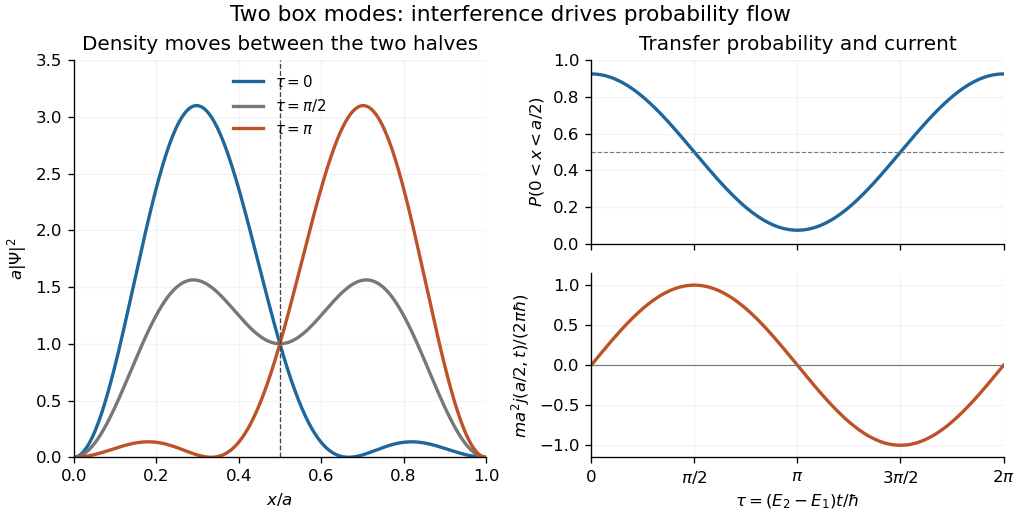
Interference between the first two box modes transfers probability between the two halves; midpoint current is minus the derivative of left-half probability
. Details. 
Articles by others on the same topic
There are currently no matching articles.