The Time-dependent Schrödinger equation, with the Hamiltonian for a particle of mass in a real potential energy , isA stationary state is an energy eigenstate: its wavefunction evolves by a single global phase,Its probability density is independent of time. For a normalized wavefunction, the probability density and probability current areSubtracting the complex conjugate of the Time-dependent Schrödinger equation, multiplied by , from the original equation multiplied by cancels the real potential energy terms and gives the continuity equation . Thus measures signed probability flow in the positive direction.
Inside the infinite square well, the time-independent Schrödinger equation and Dirichlet boundary conditions areand the wavefunction vanishes outside the interval. For a nonzero state, integration by parts givesThe strict inequality follows because a function with zero derivative and zero endpoint values is zero. Put . The general solution is ; the first boundary condition gives , and the second gives , . Since , the normalized energy eigenstates and eigenvalues areThe normalization fixes the magnitude of the coefficient; its arbitrary global phase has been chosen real and positive.
The initial quantum state is the equal superposition of the first two box states, . The orthonormality of the two energy eigenstates makes its squared norm equal to one. Their separate stationary state phases giveWrite . The probability density isEach squared sine integrates to on the left half. For the quantum interference term, the product-to-sum identity givesHence the Born rule givesThe quantum interference moves probability between the halves even though each component separately is a stationary state.
At the midpoint the second sine vanishes, whereas the derivative of the first sine vanishes. Thus the wavefunction and its spatial derivative simplify toSubstitution in the probability current givesThe continuity equation, integrated over the left half, gives . The Dirichlet boundary condition makes , and the preceding probability formula givesPositive midpoint current removes probability from the left half. This is precisely the midpoint current of a two-mode box state.
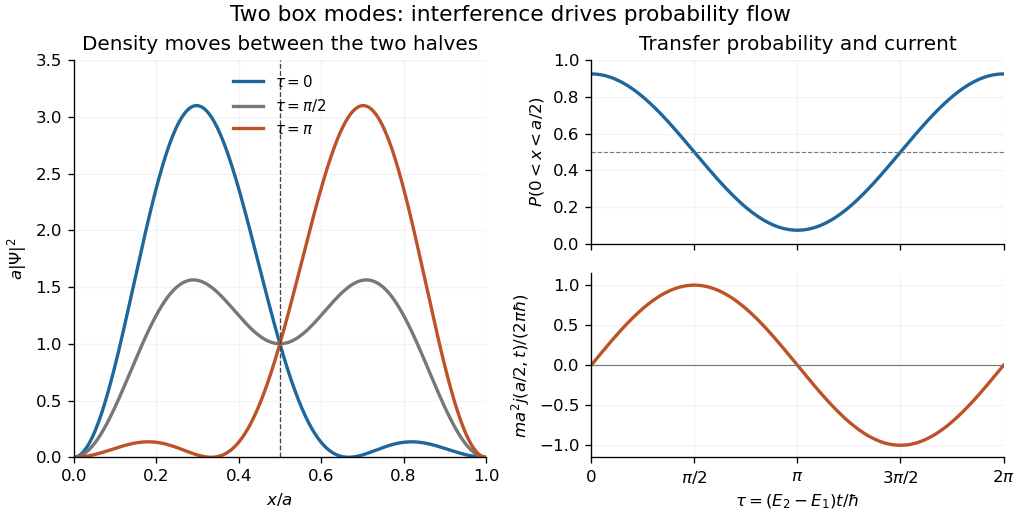
Interference between the first two box modes transfers probability between the two halves; midpoint current is minus the derivative of left-half probability
. Details. 
The dimensionless coordinate for the quantum harmonic oscillator gives . The time-independent Schrödinger equation therefore becomesFor , direct differentiation yieldsCancelling the nonzero exponential reduces the equation to the Hermite differential equation
Substitute the power series and collect each power of :Matching the power series coefficients gives the recurrence relationThe even and odd coefficients form separate sequences, determined by and , respectively. For example, and . These are the two independent power series solutions of the Hermite differential equation.
The issue is the square-integrable condition on the whole real line, not just decay at one end. Because the quantum harmonic oscillator potential is even, the even and odd parts of a square-integrable wavefunction are themselves square integrable and satisfy the same equation. It is therefore enough to examine each parity sequence separately.
For a nonterminating sequence, put , where or . Its recurrence relation givesSince is real for an energy eigenvalue, the ratio is eventually positive. After multiplying by one constant phase, the tail coefficients are all positive. Choose . For sufficiently large , the ratio is at least , so for some the tail coefficients obey . Consequently, for , the magnitude of eventually exceeds a positive multiple of after subtraction of a fixed polynomial. Multiplication by leaves exponential growth like , incompatible with the square-integrable condition. Thus each nonzero parity series must terminate. The parity argument also excludes cancellation between the two nonterminating sequences at both infinities. This proves Normalization forces Hermite-series termination.
If the terminating polynomial has degree , its top nonzero coefficient requires . Conversely, when , choosing the seed of parity nonzero makes the recurrence relation terminate exactly at degree . The opposite seed must be zero, since that sequence does not terminate. ThereforeThe resulting polynomials are proportional to the physicists' Hermite polynomials, and is normalizable because any polynomial times this Gaussian function is square integrable. The two parity seeds describe the full solution space of the second-order differential equation; the preceding argument therefore exhausts the normalizable stationary states. Each eigenspace has dimension one. General time-dependent quantum states can of course be superpositions of these energy eigenstates.
For a normalized wavefunction, the expectation value of a function of position isprovided the integral exists. For an unnormalized state, divide this expression by . Put . The ground state has probability density , which is even. ThusThe zero mean position expresses symmetry, whereas this positive expectation value measures the mean distance from the centre.
The commutator of two linear operators is . Write for the adjoint operator, using the inner product convention linear in its second argument. Since and ,Thus the commutator is anti-self-adjoint. With , conjugation of the scalar givesAll products are understood on the stated common operator domain; for physical unbounded linear operators, the state must lie in the relevant product domains and have the finite moments used below.
A normalized quantum state satisfies . Its expectation value is . The conjugate symmetry of the inner product and self-adjointness giveso the expectation value is real. If with , normalize by dividing by its norm. ThenEvery eigenvalue of a self-adjoint operator is real.
Let , which is real. The dispersion, or quantum uncertainty, is the nonnegative standard deviationIndeed, self-adjointness and normalization giveA squared norm is nonnegative, so the square root is defined. It vanishes precisely when , namely when is an eigenvector of . Conversely, an eigenvector with eigenvalue has and hence zero dispersion. Thus zero dispersion is equivalent to being an eigenstate.
Set , and . The self-adjointness of impliesThe Cauchy-Schwarz inequality followed by givesBoth inequalities must be equalities. The exact conditions are and are linearly dependent, and . Equivalently, equality holds if either vector is zero; when both are nonzero it holds precisely whenThe zero-vector cases matter: they saturate the inequality but cannot all be expressed by solving for as a multiple of . The real-part condition can also be written , using the anticommutator. This is the uncentered second-moment commutator inequality.
Centre the position operator and momentum operator by their real expectation values:Scalar multiples of the identity operator commute with every linear operator, so the canonical commutation relation givesThe second moments of the centred linear operators are the variances, and . Applying the preceding inequality and taking nonnegative square roots proves the Heisenberg uncertainty relation:Subtracting the means is essential: the uncentred second moments alone do not equal the variances. The equality case of the Heisenberg uncertainty relation requires the centred vectors to be imaginary multiples, as in the preceding equality conditions.
Articles by others on the same topic
There are currently no matching articles.