photon orbit and the Newtonian limit. Write and . For a timelike circular Schwarzschild geodesic,The denominator tends to zero at , so the energy per unit rest mass diverges as a massive circular orbit approaches that radius. The corresponding local orbital speed measured by a static observer satisfies and tends to one. This suggests a null circular orbit, but one must not simply insert into a massive-particle formula. For a photon, the radial effective potential is proportional to ; its derivative vanishes at and its second derivative there is negative. Thus the photon sphere is at , and its circular null orbits are unstable.
At , expansion givesThe second term is the total Newtonian circular-orbit energy, kinetic plus potential; the relativistic energy also includes rest energy. Here is the conserved energy referred to a stationary observer at infinity, not the local kinetic energy.
The stable inner edge. At fixed angular momentum, write . The timelike radial geodesic equation can be writtenThe circular condition gives . Substituting into the second derivative taken at fixed givesTimelike circular orbits exist for ; they are stable against radial perturbations for and unstable for . ThereforeThe boundary orbit is marginally stable. Differentiating also gives a minimum there, consistently with this fixed-angular-momentum stability calculation.
accretion efficiency and black-hole spin. Matter supplied slowly from far away initially brings rest energy . A radiatively efficient, zero-inner-torque thin disk releases the binding energy down to the innermost stable circular orbit; the remaining energy is carried into the hole during the plunge. ThusHere denotes the efficiency called in this question. The ideal relation assumes negligible additional dissipation during plunge and neglects photon capture and advection. A hot radiatively inefficient flow need not have this efficiency.
For a Kerr black hole, an equatorial prograde disk has a smaller innermost stable circular orbit and greater binding-energy efficiency than the Schwarzschild value; a retrograde disk has the opposite trend. The formal extremal prograde limits are and . These are ideal limiting values, not a universal realized efficiency. photon capture and the accretion geometry affect the achievable black-hole spin and escaping radiation.
radiation force and the limiting luminosity. For isotropic luminosity , the outward radiation momentum flux at radius is . In fully ionized hydrogen, Thomson scattering acts mainly on the electron, while electrostatic coupling makes the electron and proton move together. Neglecting the electron mass, one electron–proton pair experiencesEquating them yieldsThis Eddington luminosity uses electron-scattering opacity, spherical or isotropic force balance and negligible relativistic corrections at the force-comparison radius. Composition, other opacity, anisotropy and photon trapping can change the relevant limit.
Exponential growth and doubling. Distinguish rest-mass supply from black-hole mass growth :At the Eddington limit,Using the printed scattering cross section gives . The Salpeter time is an e-folding time; the Eddington-limited doubling time isfor the Schwarzschild thin-disk efficiency. If one approximates , the factor is dropped and the estimate is about . The retained-energy version is the mass-conserving expression.
The efficiency bound. A growth factor requires e-folds. Eddington-limited accretion is the fastest growth allowed by the adopted luminosity bound at fixed efficiency, so growth within a time requiresThis efficiency upper bound from Eddington-limited growth is an upper bound: higher efficiency radiates more of each supplied rest mass, and the luminosity ceiling therefore allows less mass to enter per unit time. A duty cycle below unity or sub-Eddington luminosity tightens it. The approximate convention would instead give ; both figures refer to the same effect, with different treatment of the radiated mass deficit. Mergers, super-Eddington growth or a different seed history would change the premises.
Coherent prograde accretion spins up the hole, moves the inner edge inward and increases . For fixed the mass-growth e-folding time then grows, so the logarithmic growth curve becomes less steep; one cannot simply retain the initial Schwarzschild efficiency throughout. Episodic misaligned accretion can have a different black-hole spin history. In general,
energy available to affect the galaxy. Let denote galaxy mass, keeping it distinct from black-hole mass. At constant efficiency, negligible seed mass and no merger contribution, the emitted energy in building isFor and the nonspinning efficiency this is approximately . The common small-efficiency approximation gives , and a fiducial would give about with retained mass included. These differences do not alter the conclusion: the available accretion energy substantially exceeds the stated galactic binding-energy estimate.
Only a coupling fraction of order one percent would then be energetically sufficient to affect the gas strongly. radiation, winds or jets can heat gas, drive outflows and suppress further cooling and star formation, providing active-galactic-nucleus feedback and possible self-regulation of black-hole growth. energy availability alone does not prove that the whole galaxy is expelled: most radiation can escape, jets can be collimated, heated gas can cool, and collisionless stars couple differently from gas.
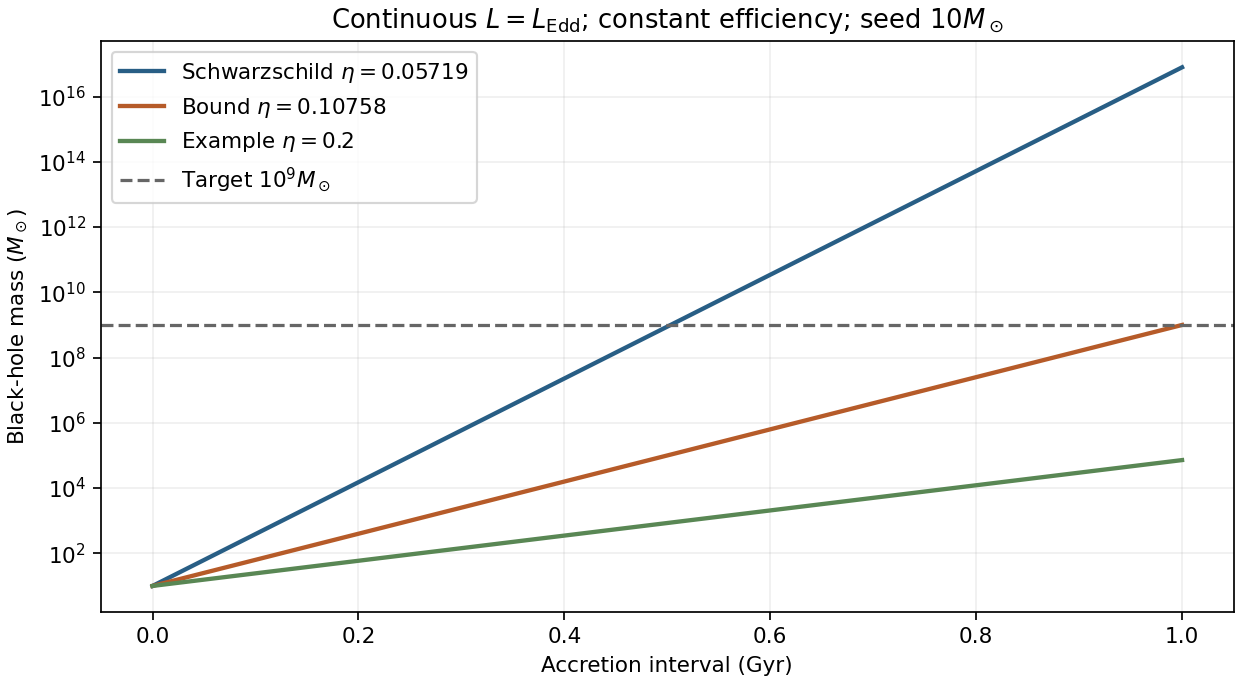
Original comparison of Eddington-limited growth at fixed efficiencies, including the radiated mass deficit
. Details. 
Articles by others on the same topic
There are currently no matching articles.