Original solutions for the Physics and MASt Physics paper. [ref]
https://www.whatdotheyknow.com/request/natural_science_tripos_physics_e_2/response/2340776/attach/2/FOI%202023%20399%20Zahid%20materials.pdf?cookie_passthrough=1. Original examination PDF, physical pages 728–731
photon orbit and the Newtonian limit. Write and . For a timelike circular Schwarzschild geodesic,The denominator tends to zero at , so the energy per unit rest mass diverges as a massive circular orbit approaches that radius. The corresponding local orbital speed measured by a static observer satisfies and tends to one. This suggests a null circular orbit, but one must not simply insert into a massive-particle formula. For a photon, the radial effective potential is proportional to ; its derivative vanishes at and its second derivative there is negative. Thus the photon sphere is at , and its circular null orbits are unstable.
At , expansion givesThe second term is the total Newtonian circular-orbit energy, kinetic plus potential; the relativistic energy also includes rest energy. Here is the conserved energy referred to a stationary observer at infinity, not the local kinetic energy.
The stable inner edge. At fixed angular momentum, write . The timelike radial geodesic equation can be writtenThe circular condition gives . Substituting into the second derivative taken at fixed givesTimelike circular orbits exist for ; they are stable against radial perturbations for and unstable for . ThereforeThe boundary orbit is marginally stable. Differentiating also gives a minimum there, consistently with this fixed-angular-momentum stability calculation.
accretion efficiency and black-hole spin. Matter supplied slowly from far away initially brings rest energy . A radiatively efficient, zero-inner-torque thin disk releases the binding energy down to the innermost stable circular orbit; the remaining energy is carried into the hole during the plunge. ThusHere denotes the efficiency called in this question. The ideal relation assumes negligible additional dissipation during plunge and neglects photon capture and advection. A hot radiatively inefficient flow need not have this efficiency.
For a Kerr black hole, an equatorial prograde disk has a smaller innermost stable circular orbit and greater binding-energy efficiency than the Schwarzschild value; a retrograde disk has the opposite trend. The formal extremal prograde limits are and . These are ideal limiting values, not a universal realized efficiency. photon capture and the accretion geometry affect the achievable black-hole spin and escaping radiation.
radiation force and the limiting luminosity. For isotropic luminosity , the outward radiation momentum flux at radius is . In fully ionized hydrogen, Thomson scattering acts mainly on the electron, while electrostatic coupling makes the electron and proton move together. Neglecting the electron mass, one electron–proton pair experiencesEquating them yieldsThis Eddington luminosity uses electron-scattering opacity, spherical or isotropic force balance and negligible relativistic corrections at the force-comparison radius. Composition, other opacity, anisotropy and photon trapping can change the relevant limit.
Exponential growth and doubling. Distinguish rest-mass supply from black-hole mass growth :At the Eddington limit,Using the printed scattering cross section gives . The Salpeter time is an e-folding time; the Eddington-limited doubling time isfor the Schwarzschild thin-disk efficiency. If one approximates , the factor is dropped and the estimate is about . The retained-energy version is the mass-conserving expression.
The efficiency bound. A growth factor requires e-folds. Eddington-limited accretion is the fastest growth allowed by the adopted luminosity bound at fixed efficiency, so growth within a time requiresThis efficiency upper bound from Eddington-limited growth is an upper bound: higher efficiency radiates more of each supplied rest mass, and the luminosity ceiling therefore allows less mass to enter per unit time. A duty cycle below unity or sub-Eddington luminosity tightens it. The approximate convention would instead give ; both figures refer to the same effect, with different treatment of the radiated mass deficit. Mergers, super-Eddington growth or a different seed history would change the premises.
Coherent prograde accretion spins up the hole, moves the inner edge inward and increases . For fixed the mass-growth e-folding time then grows, so the logarithmic growth curve becomes less steep; one cannot simply retain the initial Schwarzschild efficiency throughout. Episodic misaligned accretion can have a different black-hole spin history. In general,
energy available to affect the galaxy. Let denote galaxy mass, keeping it distinct from black-hole mass. At constant efficiency, negligible seed mass and no merger contribution, the emitted energy in building isFor and the nonspinning efficiency this is approximately . The common small-efficiency approximation gives , and a fiducial would give about with retained mass included. These differences do not alter the conclusion: the available accretion energy substantially exceeds the stated galactic binding-energy estimate.
Only a coupling fraction of order one percent would then be energetically sufficient to affect the gas strongly. radiation, winds or jets can heat gas, drive outflows and suppress further cooling and star formation, providing active-galactic-nucleus feedback and possible self-regulation of black-hole growth. energy availability alone does not prove that the whole galaxy is expelled: most radiation can escape, jets can be collimated, heated gas can cool, and collisionless stars couple differently from gas.
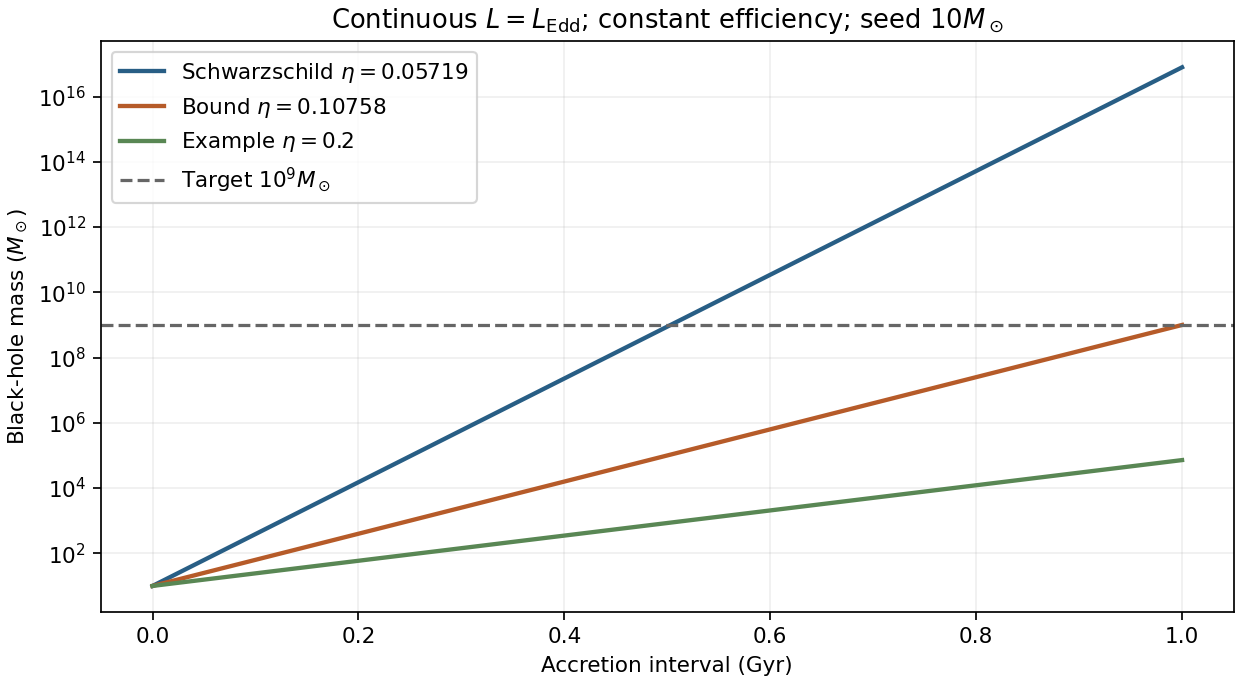
Original comparison of Eddington-limited growth at fixed efficiencies, including the radiated mass deficit
. Details. Definitions and pressure convention. is the scale factor, cosmic time and dots time derivatives. is the gravitational constant, the speed of light, the mass-equivalent density of the material fluid and the spatial-curvature sign in this normalization. here has units of inverse time squared, rather than inverse length squared. Comparison of the acceleration equation with fixesThis is a pressure parameter, unrelated to Question 1's radiative efficiency. pressureless matter has and . When solving the generalized model below, is assumed constant.
Evidence for a positive vacuum component. Standardized Type Ia supernovae measure the luminosity-distance–redshift relation. Their corrected apparent magnitudes at cosmological distances imply greater distances than a decelerating matter-dominated model of comparable parameters, favoring late accelerated expansion. Light-curve standardization, interstellar extinction, selection bias and possible population evolution must be controlled rather than treating every supernova as an identical candle.[ref]
Observational Evidence from Supernovae for an Accelerating Universe and a Cosmological Constant by Adam Riess and others. Abstract and distance–redshift analysis
[ref]Measurements of Omega and Lambda from 42 High-Redshift Supernovae by Saul Perlmutter and others. Abstract and cosmological likelihood analysis
The cosmic microwave background and baryon acoustic oscillation measurements constrain geometry and matter density in combination. Near spatial flatness together with a subcritical matter density leaves room for an additional smooth component; cosmic ages and structure growth supply consistency tests. A positive cosmological constant fits these observations within the standard framework. They do not establish that every allowed dark-energy theory must be a strictly constant vacuum energy; the inference depends on the cosmological and gravitational model.
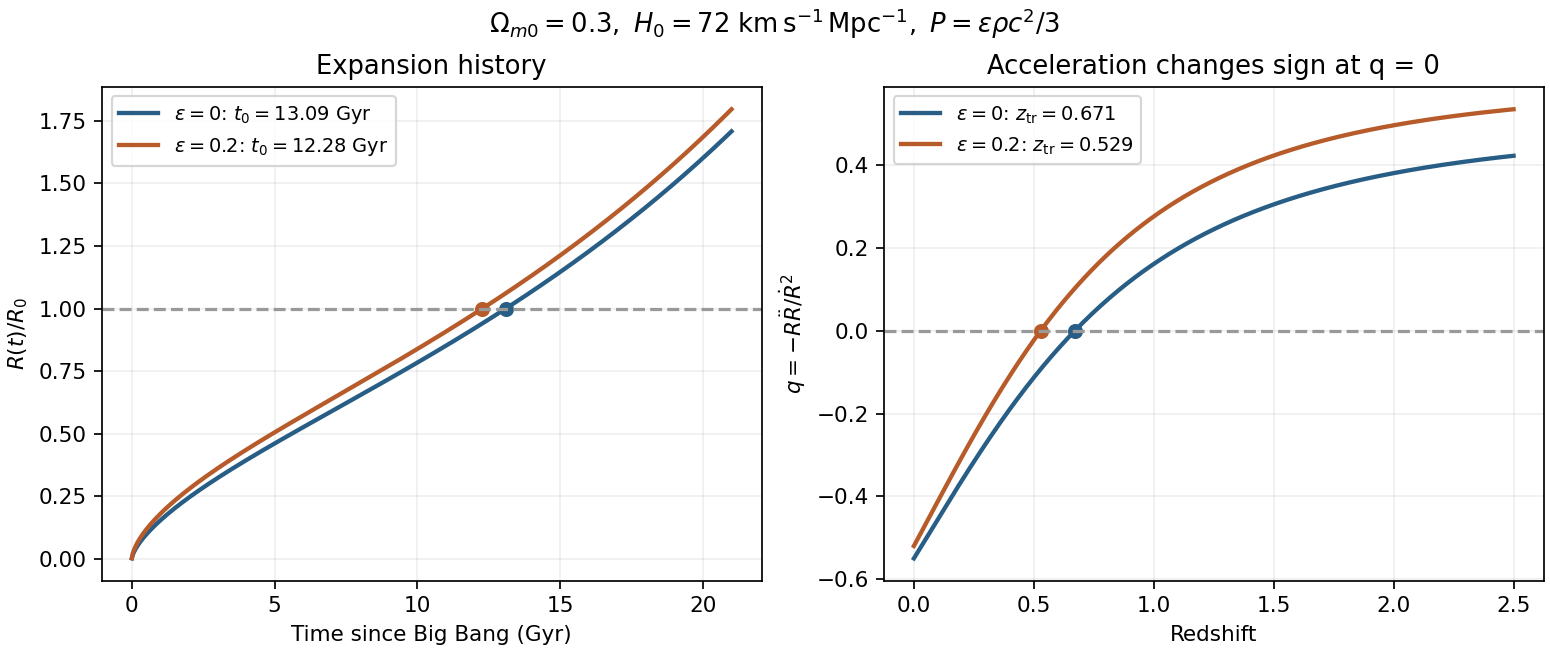
pressureless matter evolution. Set and . Since , eliminating givesFor , and . ThereforeOn the expanding Big-Bang branch with positive , chooseThe origin is the Big Bang; an arbitrary time translation would shift this origin. Integrating gives . At early times , while at late times .
Age and the density fractions. Dividing the flat constraint by , with , givesThe solution implies , soHere , using the printed megaparsec conversion. Taking one year as days givesFor the same , an Einstein-de Sitter universe hasA cosmic model must be older than its oldest objects, with additional time allowed for their formation. Old stellar populations are dated through stellar-evolution fitting, particularly the globular cluster main-sequence turnoff, with uncertainties from distances, composition and input stellar physics. A pre-examination globular-cluster age constraint on cosmology obtained a lower cosmic-age limit of after allowing for formation time. This conflicts with the model but is compatible with the calculation.[ref]
New Globular Cluster Age Estimates and Constraints on the Cosmic Equation of State and The Matter Density of the Universe by Lawrence M. Krauss and Brian Chaboyer. Abstract and stellar-age/formation-time analysis
Individual stellar age estimates are not exact clocks, and the numerical is the result for the specified and matter fraction, not a claim to be a contemporary best-fit age.Constant nonzero pressure parameter. Eliminating before setting the pressure to zero instead givesHenceFor constant , the positive-density expanding Big-Bang branch isEquivalently use in the pressureless matter solution. The scale factor obeys , and the early limit is . The age of a flat barotropic matter-vacuum universe with the same present density fractions and isThusThe small positive pressure makes the early universe expand with a smaller age at the same late expansion parameters.
The acceleration transition. Normalize the present scale factor to one. Constant and the continuity equation give . Dividing the acceleration equation by givesAt the barotropic matter-vacuum acceleration transition its right-hand side vanishes. For the parameters here, , so the past transition isAt greater redshift the material term dominates and expansion decelerates; at smaller redshift vacuum energy dominates and expansion accelerates. The pressure factor belongs in the numerator of the gravitating material term; omitting it would confuse this model with pressureless matter.


Three tracers give complementary estimates of a cluster's gravitating mass. First, galaxy redshifts measure a line-of-sight velocity dispersion . For a roughly stationary bound cluster, the virial theorem gives a cluster velocity-dispersion mass estimatewith a coefficient depending on the density profile and orbital anisotropy. The galaxy luminosity and plausible stellar mass-to-light ratio supply too little mass to bind typical rich clusters. Foreground interlopers, substructure, velocity anisotropy and a recent merger can bias the dynamical estimate; a large dispersion is not by itself proof of equilibrium.
Second, diffuse X-ray emission measures a hot intracluster plasma, not merely unresolved starlight. Spectral continuum and lines constrain its temperature, while surface-brightness profiles constrain its density after line-of-sight projection and emissivity modeling. If the gas has constant composition and is approximately spherical and in hydrostatic equilibrium,This cluster hydrostatic mass estimator uses as the mean mass per pressure-supporting particle. The inferred potential requires substantially more mass than the stars plus measured gas, although the gas contains much of the visible baryonic mass. Turbulence, bulk motion, temperature structure and departures from hydrostatic equilibrium are important systematic errors.
Third, strong-lensing arcs and multiple images, together with coherent weak-lensing shear of background galaxies, measure projected gravitational deflection. In general relativity,This cluster gravitational-lensing mass estimate does not require the cluster galaxies or gas to be in dynamical equilibrium. It does require source-distance information, a lens model and control of point-spread-function-induced shapes, line-of-sight projection, unrelated line-of-sight structure and the mass-sheet degeneracy.
The convergence of dynamical, hydrostatic and lensing masses, exceeding the baryonic inventory, is the principal evidence. The Bullet Cluster adds a spatial test: collisional X-ray gas lags behind the galaxies during the merger, while the inferred lensing concentrations lie nearer the collisionless galaxy component. An additional weakly collisional gravitating mass accounts naturally for that separation.[ref]
A direct empirical proof of the existence of dark matter by Douglas Clowe and others. L109–L113, optical/X-ray/lensing comparison
The conclusion assumes a gravitational framework and does not identify the microscopic dark-matter particle; the different tracer systematics should be evaluated rather than treating three mass estimates as completely assumption free.cosmic inflation is an early interval of accelerated expansion, . For expansion this means a shrinking comoving Hubble radius, . A nearly constant positive scalar potential can supply it: in units,Potential domination gives and approximately exponential expansion. Sustaining the interval requires sufficiently slow evolution, not just setting the initial field velocity to zero on a steep potential.
The horizon problem is the near equality of conditions in widely separated microwave-background regions that could not equilibrate in the standard decelerating hot Big Bang history. cosmic inflation permits the currently observed patch to descend from an earlier region small enough to have been causally connected, before that patch is stretched to enormous size. The claim concerns a causal history extended before the conventional hot phase; merely accelerating a collection of already disconnected regions would not explain their common temperature.
For the flatness problem, the Friedmann constraint givesA growing drives this curvature fraction toward zero, whereas ordinary matter- or radiation-dominated deceleration makes it grow. cosmic inflation therefore suppresses observable curvature without requiring an equally extreme initial tuning within the later hot evolution.
Pre-existing monopoles and other unwanted relics are also diluted by the volume increase: a conserved particle number density falls as over e-folds. The transition to the hot universe must reheat efficiently, and its temperature must not regenerate an excluded relic population. The required number of e-folds is model and reheating dependent; “about sixty” is a useful scale for many scenarios rather than a universal exact requirement.
cosmic inflation also supplies a mechanism for perturbations. quantum fluctuations are stretched beyond the Hubble radius, and nearly scale-invariant comoving curvature perturbations can later seed cosmic structure. Simple single-field slow-roll models commonly predict approximately adiabatic, nearly Gaussian fluctuations, with a small spectral tilt; tensor perturbations would provide an additional test. Acoustic coherence and the observed scalar spectrum are compatible with this account, but they do not single out one inflaton potential. cosmic inflation addresses causal homogeneity, curvature and relic dilution while motivating the initial perturbations; it does not automatically solve the cosmological constant problem or determine reheating.
A radio pulsar is a rapidly rotating, magnetized neutron star whose emission beam periodically crosses the line of sight. Collapse of a massive stellar core can leave such a compact remnant. Angular-momentum conservation during contraction helps explain rapid rotation, while amplified magnetic fields and a plasma-filled magnetosphere enable particle acceleration and beamed emission. The pulses are not repeated stellar contractions. Not every newborn neutron star is seen as a radio pulsar, because emission, beaming and observational selection matter.
rotation supplies energy to radiation and the magnetized wind. With approximately constant moment of inertia ,An ideal fixed magnetic-dipole torque has . Its integration givesso the pulsar characteristic age approximates the true age only for a short birth period, constant torque coefficient and braking index three. Real magnetospheres, field evolution and kinematic contributions to observed complicate both age and inferred magnetic field.
As the star spins down, the available accelerating potential falls. If particle acceleration and pair production can no longer sustain the radio-emitting magnetosphere, the object crosses a model-dependent pulsar death line and ceases to be detectable as an ordinary radio pulsar. It still exists as a cooling neutron star; “death” refers to the emission state, not disappearance of the star. The death boundary is not a precisely universal spin period.
In a surviving binary, later Roche-lobe overflow from a companion can create an accretion disc. Transferred angular momentum spins the old neutron star up, and the accretion luminosity can produce an X-ray binary. Long accretion episodes can produce millisecond rotation, commonly accompanied by a smaller inferred external magnetic field. After mass transfer declines, the radio pulsar can switch on again as a recycled pulsar, often with a white dwarf companion. Other binary histories can leave a second neutron star, an ablated companion or an isolated recycled object; there is no single obligatory evolutionary sequence.
A direct observational bridge is the coherent approximately X-ray pulsation discovered with RXTE in SAX J1808.4-3658, an accretion-powered binary. It demonstrated an accreting neutron star rotating at a rate appropriate to recycled millisecond radio pulsars.[ref]
Discovery of the first accretion-powered millisecond X-ray pulsar by Rudy Wijnands and Michiel van der Klis. Abstract, coherent pulsations and interpretation
Timing analysis must correct orbital Doppler shifts, telescope and solar-system timing, and instrumental aliases. Radio dispersion, sky coverage and beaming selection affect demographic inferences. The sequence is rotational pulsar spin-down, possible loss of radio activity, and possible accretion-driven recycling—not a necessary path for every neutron star.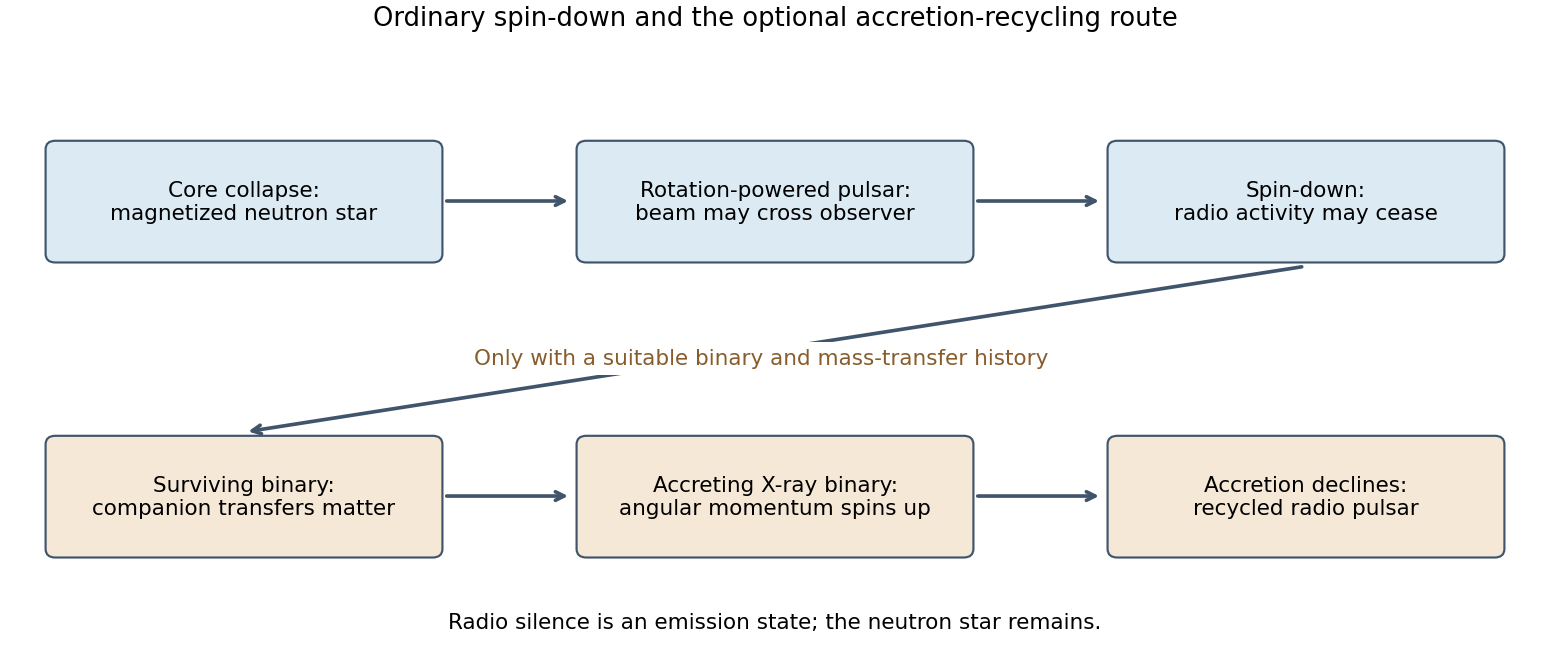
Original schematic of ordinary pulsar spin-down and the conditional binary-recycling route
. Details. 
The cosmic microwave background has an almost perfect blackbody spectrum at about . This is strong evidence for an earlier hot, dense phase in which radiation thermalized, followed by expansion that redshifted the photon spectrum while preserving its Planck form. COBE FIRAS compared the sky with a precision reference blackbody; instrument temperature, gain, foregrounds and calibrator emissivity were crucial controls. Agreement with a blackbody constrains substantial late energy injection or photon-production distortions.[ref]
Nobel Lecture: From the Big Bang to the Nobel Prize and beyond by John C. Mather. FIRAS measurement and external-blackbody calibration account
After subtracting the dominant dipole associated mainly with observer motion, anisotropies at the level of roughly reveal primordial structure. COBE DMR established large-angular-scale anisotropy; multifrequency measurements and independent maps were needed to distinguish it from Galactic emission and instrumental artifacts.[ref]
Structure in the COBE Differential Microwave Radiometer First-Year Maps by George F. Smoot and others. L1–L5, statistical and systematic checks
Approximate isotropy supports a homogeneous background model under the usual cosmological assumptions, but isotropy at one observing position is not alone a proof of spatial homogeneity everywhere.The temperature CMB angular power spectrum has multiple acoustic peaks. Their coherent pattern follows oscillations in the pre-recombination photon-baryon fluid. Peak positions compare the sound horizon with angular diameter distance and hence constrain geometry together with expansion parameters. Relative peak heights test baryon inertia, matter–radiation equality and gravitational-potential evolution, motivating both baryonic and nonbaryonic matter. Cosmic microwave background diffusion damping suppresses small-scale power. Cosmic microwave background polarization and temperature–polarization correlations provide further tests of scattering, acoustic phase and reionization; gravitational lensing remaps the observed pattern and probes intervening structure.
By the time of this examination, the Planck 2013 temperature and lensing analysis supported a spatially flat six-parameter model with cold dark matter and a cosmological constant. This is a joint fit within an explicit model, not an inference that each peak uniquely measures one parameter.[ref]
Planck 2013 results. XVI. Cosmological parameters by Planck Collaboration. Abstract and cosmological parameter/extension analysis
Foreground separation requires frequency coverage, sky masks, beam and noise characterization, and consistency across instruments. The primary microwave background has geometric and other parameter degeneracies, so acoustic-ruler, supernova and structure observations are valuable complements. The spectrum establishes a thermal hot-universe history; anisotropy and polarization constrain its geometry, contents and primordial perturbations. None of these observations by itself demonstrates a unique cosmic inflation mechanism.mass from motion. A resolved Keplerian orbit gives when the orbiting object has negligible mass. At the Galactic centre, repeated infrared astrometry and spectroscopy measure sky motion, acceleration and line-of-sight velocity of stars around Sagittarius A*. Resolving a compact enclosed mass and fitting complete orbits avoids reliance on a single projected velocity. Source confusion, reference-frame stability, distance, inclination and possible extended mass must be included in the fit.[ref]
For an unresolved stellar-mass binary in a circular orbit, the donor's velocity semiamplitude and orbital period give the binary mass functionIt provides a lower mass bound; donor mass and orbital inclination are needed for an actual mass estimate. For an eccentric orbit, multiply the observational combination by when evaluating the binary mass function. Resolved gas or maser rotation and stellar-dynamical models also measure masses, provided pressure support, noncircular motion and line-of-sight projection are modeled. Resolving the black-hole sphere of influence improves separation of central mass from the host galaxy.
For active nuclei, reverberation mapping measures a lag between variable continuum and broad-line response. With a line velocity scale ,The factor accounts for geometry and kinematics and is not known simply from the lag. Cadence, line responsivity, inclination and winds require control. Rapid variability demonstrates compactness but is not by itself a unique mass measurement.
black-hole spin from strong-field emission. Define . Large-radius Keplerian motion is principally a mass probe and usually insensitive to black-hole spin. In the Kerr model, the radius and binding energy of the innermost stable circular orbit vary with and orbital orientation, making inner-disk radiation useful.
black-hole continuum fitting infers an inner emitting radius from the disk's thermal spectrum and flux normalization, then identifies it with the innermost stable circular orbit in a relativistic thin-disk model. Independent mass, distance and inclination, together with atmospheric spectral hardening, absorption and contamination, are needed. Spectra should be selected in a disk-dominated regime where truncation and strong advection are limited. A 2011 Cygnus X-1 analysis combined such spectra with independently constrained binary parameters and reported a near-extreme black-hole spin conditional on black-hole spin–orbit alignment and its disk model.[ref]
The Extreme Spin of the Black Hole in Cygnus X-1 by Lijun Gou and others. Abstract, thermal-continuum fit and dominant mass/distance/inclination/flux-calibration uncertainties
black-hole reflection spectroscopy instead models a relativistically broadened iron-line and reflection continuum: orbital Doppler shifts and beaming broaden the profile, while gravitational redshift contributes to the extended red wing. Its innermost emitting radius can constrain black-hole spin if reflection extends to the stable inner edge. Ionization, abundance, absorption, coronal illumination, disk thickness and possible truncation are competing parameters; a broad line is not a direct black-hole spin reading independent of these assumptions. Timing or precession models can add information but introduce their own dynamical identification.
mass is principally inferred from gravitating dynamics; black-hole spin is inferred from strong-field effects with a specified spacetime and accretion model. Agreement between independent methods is especially valuable because disk inner radius, inclination and radiation-transfer assumptions can otherwise mimic a change of black-hole spin.
Articles by others on the same topic
There are currently no matching articles.