Universality of free fall equates the passive gravitational response to inertial mass up to a universal choice of units. The Einstein equivalence principle further states that local nongravitational experiments in a freely falling laboratory obey special relativity independently of the laboratory's location and velocity. A supported laboratory instead has proper acceleration, just as an accelerating laboratory in flat spacetime does.
Around an event, freely falling coordinates can be chosen so that and there. The first metric tensor derivatives vanish at that event, and nearby corrections begin at order curvature times squared separation. The metric tensor's second derivatives retain the Riemann tensor. Thus a local inertial frame removes Christoffel symbols at an event, while tidal gravity remains measurable over a finite region. Relative motion of separated freely falling test particles detects this curvature through geodesic deviation. Freely falling axes carried along an observer's world line extend the local construction, but do not make an extended curved region globally Minkowskian.
accretion-disk tests of strong-field gravity put radiating matter in a strong gravitational field at relativistic orbital speeds. general relativity predicts an innermost stable circular orbit, for a nonrotating black hole, with a spin-dependent radius in the Kerr metric. If the radiating inner edge tracks that orbit, its fitted radius and binding-energy release probe the geometry. For a thin disk with negligible inner-edge torque, ; the Schwarzschild efficiency is .
In relativistic iron-line spectroscopy, a fluorescent iron line supplies a rest-energy reference. The relativistic Doppler effect from orbital motion, relativistic beaming, gravitational redshift and ray bending produce an asymmetric broadened profile, including a red wing from the deepest emitting radii. The ASCA observation of MCG-6-30-15 showed a broad asymmetric iron feature relative to the approximately neutral-iron energy, interpreted through relativistic disk-line models.[ref]
ASCA: MCG-6-30-15 by NASA HEASARC. Mission result description: broad iron line, low-energy asymmetry and relativistic interpretation
The observed line must be separated from the illuminating continuum, absorption and other reflection features; inclination, ionization and the radial illumination law affect the inferred radius.thermal-continuum fitting of an accretion disk provides an independent method for a geometrically thin, optically thick disk. Its spectrum and normalization constrain a characteristic inner area, provided mass, distance, inclination and atmospheric spectral hardening are controlled. A pre-2013 application selected thermal-state observations of GRS 1915+105 at relatively low disk luminosity to make the thin-disk approximation appropriate.[ref]
The Spin of the Near-Extreme Kerr Black Hole GRS 1915+105 by Jeffrey E. McClintock and others. Abstract: relativistic continuum fit, thermal-state selection, luminosity cut and inner-edge assumptions
Consistency among inner radius, line transfer and thermal emission tests the strong-field disk picture. A black-hole spin estimate obtained by assuming a Kerr metric is not by itself a model-independent verification of general relativity. Stress across the nominal inner edge, finite disk thickness, coronal geometry, calibration and competing absorption models must be constrained; a gravity test compares alternative geometries while allowing for those astrophysical uncertainties. An emitting material surface or boundary layer can further complicate disks around neutron stars.
Write , and , so . The ingoing Eddington-Finkelstein coordinates use to label ingoing radial light fronts. Substituting into the Schwarzschild metric givesThe radial block has determinant even at ; its coefficients have no horizon divergence. The apparent singularity of Schwarzschild time at the future horizon is therefore a coordinate failure. The physical curvature singularity at remains.
The radial null trajectories in ingoing Eddington-Finkelstein coordinates haveThe ingoing family crosses the future horizon smoothly. The outgoing family has zero outward radial coordinate speed at the horizon and decreasing radius inside it; both future null directions then lead toward smaller radius. These advanced coordinates cover the exterior and future black-hole horizon, rather than simultaneously regularizing the past white-hole horizon. Their null time coordinate is not a clock reading of a stationary observer.
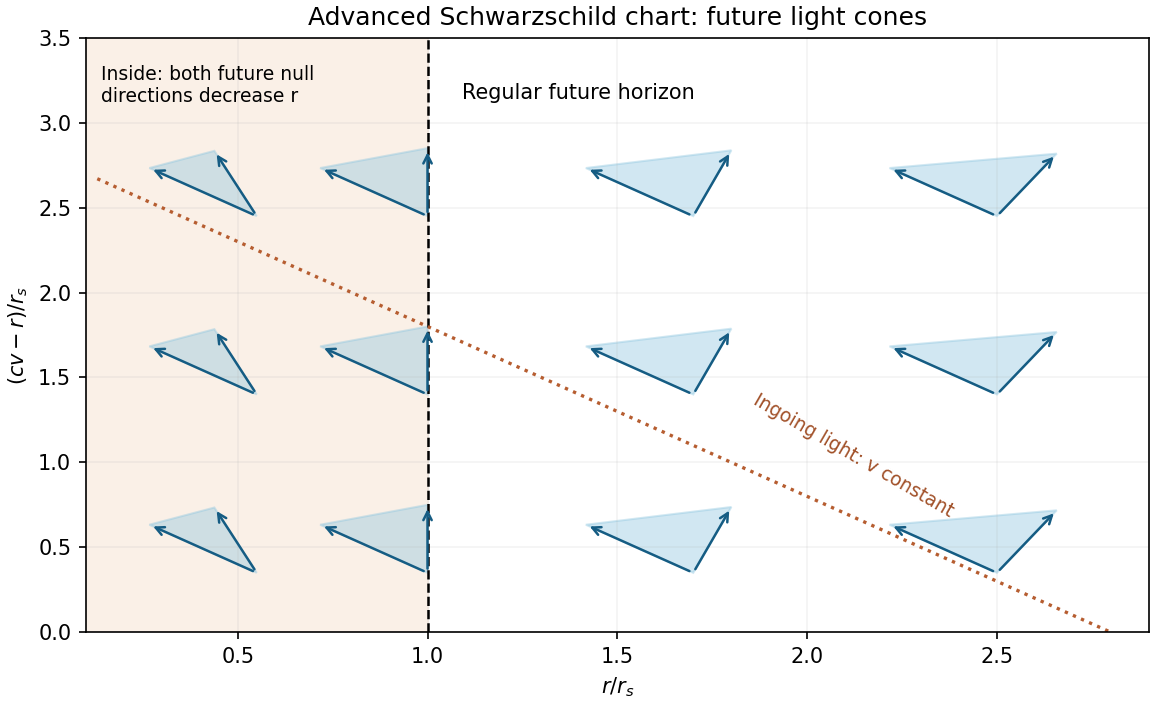
Original future light-cone schematic in regular advanced Schwarzschild coordinates, using vertical coordinate cv minus r
. Details. 
Articles by others on the same topic
There are currently no matching articles.