[ref]
https://www.whatdotheyknow.com/request/natural_science_tripos_physics_e_2/response/2340776/attach/2/FOI%202023%20399%20Zahid%20materials.pdf?cookie_passthrough=1. Original public PDF, physical pages 246–249
Use the angular-diameter ratio under a collinear boost, with motion along the common sightline and small angular radius . For a boost toward the source, relativistic aberration of the incoming light gives , where is the relative rapidity. Thus the observer seeing the smaller disk has angular diameter reduced by . The ratio two implies , soThe answer is . Both observations occur at one event, so this is a relativistic aberration comparison rather than a change of geometrical distance during observation. Arbitrary transverse relative motion would require additional directional information; the stated motion toward the same distant target selects the collinear interpretation.
For geodesic motion of uncharged dust, use the pressureless stress-energy form, and . stress-energy conservation expands toContracting with kills the second term, since . Hence , and wherever ,On a flow line , so this becomes . Each relativistic dust element therefore follows a timelike geodesic with proper time as an affine parameter. pressure gradients or external nongravitational forces would add an acceleration term.
The Christoffel symbols of a spatially flat FLRW metric depend on the time-coordinate convention. Here is , not . For an affine parameter , take . Its Euler-Lagrange equations areComparison with the geodesic equation givesAll others vanish because is constant and there are no spatial metric tensor derivatives. The lower-index interchange is essential: the printed list specifies one member of each symmetric mixed pair. The factor of two in the spatial geodesic equation comes from those two members.
Universality of free fall equates the passive gravitational response to inertial mass up to a universal choice of units. The Einstein equivalence principle further states that local nongravitational experiments in a freely falling laboratory obey special relativity independently of the laboratory's location and velocity. A supported laboratory instead has proper acceleration, just as an accelerating laboratory in flat spacetime does.
Around an event, freely falling coordinates can be chosen so that and there. The first metric tensor derivatives vanish at that event, and nearby corrections begin at order curvature times squared separation. The metric tensor's second derivatives retain the Riemann tensor. Thus a local inertial frame removes Christoffel symbols at an event, while tidal gravity remains measurable over a finite region. Relative motion of separated freely falling test particles detects this curvature through geodesic deviation. Freely falling axes carried along an observer's world line extend the local construction, but do not make an extended curved region globally Minkowskian.
accretion-disk tests of strong-field gravity put radiating matter in a strong gravitational field at relativistic orbital speeds. general relativity predicts an innermost stable circular orbit, for a nonrotating black hole, with a spin-dependent radius in the Kerr metric. If the radiating inner edge tracks that orbit, its fitted radius and binding-energy release probe the geometry. For a thin disk with negligible inner-edge torque, ; the Schwarzschild efficiency is .
In relativistic iron-line spectroscopy, a fluorescent iron line supplies a rest-energy reference. The relativistic Doppler effect from orbital motion, relativistic beaming, gravitational redshift and ray bending produce an asymmetric broadened profile, including a red wing from the deepest emitting radii. The ASCA observation of MCG-6-30-15 showed a broad asymmetric iron feature relative to the approximately neutral-iron energy, interpreted through relativistic disk-line models.[ref]
ASCA: MCG-6-30-15 by NASA HEASARC. Mission result description: broad iron line, low-energy asymmetry and relativistic interpretation
The observed line must be separated from the illuminating continuum, absorption and other reflection features; inclination, ionization and the radial illumination law affect the inferred radius.thermal-continuum fitting of an accretion disk provides an independent method for a geometrically thin, optically thick disk. Its spectrum and normalization constrain a characteristic inner area, provided mass, distance, inclination and atmospheric spectral hardening are controlled. A pre-2013 application selected thermal-state observations of GRS 1915+105 at relatively low disk luminosity to make the thin-disk approximation appropriate.[ref]
The Spin of the Near-Extreme Kerr Black Hole GRS 1915+105 by Jeffrey E. McClintock and others. Abstract: relativistic continuum fit, thermal-state selection, luminosity cut and inner-edge assumptions
Consistency among inner radius, line transfer and thermal emission tests the strong-field disk picture. A black-hole spin estimate obtained by assuming a Kerr metric is not by itself a model-independent verification of general relativity. Stress across the nominal inner edge, finite disk thickness, coronal geometry, calibration and competing absorption models must be constrained; a gravity test compares alternative geometries while allowing for those astrophysical uncertainties. An emitting material surface or boundary layer can further complicate disks around neutron stars.
Write , and , so . The ingoing Eddington-Finkelstein coordinates use to label ingoing radial light fronts. Substituting into the Schwarzschild metric givesThe radial block has determinant even at ; its coefficients have no horizon divergence. The apparent singularity of Schwarzschild time at the future horizon is therefore a coordinate failure. The physical curvature singularity at remains.
The radial null trajectories in ingoing Eddington-Finkelstein coordinates haveThe ingoing family crosses the future horizon smoothly. The outgoing family has zero outward radial coordinate speed at the horizon and decreasing radius inside it; both future null directions then lead toward smaller radius. These advanced coordinates cover the exterior and future black-hole horizon, rather than simultaneously regularizing the past white-hole horizon. Their null time coordinate is not a clock reading of a stationary observer.
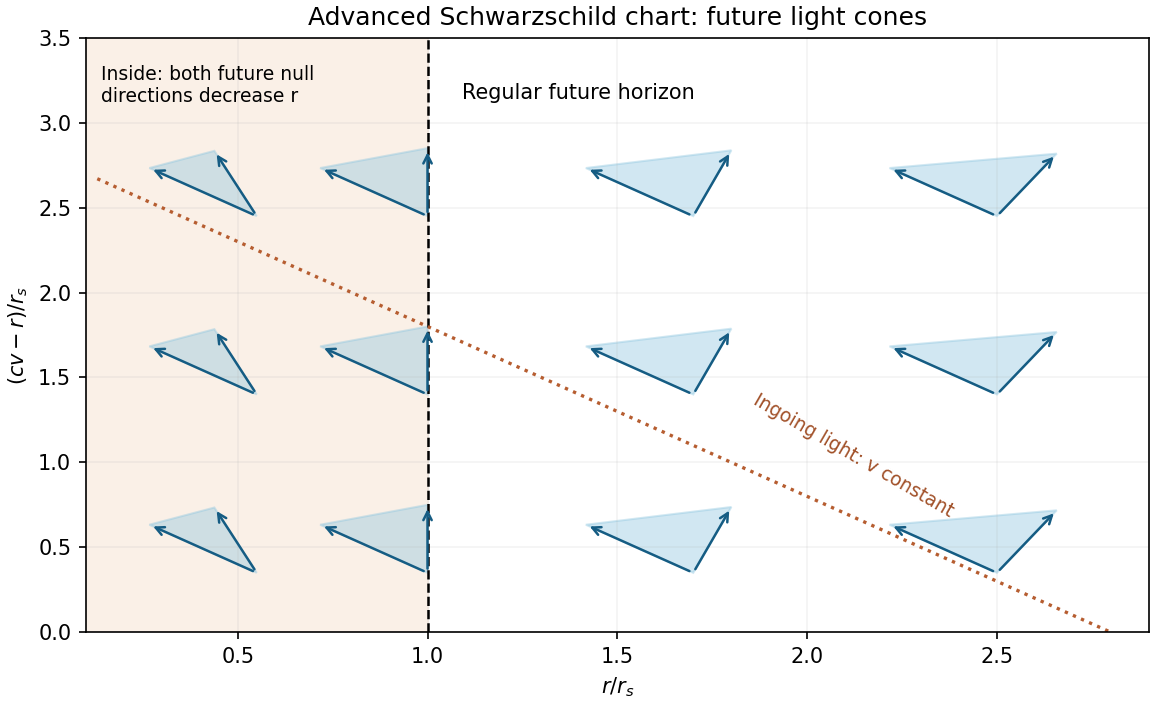
Original future light-cone schematic in regular advanced Schwarzschild coordinates, using vertical coordinate cv minus r
. Details. 
Throughout this solution and .
Null metric tensor and boost. Inverting the coordinate definitions gives , , and henceFor a frame moving at speed along positive , use , . Their difference and sum giveThe reciprocal scale factors preserve . They are in rapidity notation.
acceleration invariants. Proper-time normalization gives , so . The four-acceleration has squared norm ; thereforeFor future motion write and . Then the second equation is . acceleration toward positive selects .
hyperbolic motion from an initial event and rapidity. The stated initial event fixes , , but not the initial rapidity . Integrating with positive signed acceleration gives the general familyTODO: the initial velocity and acceleration orientation are not explicitly specified. To obtain the trajectory requested in the next paragraph, choose the intended additional condition and positive- acceleration. Thenand consequentlyWith arbitrary the equivalent expressions are and . Thus position data alone do not select the displayed special hyperbola. The following calculations use that intended hyperbola, which is also explicitly given by the paper.
Diagram and horizon. The selected world line is the right-hand branch . Its future asymptote is a reception horizon: rightmoving signals have constant , whereas the observer has and approaches zero only as . Events with cannot send a future signal to this observer if the acceleration continues indefinitely. This is an observer-dependent causal restriction in flat spacetime, not a curvature singularity.
photon reception by a uniformly accelerated observer. A rightmoving photon from the stationary source has four-momentum . Contracting with the observer's four-velocity givesThe same result follows by differentiating its emission-time relation. A photon emitted at and time has , so intersection requiresThus is the supremum of receivable emission times, reached only in the limit of infinite receiver proper time. A photon emitted exactly then lies on the horizon and is never received at finite time; later photons cannot catch the ship. Restoring dimensions gives the limiting emission time for this chosen origin and trajectory.
Rindler coordinates. Substitution of the selected trajectory into the coordinate transformation givesDifferentiating the transformation also gives . Curves of fixed are hyperbolae, while curves of fixed are straight rays within the right wedge. The coordinate is the selected ship's proper clock; at another fixed , proper time obeys . The spatial coordinate is logarithmic in , rather than being proper distance itself. Fixed- observers have proper acceleration .
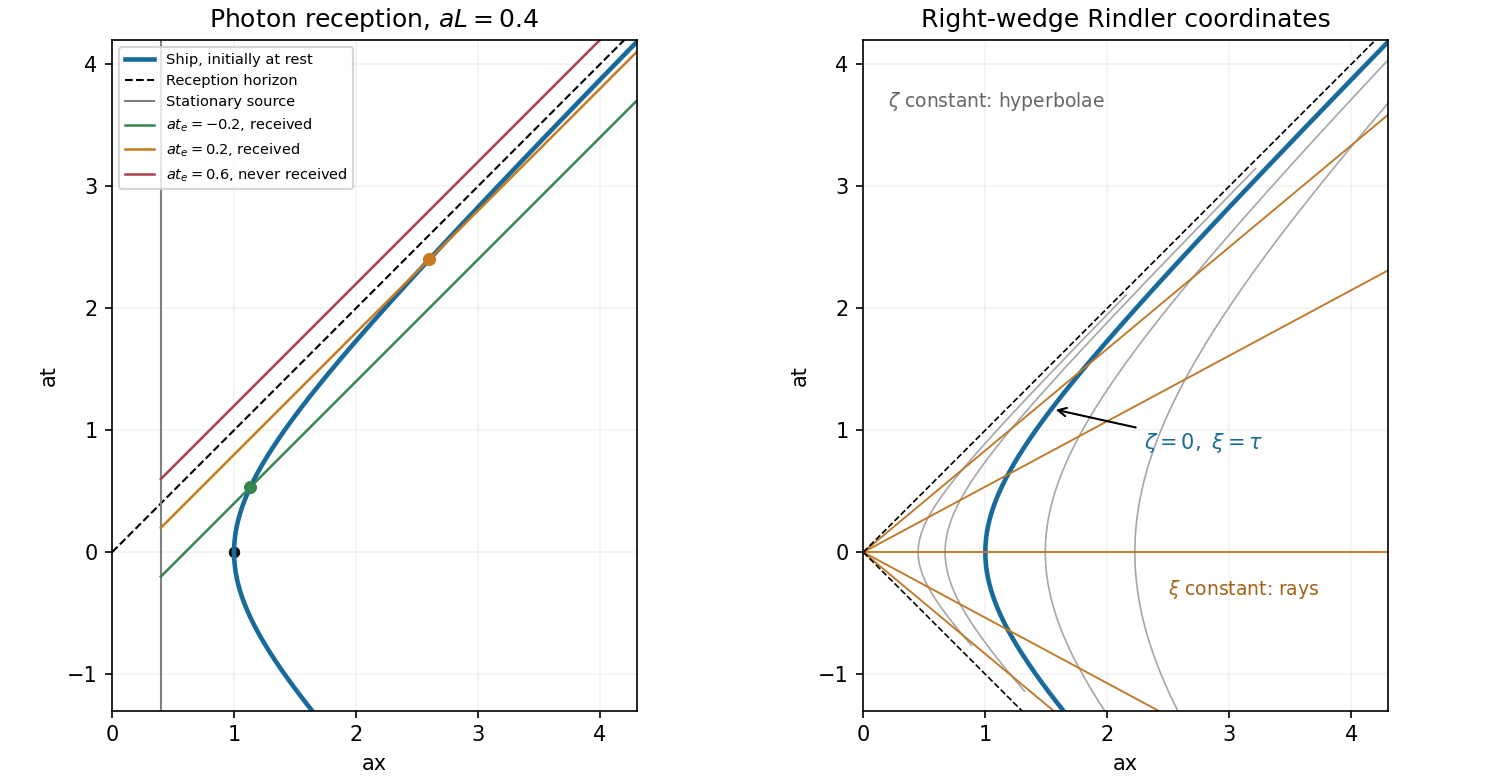
Original accelerated worldline, reception horizon and stellar photon rays, with a separate Rindler coordinate grid
. Details. 
redshift. An incoming radial null ray satisfies . Consecutive wave crests follow the same comoving path, so the endpoint changes in the fixed path integral obey . Comoving clocks read cosmic time; hence their measured periods and frequencies satisfyThe physical wavelength stretches with the scale factor during propagation. It is not necessary to assign a unique global inertial-frame recession velocity to a distant source.
Radial coordinate and cosmological look-back time. Differentiating gives . Combining this with the null-ray integral yieldsThe extra factor in the second denominator records the conversion from scale-factor change to elapsed cosmic time.
proper-motion distance. A small transverse displacement at emission has proper length . Define its source-frame transverse speed as ; cosmological time dilation makes . ThereforeEquivalently, , where the angular diameter distance is . The observer-time versus source-time distinction is essential. This calculation uses the stated transverse speed convention and the homogeneous background, without additional peculiar radial relativistic Doppler effect or gravitational lensing.
redshift shell volume at the present epoch. The induced spatial metric tensor on the present slice gives . Since ,This is the volume at the present epoch of the comoving shell intersected by the past light cone. Its proper volume at emission is smaller by ; a conserved population's proper number density is larger by the same factor, preserving its count.
Einstein-de Sitter cumulative number counts. In flat geometry . Inserting the stated Hubble parameter into the radial integral givesThe constant present-volume number density makes . With no members of the population before its formation epoch,As an independent check, substitution evaluates this toThis is exactly the Euclidean comoving volume per unit solid angle in the flat model. It assumes a complete count with the specified fixed population; luminosity selection, mergers or subsequent number-density evolution would require additional factors.
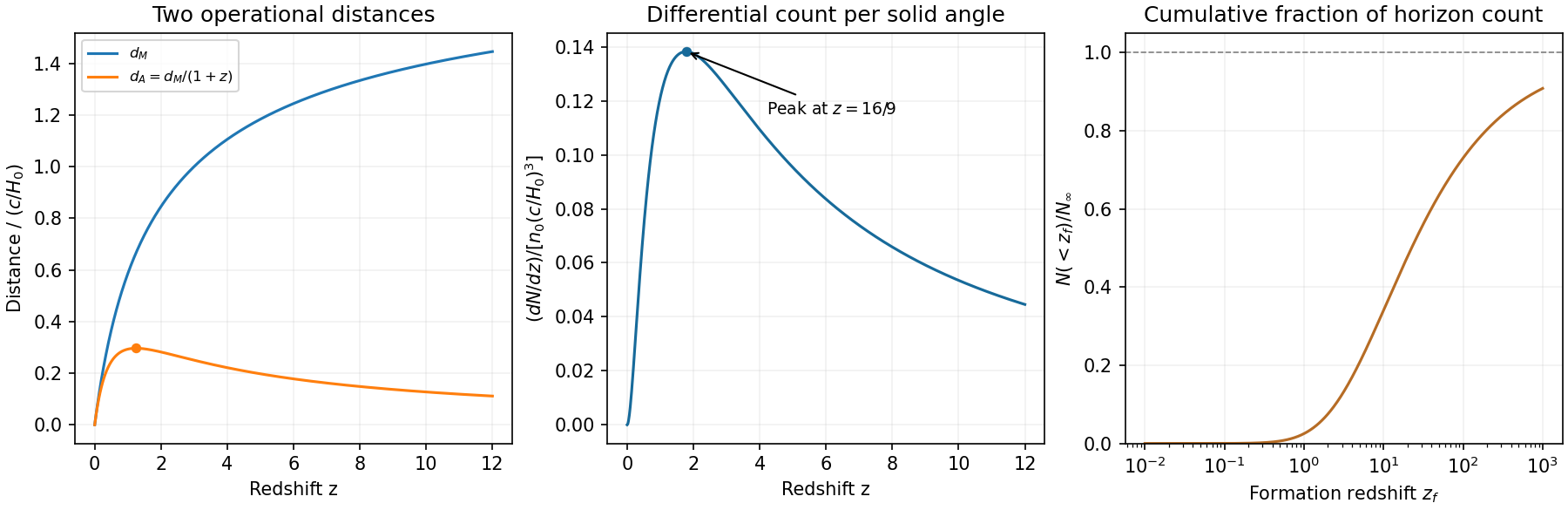
Original Einstein-de Sitter proper-motion and angular diameter distances, differential counts and cumulative fraction
. Details. 
Articles by others on the same topic
There are currently no matching articles.