A tidal force is a difference of gravitational acceleration across an extended region. In Newtonian gravity, . Two neighboring freely falling particles separated by have, to first order,For a point mass, . In a local orthonormal radial/transverse frame,A small freely falling cloud stretches radially and compresses transversely. Outside the source the three eigenvalues sum to zero, consistently with ; within matter the trace is . These are accelerations of separations, not the much larger common acceleration of the cloud's centre.
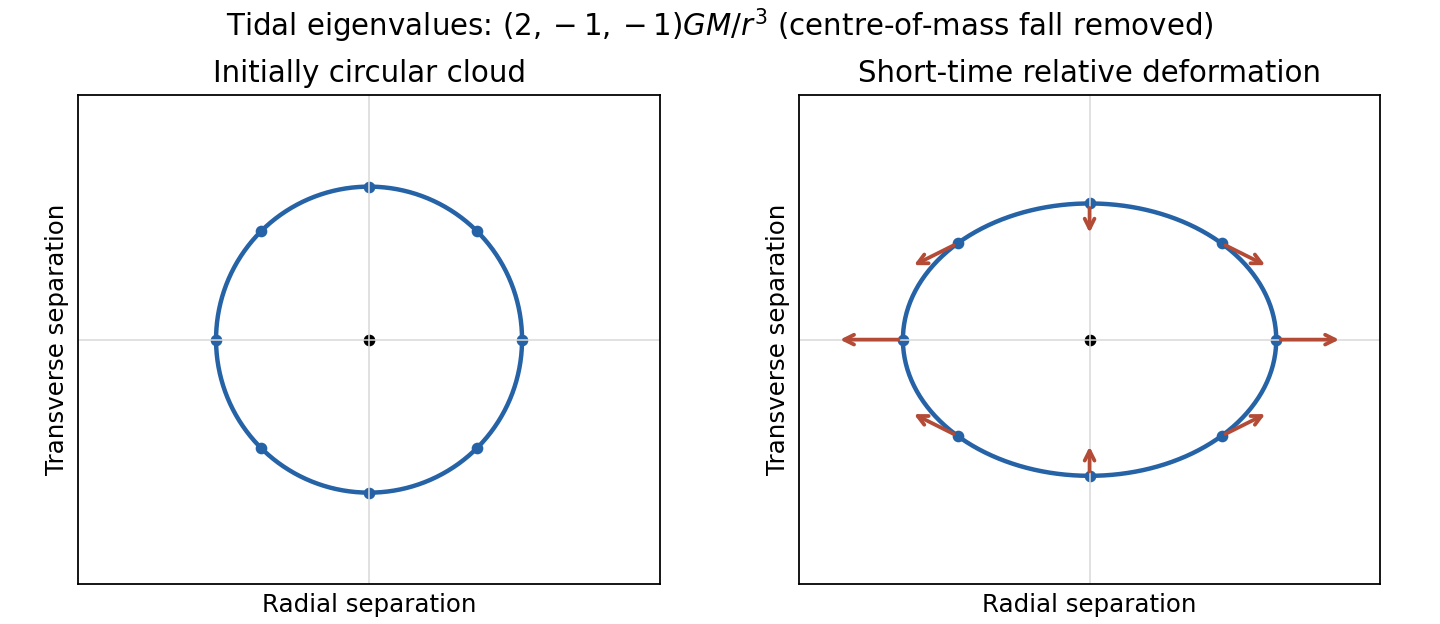
Original local tidal map: a freely falling cloud stretches along the radial direction and contracts in both transverse directions
. Details. 
In general relativity, freely falling test particles follow timelike geodesics. A freely falling frame can eliminate the connection at one event, but not the Riemann curvature tensor throughout a finite laboratory. Let be the geodesic tangent and a connecting vector for neighboring geodesics with . In the explicitly chosen curvature conventionthe geodesic deviation equation isIt follows by commuting , using and zero torsion. In a parallel-propagated orthonormal frame, its spatial components directly describe measured relative acceleration. The weak-field, slow-motion limit recovers the Newtonian Hessian above. Reversing the curvature sign convention reverses the displayed curvature side, without changing the physical stretching. The equivalence principle removes locally uniform gravity, while geodesic deviation measures the residual tidal field. The connection between parallel transport, curvature and neighboring geodesics is developed systematically in the standard geometric construction.[ref]
Lecture Notes on General Relativity by Sean M. Carroll. Section 3, Curvature: parallel transport and geodesic deviation; translate the chosen curvature sign consistently
Articles by others on the same topic
There are currently no matching articles.