A tidal force is a difference of gravitational acceleration across an extended region. In Newtonian gravity, . Two neighboring freely falling particles separated by have, to first order,For a point mass, . In a local orthonormal radial/transverse frame,A small freely falling cloud stretches radially and compresses transversely. Outside the source the three eigenvalues sum to zero, consistently with ; within matter the trace is . These are accelerations of separations, not the much larger common acceleration of the cloud's centre.
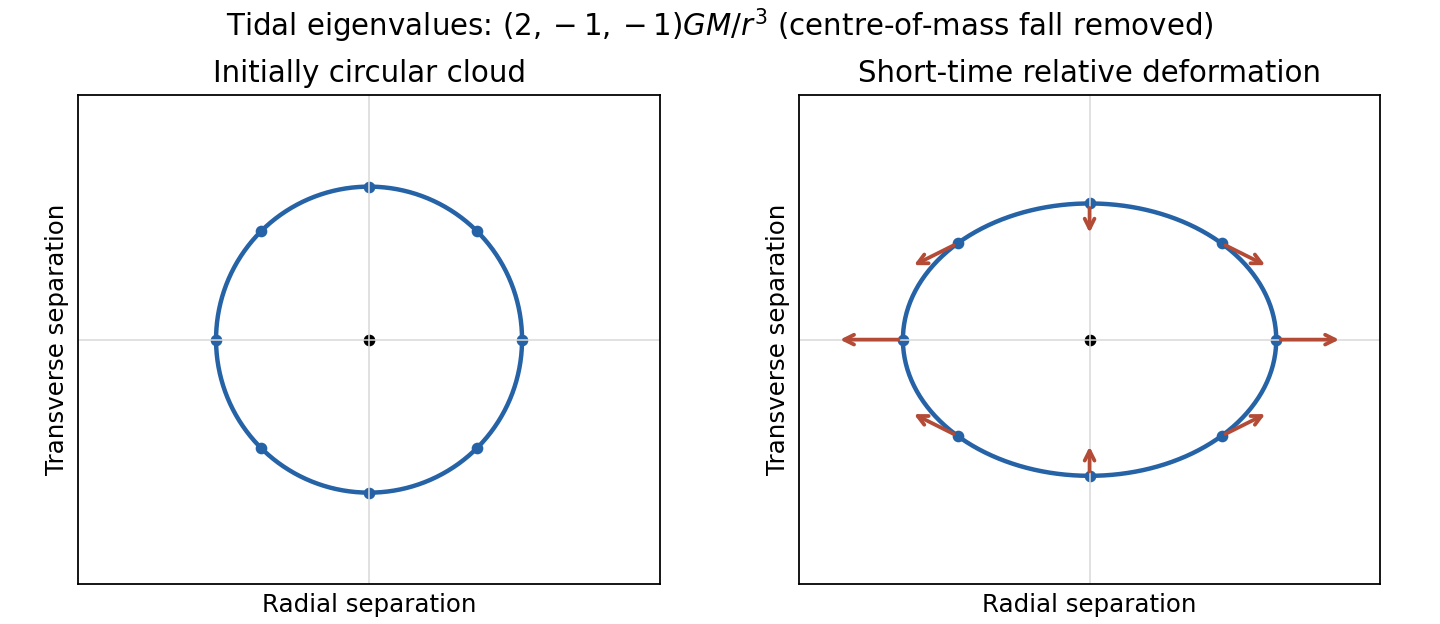
Original local tidal map: a freely falling cloud stretches along the radial direction and contracts in both transverse directions
. Details. 
In general relativity, freely falling test particles follow timelike geodesics. A freely falling frame can eliminate the connection at one event, but not the Riemann curvature tensor throughout a finite laboratory. Let be the geodesic tangent and a connecting vector for neighboring geodesics with . In the explicitly chosen curvature conventionthe geodesic deviation equation isIt follows by commuting , using and zero torsion. In a parallel-propagated orthonormal frame, its spatial components directly describe measured relative acceleration. The weak-field, slow-motion limit recovers the Newtonian Hessian above. Reversing the curvature sign convention reverses the displayed curvature side, without changing the physical stretching. The equivalence principle removes locally uniform gravity, while geodesic deviation measures the residual tidal field. The connection between parallel transport, curvature and neighboring geodesics is developed systematically in the standard geometric construction.[ref]
Lecture Notes on General Relativity by Sean M. Carroll. Section 3, Curvature: parallel transport and geodesic deviation; translate the chosen curvature sign consistently
The cosmological principle idealizes spatial slices as homogeneous and isotropic. The corresponding Friedmann-Lemaître-Robertson-Walker metric can be writtenHere is cosmic time, has dimensions of length in this convention, and is a dimensionless comoving coordinate. The sign of gives positive, zero or negative spatial curvature. It does not alone determine global topology. A comoving pair at fixed radial coordinates has proper separation scaling with , so the Hubble parameter is , and cosmological redshift satisfies .
For a perfect fluid of mass-equivalent energy density and pressure , Einstein's equations giveThe last equation is local energy conservation for constant , with vacuum energy kept separate from . A component with has : pressureless matter dilutes as and radiation as , the additional radiation factor being photon redshift. With , matter domination gives and radiation domination gives . Positive vacuum energy alone gives exponential expansion, with .
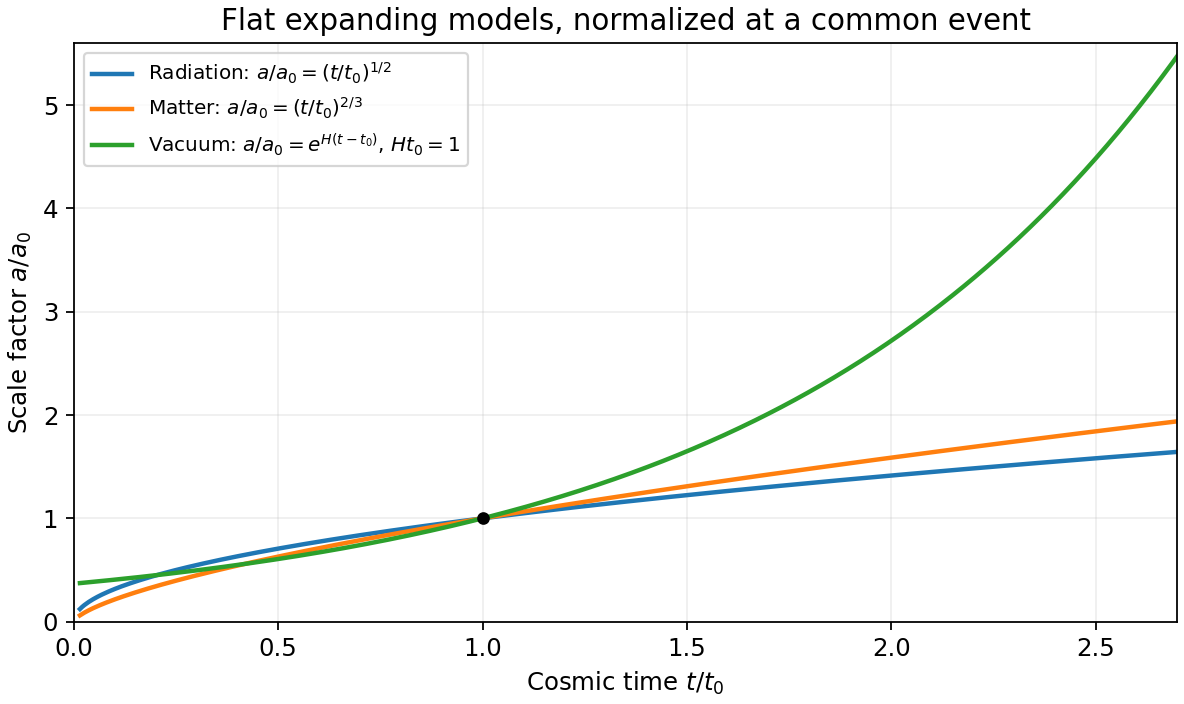
Original comparison of normalized scale factors in flat radiation, matter and positive-vacuum models; the vacuum model has no finite-time big-bang origin in this chart
. Details. 
Geometry, contents and initial conditions together determine the expansion history. A closed matter-only model recollapses; an open matter-only model expands indefinitely. With a cosmological constant, positive spatial curvature no longer by itself implies recollapse. Present critical density is and the density parameters obey , where . These models describe the large-scale background, while local structure and inhomogeneities require perturbations or more general metrics.
Ordinary component differences at neighboring points depend on how the local bases vary. The covariant derivative corrects for that variation:Each upper tensor index adds a connection term and each lower index subtracts one. A scalar has , while the derivative of a tensor transforms as a tensor with one additional covariant index. The Christoffel symbols themselves are not tensor components; their inhomogeneous transformation cancels that of the ordinary derivative.
For the Levi-Civita connection,These express metric compatibility and zero torsion. Along , parallel transport is the initial value problemIt preserves inner products for the Levi-Civita connection. Parallel transport of the tangent itself gives the affinely parametrized geodesic equation, .
Transport generally depends on the path. On a round sphere, transport a tangent vector around the triangle bounded by two meridians degrees apart and the intervening equatorial arc. All three sides are geodesics; the enclosed spherical area is . The returning vector is rotated by degrees, with sign set by traversal orientation. Locally this holonomy is controlled by curvature, even though the connection can be made zero at a single point. A vector can therefore have changing coordinate components while remaining parallel, and constant components do not generally mean parallel transport.
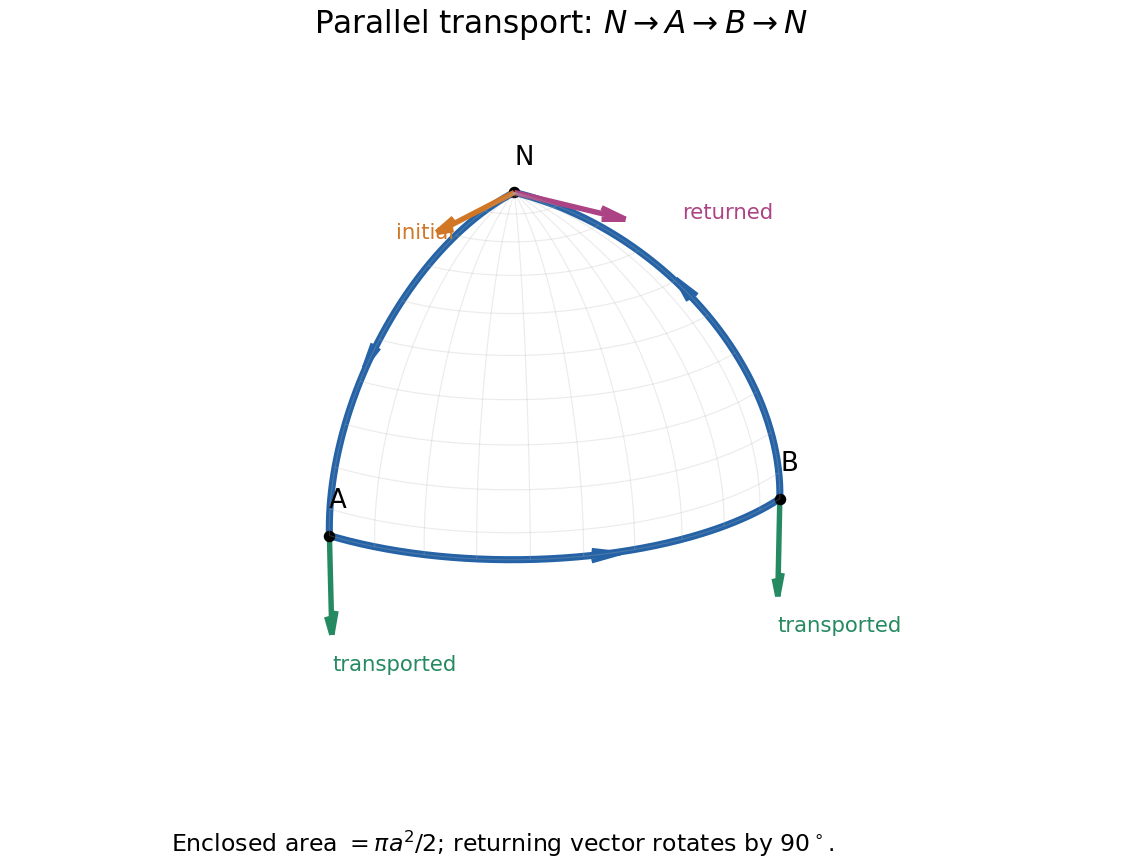
Original spherical-triangle transport: a tangent initially pointing along the first meridian returns rotated by ninety degrees
. Details. 
Articles by others on the same topic
There are currently no matching articles.