Use an affine parameter , with dots denoting its derivatives, and take so the metric is nondegenerate for . The geodesic Lagrangian is . The Euler-Lagrange equations giveor . The conserved cyclic angular momentum isThis is the cyclic angular momentum in a rotational metric, associated with the rotational Killing vector . Explicitly, by the angular equation.
Differentiating the Lagrangian and substituting both equations givesThus the squared tangent norm is constant. If is arc length, it equals one; its numerical value otherwise depends on affine normalization. An arbitrary nonaffine parametrization would not preserve this constant-speed statement.
Denote the parent rest mass by , the daughter rest masses by , and their total energies in any inertial frame by and . For an isolated disintegration with all products included, energy conservation gives . The corresponding kinetic energies are and . ConsequentlyEvery mass on the right is a rest mass, hence invariant under a Lorentz transformation. This proves the kinetic energy released by relativistic decay is frame independent even though either total kinetic energy separately is not. In the parent rest frame the initial kinetic energy vanishes and the final kinetic energy equals the energy associated with this mass defect. External energy input or omission of radiation would invalidate the energy-cancellation step; if photons are products, include their energies with zero rest-mass subtraction.
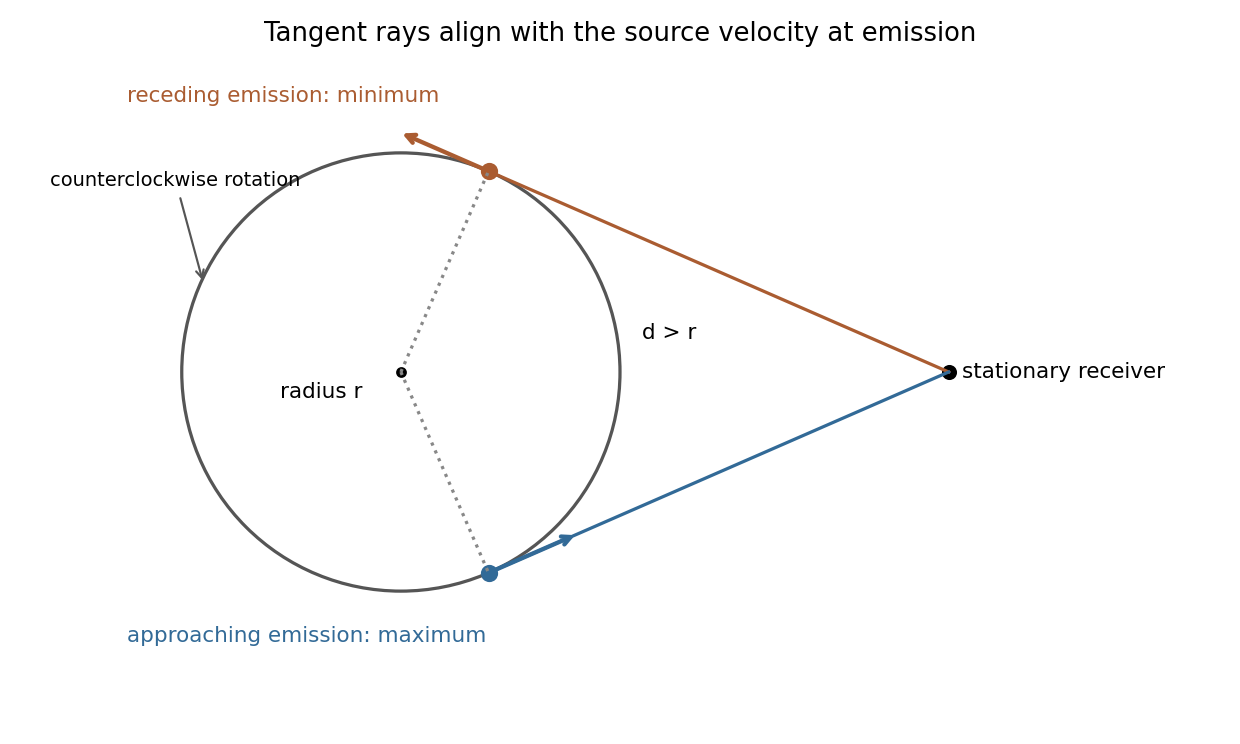
Put , and . For a photon emitted in laboratory direction toward the stationary receiver, its frequency there isSince the receiver lies outside the circle, two emission points have a line of sight tangent to the circle. At those points the source velocity is directly toward or away from the receiver, so . Thus the doppler extrema for a circularly moving source areThey do not depend on , provided ; changing changes the emission and reception phases of the extrema. Closest and farthest source positions instead have transverse velocity relative to that ray, and are not the extrema.

For the corotating receiver, velocities must be evaluated at the actual emission and reception events. An unobstructed vacuum ray satisfies , while rigid steady rotation gives . Therefore . The emitter and receiver have equal speed magnitudes, hence equal Lorentz factors. The frequency ratio of corotating clocks is consequentlyThus the rim receiver measures , independently of its angular separation. Different transit times or a Sagnac effect do not by themselves imply a frequency change between these identical-radius clocks. The model treats as a fixed proper clock frequency and assumes a signal path is available; it does not specify the disc's electromagnetic opacity.
Articles by others on the same topic
There are currently no matching articles.