A map is differentiable at when a linear map approximates its increment to first order:This Fréchet derivative is unique, and its matrix in the standard bases is the Jacobian matrix. Differentiability on a domain means differentiability at each point there.
A standard sufficient condition for a zero locus to be a submanifold is the regular level set theorem: if is on an open domain and is surjective at every , thenFor smooth , the submanifold is smooth. The full-rank condition is the relevant constraint qualification.
Under this regularity hypothesis, its tangent space isIndeed, if a differentiable curve lies in and passes through , the chain rule gives . Thus all tangent velocities lie in the kernel of a linear map. The rank-nullity theorem makes this kernel -dimensional, the same dimension as the tangent space, proving equality. In coordinates, solve the homogeneous linear equations given by the Jacobian matrix.
The regularity qualification matters: has zero set , a zero-dimensional submanifold, but . Its kernel is all of , whereas its tangent space is zero. This is the phenomenon that singular defining maps can overestimate tangent spaces.
At a constrained critical point, the directional derivative of vanishes along every admissible tangent velocity:For a regular zero locus, . A linear functional vanishing on this kernel lies in the row space of . Equivalently there are Lagrange multipliers such thatGeometrically, is orthogonal to the tangent space, so it lies in its orthogonal complement, spanned by the independent constraint gradients. Thus the level set of has no first-order change in a tangent direction. The equations provide candidates for constrained extrema; they must still be classified and compared, and boundary or singular cases must be treated separately. The condition is necessary for a regular constrained extremum, not a guarantee of a maximum.
The feasible set is closed and contained in the rectangleIt is therefore compact, and the continuous function attains a global maximum there by the extreme value theorem. At the two boundary endpoints where a coordinate is zero, the product is zero. Meanwhile is feasible because the conjugate exponents satisfy , and its product is one. Hence every maximizer has .
On that positive region the constraint is with nonzero gradient. The Lagrange multiplier equations areThe first two identities imply . Since , the multiplier is nonzero, so . The constraint now givesThus the sole interior candidate is . Existence of a maximum and the boundary comparison prove the unique global resultThis conjugate-power constrained product maximum is valid for all real with ; no integrality of the exponents is needed.
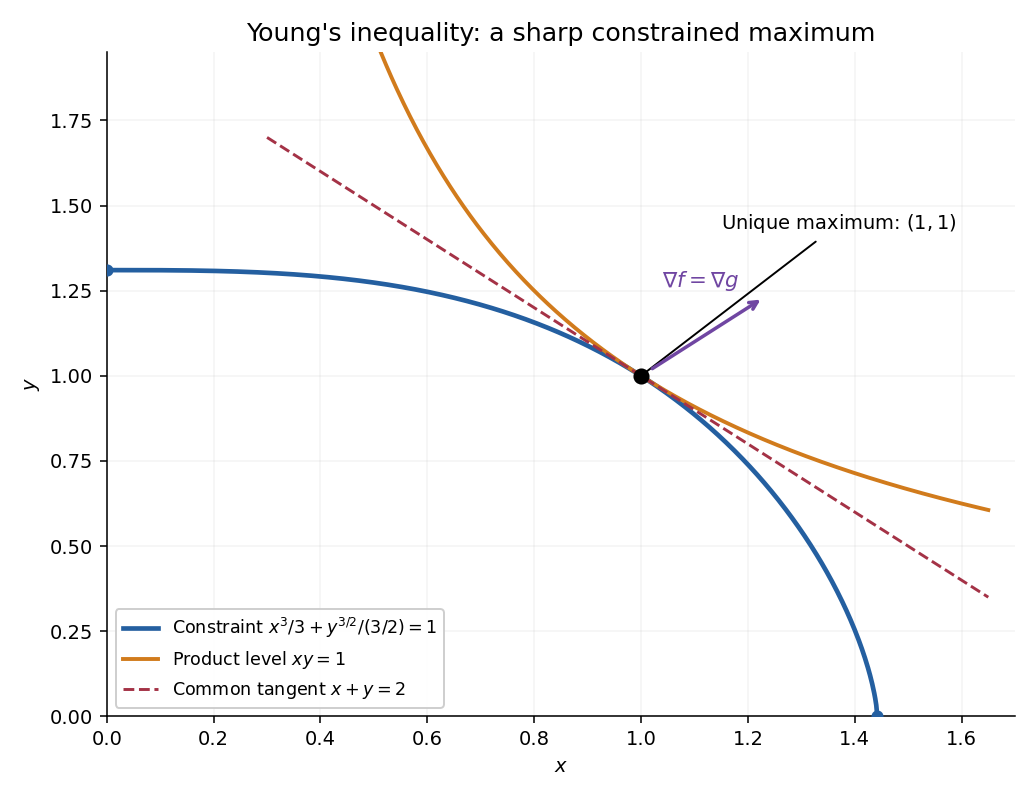
The constrained product reaches one where the two level curves are tangent
. Original illustration for p=3 and q=3/2. The constraint arc meets the product level xy=1 only at (1,1), where both gradients point along (1,1). The red dashed line is their common tangent. Details.
Use a normalization proof of Young's inequality. For arbitrary , putIf , both coordinates are zero and the desired inequality is equality. If , defineThen . Part (c) gives , and the conjugate exponent identity gives . Therefore Young's inequality for products isThe unique equality case in part (c) says . Translated back, and including the zero case, this gives the sharp conditionConversely, if both powers equal , then and the right side is , directly verifying equality.
Articles by others on the same topic
There are currently no matching articles.