A blackbody is an ideal body that absorbs all incident electromagnetic radiation, at every frequency and direction. Its absorptivity is one, so Kirchhoff's law of thermal radiation makes its equilibrium emissivity one as well. At a specified temperature its thermal spectrum is universal: it depends on temperature, not material or shape. This does not mean it looks black when hot; it can glow brightly while remaining a perfect absorber.
A small hole in a nearly isothermal opaque cavity approximates a blackbody, because radiation entering the hole undergoes many interactions before it could escape. In thermal equilibrium the cavity contains an approximately isotropic Planck spectrum. The emitted radiance follows Planck's law, its integrated outward radiant exitance follows the Stefan–Boltzmann law, and its wavelength peak follows Wien's displacement law. A real surface can have wavelength- and direction-dependent emissivity below this ideal limit.
The constants are the Planck constant , photon frequency , speed of light , Boltzmann constant and absolute temperature . The supplied is a spectral energy density, with units . It describes equilibrium radiation per volume and frequency interval, rather than emitted power itself. For isotropic cavity radiation the corresponding surface spectral radiant exitance is .
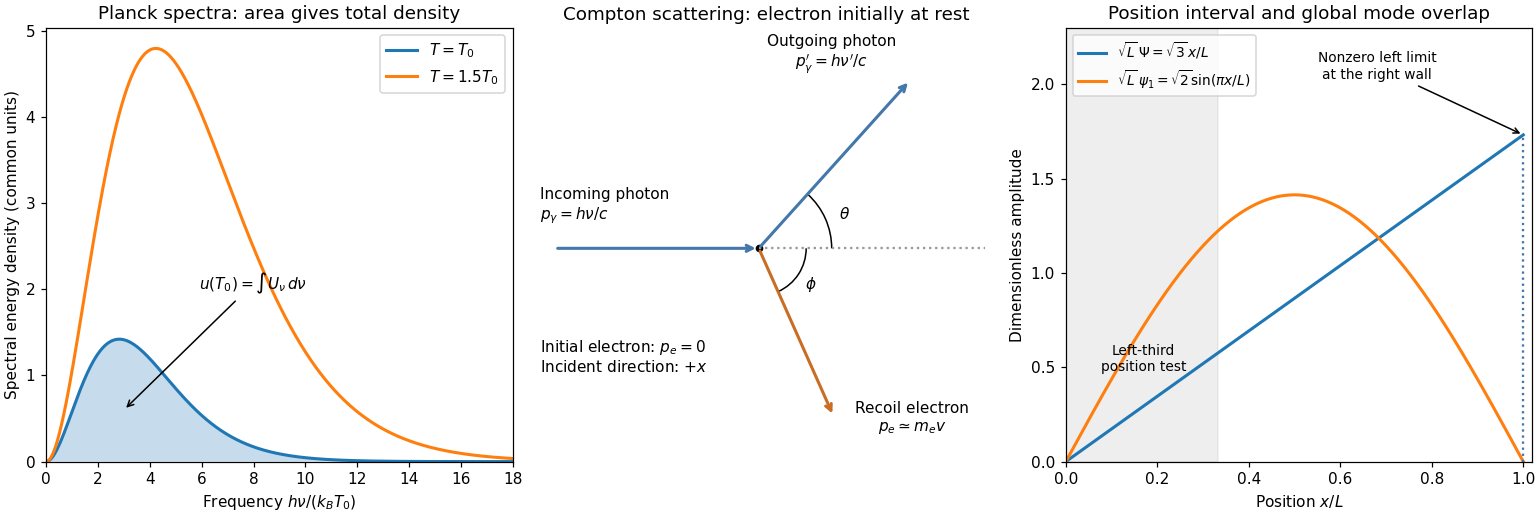
At low frequency the curve rises as ; it has one positive maximum and an exponentially decaying high-frequency tail. The left panel below shades the area under one curve. Put ; thenThe remaining dimensionless integral is independent of temperature, soThus doubling temperature doubles the characteristic frequency scale, raises the spectrum's height by eight and increases its area by sixteen. Total emitted energy also depends on emitting area and elapsed time.

For , the Taylor expansion gives the Rayleigh-Jeans law for equilibrium radiation,This is the classical limit: each electromagnetic mode has mean thermal energy approximately . Extending it to arbitrarily large frequencies would give a divergent integrated energy density, the ultraviolet catastrophe.
For , , giving the Wien approximationPlanck's quantum hypothesis assigns equally spaced mode energies . When the spacing is small relative to , many levels are occupied and the classical approximation works. When , exciting even one quantum is exponentially unlikely, suppressing the high-frequency tail. The single expression contains both limits. Comparing temperature directly to would be dimensionally incorrect; the low-temperature condition means .
First convert from a spectral energy density per unit frequency to one per unit wavelength, including the Jacobian matrix and determinant:Set and define . The nonzero maximum satisfies , with numerical root . ConsequentlyThis is Wien's displacement law. One must maximize the wavelength density, rather than find the frequency maximum and merely put : the frequency and wavelength peaks of Planck's law are different because a spectral density changes under a change of coordinate.
Using the stipulated as a wavelength-density peak, Wien's displacement law givesThis is a rough estimate from the supplied characteristic wavelength, not an accurate measurement of the Sun's effective temperature. The Sun emits a broad, approximately thermal visible spectrum and appears white outside the atmosphere; its familiar yellow appearance does not identify a monochromatic thermal peak. A photospheric effective temperature near instead corresponds to a wavelength-density maximum near .[ref]
Sun colouring page by NASA Space Place. Statement that the Sun emits all visible colours and appears white
[ref]The core must be much hotter to provide the pressure required for hydrostatic equilibrium and to sustain nuclear fusion. Outward energy transport through an opaque interior proceeds down a temperature gradient, by radiative diffusion and then convection through much of the outer envelope. The observable photosphere radiates to space at the temperature needed to carry the solar luminosity, ; it is not an unobstructed view of the hot core. The printed core estimate above million degrees is also too high for the present Sun: the standard central temperature is about . This correction leaves the large core-to-surface contrast and its explanation intact.[ref]
Articles by others on the same topic
There are currently no matching articles.