A blackbody is an ideal body that absorbs all incident electromagnetic radiation, at every frequency and direction. Its absorptivity is one, so Kirchhoff's law of thermal radiation makes its equilibrium emissivity one as well. At a specified temperature its thermal spectrum is universal: it depends on temperature, not material or shape. This does not mean it looks black when hot; it can glow brightly while remaining a perfect absorber.
A small hole in a nearly isothermal opaque cavity approximates a blackbody, because radiation entering the hole undergoes many interactions before it could escape. In thermal equilibrium the cavity contains an approximately isotropic Planck spectrum. The emitted radiance follows Planck's law, its integrated outward radiant exitance follows the Stefan–Boltzmann law, and its wavelength peak follows Wien's displacement law. A real surface can have wavelength- and direction-dependent emissivity below this ideal limit.
The constants are the Planck constant , photon frequency , speed of light , Boltzmann constant and absolute temperature . The supplied is a spectral energy density, with units . It describes equilibrium radiation per volume and frequency interval, rather than emitted power itself. For isotropic cavity radiation the corresponding surface spectral radiant exitance is .
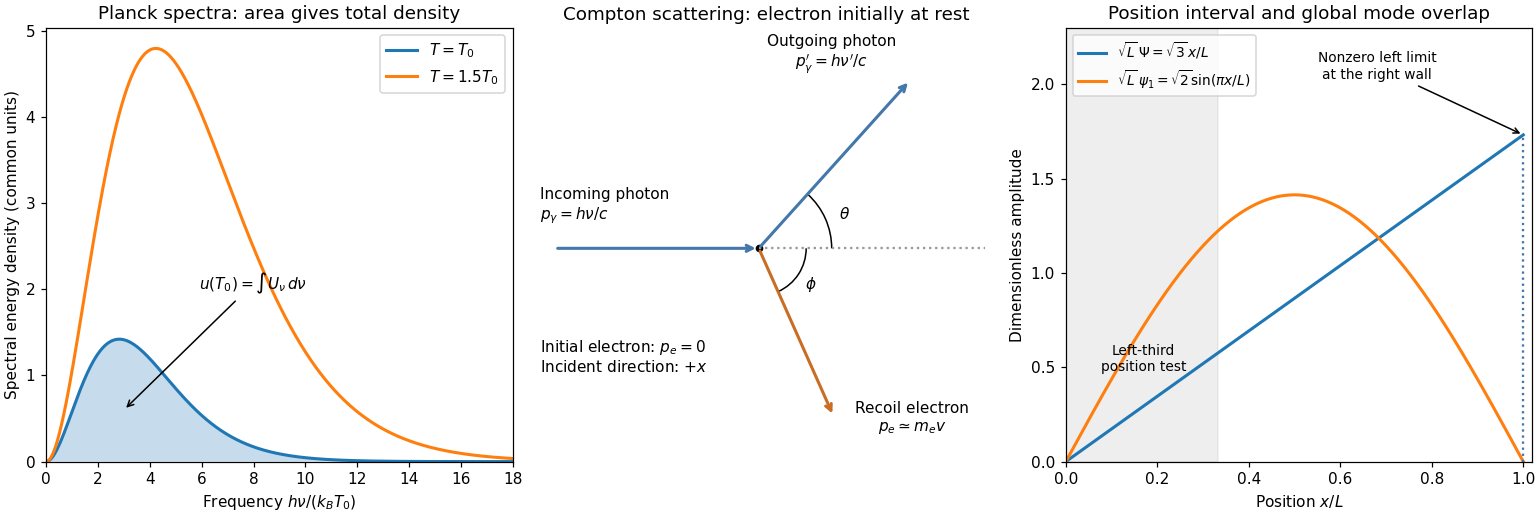
At low frequency the curve rises as ; it has one positive maximum and an exponentially decaying high-frequency tail. The left panel below shades the area under one curve. Put ; thenThe remaining dimensionless integral is independent of temperature, soThus doubling temperature doubles the characteristic frequency scale, raises the spectrum's height by eight and increases its area by sixteen. Total emitted energy also depends on emitting area and elapsed time.

For , the Taylor expansion gives the Rayleigh-Jeans law for equilibrium radiation,This is the classical limit: each electromagnetic mode has mean thermal energy approximately . Extending it to arbitrarily large frequencies would give a divergent integrated energy density, the ultraviolet catastrophe.
For , , giving the Wien approximationPlanck's quantum hypothesis assigns equally spaced mode energies . When the spacing is small relative to , many levels are occupied and the classical approximation works. When , exciting even one quantum is exponentially unlikely, suppressing the high-frequency tail. The single expression contains both limits. Comparing temperature directly to would be dimensionally incorrect; the low-temperature condition means .
First convert from a spectral energy density per unit frequency to one per unit wavelength, including the Jacobian matrix and determinant:Set and define . The nonzero maximum satisfies , with numerical root . ConsequentlyThis is Wien's displacement law. One must maximize the wavelength density, rather than find the frequency maximum and merely put : the frequency and wavelength peaks of Planck's law are different because a spectral density changes under a change of coordinate.
Using the stipulated as a wavelength-density peak, Wien's displacement law givesThis is a rough estimate from the supplied characteristic wavelength, not an accurate measurement of the Sun's effective temperature. The Sun emits a broad, approximately thermal visible spectrum and appears white outside the atmosphere; its familiar yellow appearance does not identify a monochromatic thermal peak. A photospheric effective temperature near instead corresponds to a wavelength-density maximum near .[ref]
Sun colouring page by NASA Space Place. Statement that the Sun emits all visible colours and appears white
[ref]The core must be much hotter to provide the pressure required for hydrostatic equilibrium and to sustain nuclear fusion. Outward energy transport through an opaque interior proceeds down a temperature gradient, by radiative diffusion and then convection through much of the outer envelope. The observable photosphere radiates to space at the temperature needed to carry the solar luminosity, ; it is not an unobstructed view of the hot core. The printed core estimate above million degrees is also too high for the present Sun: the standard central temperature is about . This correction leaves the large core-to-surface contrast and its explanation intact.[ref]
Compton scattering transfers energy and momentum from a photon to an electron. For an initially stationary, approximately free electron, a photon scattered through a nonzero angle generally has lower frequency and longer wavelength; the recoiling electron carries the difference. The effect demonstrates the photon momentum , beyond a purely elastic classical scattering description.
The middle panel of the figure in solution shows the incident photon along , the outgoing photon at angle above that direction, and the recoiling electron at deflection angle below it. Each arrow labels its particle and momentum; the initial electron is at rest at the interaction point. The scattered photon and electron have opposite transverse momentum components, while their forward components sum to the incident photon momentum.
Take a stationary initial electron of mass , a photon incident along , and a nonrelativistic recoil velocity of magnitude . Choose above for the scattered photon and below for the electron. Conservation of momentum givesThe electron's unchanged rest energy cancels in conservation of energy, leavingEquivalently use and . The nonrelativistic limit requires , and treating the electron as free requires its binding energy to be negligible on the scale of the collision.
For complete photon backscatter , the electron recoils forward and momentum conservation givesCombining this with conservation of energy and writing givesFor , the final ratio is approximately four, soWithin the stated nonrelativistic equations the unsimplified relation is implicit and has higher-order recoil corrections; the displayed final approximation is all that the small-shift assumption supports. Exact relativistic Compton recoil kinematics gives , and therefore exactly at backscatter. Agreement at leading order does not make the nonrelativistic derivation exact at arbitrary photon energy.
The ordinary electron Compton wavelength isA photon of that wavelength has energy equal to the electron rest energy, . It therefore sets the characteristic scale at which photon recoil cannot generally be treated nonrelativistically, and it sets the magnitude of the Compton wavelength shift. The reduced Compton wavelength, , is a related but different convention. Localization on this reduced scale needs momenta of order , so a nonrelativistic single-particle description becomes inadequate. Neither wavelength is a measured geometrical radius of the electron.
Retain the backscattering geometry from part (c). With , differs from by only of its value. Momentum conservation givesThe Lorentz-factor correction is of order , so the electron recoil is safely nonrelativistic. Its kinetic energy is only about , compared with incoming photon energy about . This validates the free-electron recoil approximation's relativistic aspect; actual binding or thermal motion in matter can require separate corrections. No larger recoil occurs at another scattering angle for the same initial photon.
Inside the infinite square well, , and the time-independent Schrödinger equation isFor , write and . The first Dirichlet boundary condition gives , and the second requires for a nonzero state. The case is identically zero; negative only changes an overall quantum phase. For a linear solution satisfying both walls is zero, and for the hyperbolic solutions likewise cannot satisfy both walls nontrivially.
Wavefunction normalization, , fixes . The orthonormal energy eigenstates and energy eigenvalues are thereforeEach state vanishes outside the well. Its stationary time-dependent form is . General states are normalized superpositions of these modes, rather than additional single energy eigenstates.
Assume the given wavefunction is zero outside . Wavefunction normalization requiresAn arbitrary overall quantum phase is unobservable, so choose the positive real representative .
The linear ramp state in an infinite square well has a boundary subtlety: the limiting value at is , rather than zero. The function is still a normalized element of the well's Hilbert space , so position measurement and energy-projection probabilities are meaningful. It is not in the domain of the Dirichlet Hamiltonian, nor is it a finite-energy box state. Altering the value at the single endpoint does not cure its nonzero boundary trace; a physical finite-energy preparation must smooth the function to zero near the wall. The following probabilities refer to the supplied idealized state.
Apply the position version of the Born rule to the normalized wavefunction:The result is independent of because the state and the measurement interval scale together. Most position probability lies towards the right wall, since the probability density grows as .
An energy measurement selects the ground state with probability equal to the squared inner product with . Using and integration by parts,ThusThe full Fourier sine series has , so , an independent wavefunction normalization check. However for every , hence diverges. This explicitly verifies the infinite-energy expectation qualification in part (b), without invalidating the individual projection probabilities.
The two probabilities concern different quantum measurements, so there is no requirement that they match or that one bound the other. The spatial interval contains little of the state: its probability density is smallest near zero and increases towards . By contrast, the positive ground state extends across the whole well. It has substantial same-sign overlap with the positive linear wavefunction, with no cancellation between lobes in the overlap integral. The right panel of the figure in solution illustrates these two amplitudes and marks the small position interval.
Consequently a large global ground-state probability can coexist with a small probability of finding the particle in the left third. This is not because the ground state is spatially confined to that third; a ground-state particle can be found throughout the well. In operator language the two events are projections onto a spatial subspace and onto one energy eigenstate, respectively.
Articles by others on the same topic
There are currently no matching articles.