A blackbody absorbs all incident electromagnetic radiation, at every frequency, direction and polarization: its absorptivity is one. In thermal equilibrium, Kirchhoff's law of thermal radiation makes its emissivity one as well. Its emitted spectrum depends only on its absolute temperature, through Planck's law, rather than on the material of its surface.
A small aperture in a large isothermal cavity approximates a blackbody because radiation entering it undergoes many reflections and is very unlikely to escape before absorption. The equilibrium radiation field is isotropic and unpolarized. The total emitted radiant exitance is by the Stefan–Boltzmann law; the peak of the wavelength spectrum shifts to shorter wavelengths as temperature increases according to Wien's displacement law. An ideal absorber can therefore glow brightly when hot: “black” describes absorption, not the absence of thermal emission.
Here is the Planck constant, is the radiation frequency, is the speed of light in vacuum, is the Boltzmann constant, and is the absolute temperature in kelvin. The quantity is spectral energy density per unit frequency, so is energy per unit volume in the interval , and is dimensionless.
Put . In the long-wavelength limit , the Taylor expansion in Planck's law gives the Rayleigh-Jeans law,This is the classical equipartition theorem result: each electromagnetic mode carries mean energy . Extending it to arbitrarily high frequency would make the total energy density diverge, the ultraviolet catastrophe.
In the short-wavelength limit , , giving the Wien approximation,Large photon energies are thermally suppressed, removing the classical high-frequency divergence.
If the requested “form” is expressed per unit wavelength, the change of variables includes its Jacobian determinant: . ThusSubstituting without the Jacobian determinant would give an incorrect spectral density.
Convert the skin temperature to . To locate the peak per unit wavelength in Planck's law, write and maximize . Its positive stationary point obeysThis gives Wien's displacement law, . Hencein the thermal infrared. A peak per unit frequency would occur at a different spectral position; this answer uses the conventional wavelength peak.
For an ideal blackbody surface completely surrounded by an isothermal environment, the Stefan–Boltzmann law gives emitted power and absorbed power . The net outward radiative heat transfer is thereforeThe gross emitted power is about , but about is absorbed back from the surroundings. The difference, rather than the emitted term alone, is the relevant energy loss.
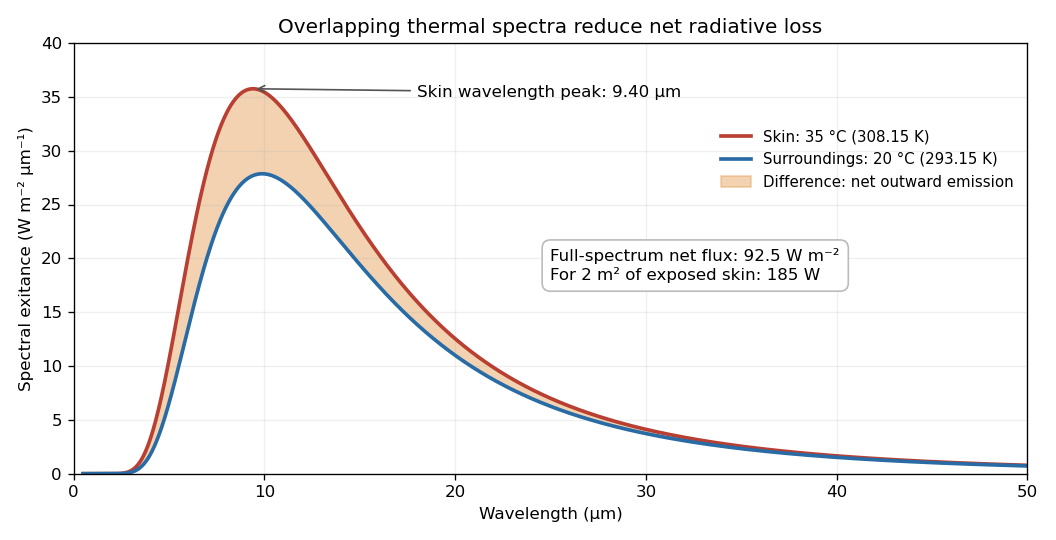
Skin and surroundings emit overlapping thermal spectra; their difference gives the net radiative loss
. Details. 
If the temperatures, exposed area, and surroundings remain fixed, the net radiated energy over one day isUsing the supplied conversion givesA dietary Calorie is one kilocalorie, so the result is about 3820 dietary Calories, rather than 3.82 million dietary Calories.
The estimate assumes the entire surface remains exposed at continuously. Clothing reduces direct exposure and presents a cooler outer emitting surface; the skin temperature also varies across the body and decreases in cooler surroundings through changes in blood flow. Body posture and nearby surfaces reduce the effective exchange area, while blankets and warm surrounding surfaces reduce net radiative heat transfer. These effects make the full-area, constant-temperature daily radiative estimate too large for ordinary clothed conditions.
The unit emissivity approximation is already fairly good for skin in the thermal infrared, so reducing emissivity alone is not the main correction. Also, convection, thermal conduction, and evaporation are additional channels of heat transfer; their existence does not subtract from the calculated radiative term. The computed number is a simplified radiative loss, not a complete metabolic energy budget.
Articles by others on the same topic
There are currently no matching articles.