The one-dimensional time-independent Schrödinger equation isThe differential term is the kinetic energy operator acting on the wave function, V(x) supplies the multiplicative potential energy, and their sum is the Hamiltonian operator. The eigenvalue E is the stationary state's total energy. This form assumes a nonrelativistic particle, a time-independent scalar potential, and no additional internal degrees of freedom in the stated model.
−2mℏ2dx2d2ψ+V(x)ψ(x)=Eψ(x).
The wave function is a probability amplitude: by the Born rule, ∣ψ(x)∣2dx is the probability of a position measurement in an interval of width dx. For a normalized bound state ∫∣ψ∣2dx=1, the expected values areThe integrals run over the allowed domain. If the given state is not normalized, divide both by ∫∣ψ∣2dx. Its variance is ⟨x2⟩−⟨x⟩2; neither ψ itself nor its overall phase is a directly measured position probability.
⟨x⟩=∫x∣ψ(x)∣2dx,⟨x2⟩=∫x2∣ψ(x)∣2dx.
Each energy eigenstate acquires its own phase under the time-independent Hamiltonian operator:Orthonormality removes all off-diagonal terms from the expected value of the energy, givingReturn up to an overall phase requires the relative phase to return to one. For E1=E2, the shortest positive recurrence time isIf the two energies coincide, the whole superposition is stationary up to a common phase for every time; there is then no smallest strictly positive recurrence time. A half-period changes the relative sign and produces the orthogonal antisymmetric state rather than the original symmetric state.
∣ψ(t)⟩=2e−iE1t/ℏ∣1⟩+e−iE2t/ℏ∣2⟩.
⟨E⟩=2E1+E2,independent of time.
τ=∣E2−E1∣2πℏ.
Projection onto the antisymmetric quantum superposition gives amplitude 21(e−iE1t/ℏ−e−iE2t/ℏ). Its squared modulus isIt vanishes initially, reaches one at a half-recurrence time, and returns to zero after τ. This interference depends on a relative phase even though each energy-eigenstate population and the mean energy remain constant.
P+→−(t)=sin2(2ℏ(E2−E1)t).
An ideal projective measurement yielding the antisymmetric state prepares that state at t1. Starting from it, the probability of reaching the symmetric state after an additional interval s is again sin2((E2−E1)s/(2ℏ)). At the full recurrence interval found above,The full-period propagator is proportional to the identity on the two-dimensional subspace, so it returns the antisymmetric state to itself, not to its orthogonal partner. The result assumes the stated time-independent evolution continues after the measurement.
P(+ at t1+τ∣− at t1)=sin2π=0.
Choose the infinite well as 0<x<a with real eigenfunctions ψn=2/asin(nπx/a). This fixes the relative phase convention for the specified initial plus state. Each of the first two states has probability 1/2 in the left half. Their cross integral isThe evolving superposition therefore givesSince En=n2π2ℏ2/(2ma2), the angular frequency and ordinary frequency areThe probability varies between 1/2±4/(3π) and remains in [0,1]. Changing the sign convention of one eigenfunction while keeping the same physical initial state requires changing its superposition coefficient too; otherwise one has prepared the other initial state and reversed the initial spatial bias.
∫0a/2ψ1ψ2dx=π2∫0π/2sinusin2udu=3π4.
Pleft(t)=21+3π4cos(ℏ(E2−E1)t).
ω=2ma23π2ℏ,f=2πω=8ma23h.
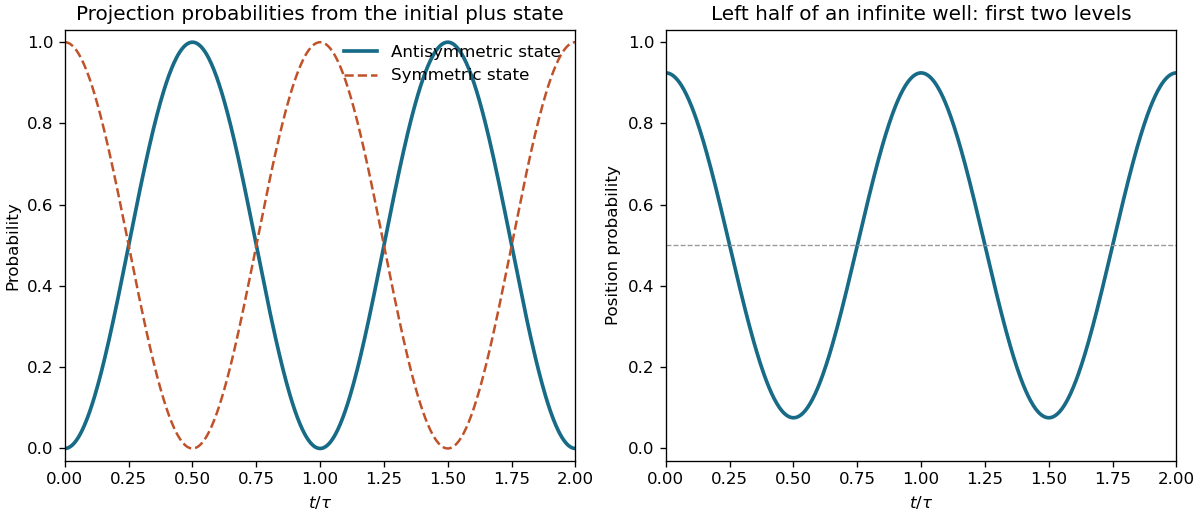
Original two-state transition and left-half well probabilities over two recurrence periods
. Details. 
Ancestors (10)
- S3
- 2012
- Past exam of the short options paper shared by Prelims and Parts A and B of the physics course of the University of Oxford
- Short options paper shared by Prelims and Parts A and B of the physics course of the University of Oxford
- Physics course of the University of Oxford
- Undergraduate course of the University of Oxford
- Course of the University of Oxford
- University of Oxford
- List of universities
- Home
Discussion (0)
New discussionThere are no discussions about this article yet.
Articles by others on the same topic (0)
There are currently no matching articles.