Black-body radiation and the photoelectric effect exposed failures of classical continuous-wave energy exchange. Classical equipartition predicted an unbounded short-wavelength thermal spectrum, the ultraviolet catastrophe. Quantized oscillator energies En=nhν give the mean excitation energy hν/(ehν/(kBT)−1) and suppress high-frequency modes, producing Planck's law. In the modern description, thermal radiation consists of photons with energy hν and Bose occupation numbers.
For the photoelectric effect, increasing intensity below a threshold frequency does not eject electrons, whereas the maximum electron kinetic energy grows with frequency above threshold. Absorption of one photon transfers hν to one electron, giving Kmax=hν−W and threshold ν0=W/h, where W is the work function. Intensity primarily changes the photon arrival rate and hence the photocurrent in the ordinary single-photon regime. Thus changing energy per quantum and changing the number of quanta have distinct consequences. Historically the thermal derivation first quantized matter's energy exchange; it should not be described as an already complete derivation of modern photon theory.
For a photon, pγ=E/c and λγ=hc/E. The neutron is nonrelativistic here because 18.8keV≪mnc2, so pn=2mnE and λn=h/pn. Using the supplied common energy givesEqual kinetic energies do not imply equal momenta: the massive particle obeys E=p2/(2mn), while the massless photon obeys E=pc. The neutron momentum is about 316 times larger, so its de Broglie wavelength is about 316 times smaller.
pγ=1.005×10⁻²³kgms−1,λγ=6.595×10⁻¹¹m,
pn=3.176×10⁻²¹kgms−1,λn=2.086×10⁻¹³m.
To give the neutron the photon wavelength, set its momentum to E/c, not its kinetic energy to E again. ThenIts kinetic energy would then be about 0.188eV, connecting this comparison with the next calculation.
vn≃mncE=5.999×10³ms−1.
For a transverse periodic row of scatterers of spacing d, normal incidence makes their incident phases equal. Scattering at angle θ from that normal creates an outgoing path difference dsinθ between neighbours. Constructive interference requires a phase difference 2πn, givingUsing this printed relation as the intended transverse diffraction grating model, the nonrelativistic neutron wavelength at 0.188eV is λ=6.5964×10⁻¹¹m. Hence the first-order data giveGeometry qualification: this is not a derivation from reflection at crystal planes parallel to the surface, as the source prose says. The ordinary Bragg's law for planes of normal separation d is 2dsinθB=nλ, where θB is the incident glancing angle to those planes. At normal incidence on parallel planes, θB=π/2 and specular reflected rays leave along the normal, so their angle from the normal is zero; they cannot obey the printed positive-order relation dsin0=nλ for λ>0. This is a concrete counterexample to identifying the two geometries. The numerical spacing above is therefore conditional on the printed grating-like relation, rather than a forced assertion that the stated Bragg geometry proves it.
dsinθ=nλ.
d=sin(0.117)λ=5.651×10⁻¹⁰m.
For nonrelativistic neutrons, λ∝EK−1/2, so first-order uncertainty propagation gives ∣Δλ∣/λ=21∣ΔEK∣/EK=0.05. ThusAt fixed d, differentiating the stipulated first-order relation dsinθ=λ gives Δθ=tanθΔλ/λ. ConsequentlyFor photons, λ∝E−1, so the same fractional energy uncertainty gives Δλγ/λγ=0.10. Their 18.8keV wavelength almost equals the low-energy neutron wavelength, so the conditional central angle is 0.116973rad andabout twice the neutron angular spread. This difference comes from the different energy-momentum relations, not from substantially different central wavelengths. The small-angle approximation is adequate at 0.117rad: replacing sinθ by θ changes it by about θ2/6=0.23%, and replacing tanθ by θ changes the sensitivity by about 0.46%. The numerical angular results retain the preceding geometry qualification; a different physical scattering geometry would require its own angle convention.
Δλn≃3.30×10⁻¹²m.
Δθn≃0.00588rad.
Δθγ≃0.01175rad,
In the Franck-Hertz experiment, electrons emitted from a heated cathode are accelerated through a dilute atomic vapour toward a collector. A small retarding potential before the collector rejects electrons that have lost too much kinetic energy. Below the first excitation threshold, mainly elastic collisions occur and the collector current rises as the accelerating voltage increases. At threshold an inelastic collision can transfer a definite excitation energy to an atom, causing a current drop because the slowed electron cannot overcome the retarding potential.
Raising the voltage further permits acceleration again, and repeated losses produce successive current minima. For mercury their spacing is about 4.9V, corresponding to an atomic excitation of about 4.9eV and an associated ultraviolet photon near 254nm. Contact potentials shift the absolute voltages, so the spacing is more informative than the first minimum's position alone. Discrete energy losses support discrete atomic energy levels; a continuously variable excitation energy would not produce the same recurring fixed loss scale. The experiment establishes quantized excitations without requiring the classical electron orbit of the Bohr model to be literally correct.
A classical orbiting electron accelerates and therefore radiates according to the Larmor formula. Its mechanical energy becomes more negative, its radius decreases, and the orbit spirals inward rather than remaining a stable atom. The Bohr model replaces this prediction with postulated nonradiating stationary states and quantized orbital angular momentum, together with photon emission or absorption only between states, hν=∣En−Em∣.
For a heavy nucleus, mevr=nℏ. Since the de Broglie wavelength is h/(mev), this impliesThe electronic wave fits an integer number of wavelengths around the orbit. This is a standing-wave consistency interpretation of the quantization rule, not a classical mechanism that prevents an accelerating charge from radiating. For finite nuclear mass, the two-body relative coordinate uses reduced mass μ=meM/(me+M); the next derivation retains that correction. In the limit M≫me, it reduces to the fixed-nucleus electron description above.
2πr=nλ,n=1,2,….
Let r be the electron-nucleus separation and use the reduced mass μ=meM/(me+M). Coulomb attraction supplies the relative centripetal force, and Bohr quantization fixes the relative angular momentum:Eliminating v givesThe total energy is E=μv2/2−Ze2/(4πϵ0r)=−Ze2/(8πϵ0r), henceHere a0 is the ordinary Bohr radius and R∞ the infinite-nuclear-mass Rydberg constant. The electron's radius about the centre of mass is Mrn/(M+me); for a heavy nucleus this distinction and the reduced-mass correction are small, but the supplied nuclear mass permits them to be stated precisely.
rμv2=4πϵ0r2Ze2,μvr=nℏ.
rn=μZe24πϵ0ℏ2n2=a0μmeZn2.
En=−2(4πϵ0)2ℏ2n2μZ2e4=−hcRMn2Z2,RM=R∞meμ.
The emitted photon carries the decrease in atomic energy, so hc/λ=En−Em for n>m. Using the preceding energy levels givesThe lower state's energy is more negative, making the right-hand side positive. This is the hydrogenic Rydberg formula, with the finite-nuclear-mass factor included in RM.
λ1=RMZ2(m21−n21).
At room temperature, kBT is of order 0.026eV, far smaller than the electronic excitation gaps of the inferred hydrogenic ion. Ground-state absorption is therefore the natural interpretation. Assign the three lines to 1→2, 1→3, and 1→4. Dividing each reciprocal wavelength by its corresponding factor 1−1/n2 givesThe small scatter is consistent with the rounded wavelength data. Since R∞≃1.0974×10⁷m−1 and μ≃me,The ion is thus hydrogen-like lithium, Li2+. If “effective Rydberg constant” denotes only the reduced-mass constant rather than the charge-inclusive spectral coefficient, its value is RM≃Reff/9≃1.097×107m−1. The two conventions are explicitly distinguished; the rounded lines do not determine a precise isotope mass.
Reff=RMZ2≃(9.8765,9.8684,9.8765)×107m−1.
Reff≃9.87×10⁷m−1,Z≃Reff/R∞=3.
For Coulomb binding, the virial theorem gives a typical kinetic energy of the order of the binding energy. Taking ptyp≃2me∣E1∣ and using the Heisenberg uncertainty relation estimate rtyp∼ℏ/ptyp givesThe Bohr model gives r1=a0/Z=a0/2=2.65×10−11m for a heavy helium nucleus, agreeing with the characteristic scale. Equivalently, minimizing the localization estimate E(r)∼ℏ2/(2mer2)−Ze2/(4πϵ0r) gives that same scale.
rtyp∼2me(54.4eV)ℏ=2.65×10⁻¹¹m.
This is an order-of-magnitude radius estimate, not an exact deduction of the cloud's expected value from the inequality alone. Numerical coefficients depend on which spread is used; ΔxΔp≥ℏ/2 does not assert ⟨r⟩=ℏ/p. For the exact hydrogenic 1s state, ⟨r⟩=3a0/(2Z)=3.97×10−11m at Z=2, one and a half times the Bohr orbital radius. An electron cloud has a radial distribution, whereas the Bohr model assigns a definite radius.
The one-dimensional time-independent Schrödinger equation isThe differential term is the kinetic energy operator acting on the wave function, V(x) supplies the multiplicative potential energy, and their sum is the Hamiltonian operator. The eigenvalue E is the stationary state's total energy. This form assumes a nonrelativistic particle, a time-independent scalar potential, and no additional internal degrees of freedom in the stated model.
−2mℏ2dx2d2ψ+V(x)ψ(x)=Eψ(x).
The wave function is a probability amplitude: by the Born rule, ∣ψ(x)∣2dx is the probability of a position measurement in an interval of width dx. For a normalized bound state ∫∣ψ∣2dx=1, the expected values areThe integrals run over the allowed domain. If the given state is not normalized, divide both by ∫∣ψ∣2dx. Its variance is ⟨x2⟩−⟨x⟩2; neither ψ itself nor its overall phase is a directly measured position probability.
⟨x⟩=∫x∣ψ(x)∣2dx,⟨x2⟩=∫x2∣ψ(x)∣2dx.
Each energy eigenstate acquires its own phase under the time-independent Hamiltonian operator:Orthonormality removes all off-diagonal terms from the expected value of the energy, givingReturn up to an overall phase requires the relative phase to return to one. For E1=E2, the shortest positive recurrence time isIf the two energies coincide, the whole superposition is stationary up to a common phase for every time; there is then no smallest strictly positive recurrence time. A half-period changes the relative sign and produces the orthogonal antisymmetric state rather than the original symmetric state.
∣ψ(t)⟩=2e−iE1t/ℏ∣1⟩+e−iE2t/ℏ∣2⟩.
⟨E⟩=2E1+E2,independent of time.
τ=∣E2−E1∣2πℏ.
Projection onto the antisymmetric quantum superposition gives amplitude 21(e−iE1t/ℏ−e−iE2t/ℏ). Its squared modulus isIt vanishes initially, reaches one at a half-recurrence time, and returns to zero after τ. This interference depends on a relative phase even though each energy-eigenstate population and the mean energy remain constant.
P+→−(t)=sin2(2ℏ(E2−E1)t).
An ideal projective measurement yielding the antisymmetric state prepares that state at t1. Starting from it, the probability of reaching the symmetric state after an additional interval s is again sin2((E2−E1)s/(2ℏ)). At the full recurrence interval found above,The full-period propagator is proportional to the identity on the two-dimensional subspace, so it returns the antisymmetric state to itself, not to its orthogonal partner. The result assumes the stated time-independent evolution continues after the measurement.
P(+ at t1+τ∣− at t1)=sin2π=0.
Choose the infinite well as 0<x<a with real eigenfunctions ψn=2/asin(nπx/a). This fixes the relative phase convention for the specified initial plus state. Each of the first two states has probability 1/2 in the left half. Their cross integral isThe evolving superposition therefore givesSince En=n2π2ℏ2/(2ma2), the angular frequency and ordinary frequency areThe probability varies between 1/2±4/(3π) and remains in [0,1]. Changing the sign convention of one eigenfunction while keeping the same physical initial state requires changing its superposition coefficient too; otherwise one has prepared the other initial state and reversed the initial spatial bias.
∫0a/2ψ1ψ2dx=π2∫0π/2sinusin2udu=3π4.
Pleft(t)=21+3π4cos(ℏ(E2−E1)t).
ω=2ma23π2ℏ,f=2πω=8ma23h.
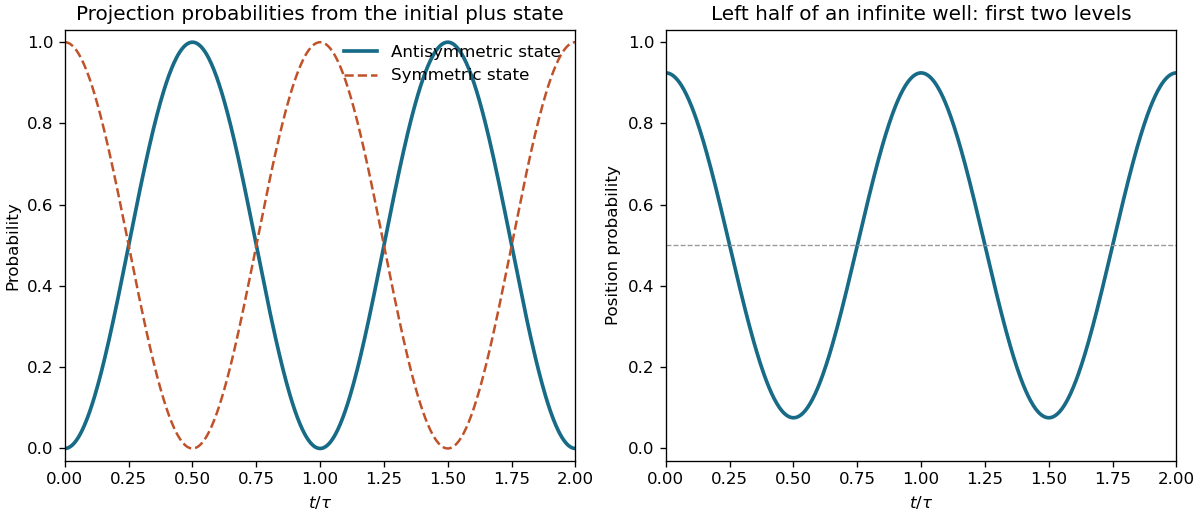
Original two-state transition and left-half well probabilities over two recurrence periods
. Details. 
Ancestors (9)
- 2012
- Past exam of the short options paper shared by Prelims and Parts A and B of the physics course of the University of Oxford
- Short options paper shared by Prelims and Parts A and B of the physics course of the University of Oxford
- Physics course of the University of Oxford
- Undergraduate course of the University of Oxford
- Course of the University of Oxford
- University of Oxford
- List of universities
- Home
Discussion (0)
New discussionThere are no discussions about this article yet.
Articles by others on the same topic (0)
There are currently no matching articles.