Dust condenses in cool stellar outflows and ejecta and is processed and grown in interstellar clouds. It absorbs and scatters starlight, usually more efficiently at blue wavelengths, making a background star fainter and redder. RR Lyrae variables are old horizontal-branch pulsators with approximately calibrated absolute luminosities, so their recognizable light curves and standard-candle relation provide distances after metallicity and extinction corrections. They are not exactly identical-luminosity objects in every population.
The color excess is E(B−V)=0.3−0.2=0.10 mag, hence AV=0.31 mag. The observed modulus V−MV is 15.4, while the extinction-corrected modulus is μ0=15.09. Thus d=10(μ0+5)/5≃1.04×104 pc. Distinguishing the apparent and true moduli avoids treating extinction as extra distance.
Hot bright stars lie toward the upper left: smaller B−V means bluer/hotter, and smaller numerical V means brighter. The vertical axis is inverted in the original diagram. The plot shows apparent magnitudes, but cluster members at a common distance permit relative luminosity comparisons.
Cool faint stars lie toward the lower right. Redder color and larger magnitude identify that corner, subject to common extinction and the atmospheric color-temperature relation. A color-magnitude diagram is not a geometrical map of where the stars are located within the cluster.
An isochrone is the locus of stars of a common age and composition over a range of initial masses. A real cluster diagram approximates it, with scatter from binaries, measurement errors, composition spread and differential reddening. Region A is the hydrogen-core-burning main sequence. Region B contains evolved subgiant/red-giant stars, typically with hydrogen-shell burning around an increasingly helium-rich core. Region C is the horizontal branch, occupied by core-helium-burning stars; RR Lyrae lie in its instability strip.
Point D is the main-sequence turnoff: core hydrogen exhaustion drives structural readjustment toward shell burning and expansion. Point E is the tip of the red-giant branch, where a low-mass star ignites helium in its degenerate core, the helium flash, and subsequently moves toward horizontal-branch conditions. The two labeled events are different evolutionary transitions, not merely changes in apparent color from dust.
At D, MV=20.3−15.09=5.21. Ignoring differential bolometric corrections, L/L⊙≃10−0.4(5.21−4.74)≃0.65, and L∝M4 gives MD≃0.90M⊙. If accessible fuel fraction is similar, lifetime scales as M/L∝M−3. Normalizing to a solar main-sequence lifetime about 10 Gyr gives an age near 14 Gyr.
This is much older than the Sun's current approximately 4.6 Gyr and close to the cosmological age scale. The approximate estimate is not evidence for a cluster older than the Universe: bolometric corrections, abundance, accessible hydrogen fraction and the crude mass-luminosity law limit precision. The stated 26.7 MeV conversion and an assumed core fuel fraction can supply the order-of-magnitude solar lifetime; they do not by themselves specify the burned fraction or composition precisely.
For a thin spherical shell, outward pressure force is −4πr2(dP/dr)dr and inward weight is GM(r)ρ(4πr2dr)/r2. Balance gives dP/dr=−GM(r)ρ/r2. This assumes approximately spherical, slowly evolving structure without important rotational or magnetic support.
A white dwarf is a compact stellar remnant supported primarily by electron degeneracy pressure, radiating stored thermal energy rather than sustained main-sequence fusion. At zero-temperature leading order, filling electron momentum states gives ne=pF3/(3π2ℏ3) and P=pF5/(15π2ℏ3me). Fully ionized hydrogen mass fraction X, with other nuclei approximately one electron per two nucleons, implies ne=(1+X)ρ/(2mu). ThereforeThis is an n=3/2 polytrope. Solving hydrostatic structure with a zero-pressure surface gives R=2.357K1(1+X)5/3M−1/3/G; the numerical factor uses ξ1=3.65375 and −ξ12θ′(ξ1)=2.71406 of that Lane-Emden solution. Thus R∝M−1/3. For X=0, M=M⊙, R is about 9×10³ km. A uniform-density scaling gives the same mass dependence but a different order-one coefficient and should be identified as such.
P=K1(1+X)5/3ρ5/3,K1=5me(2mu)5/3ℏ2(3π2)2/3.
Independently, R/R⊙=0.056(T⊙/25000)2≃0.0126, or about 8.8×10³ km. Agreement is good at this level; relativistic degeneracy becomes relevant for accurate modeling near one solar mass and eventually invalidates an unlimited nonrelativistic mass-radius law.
Degenerate electrons conduct heat efficiently, making most of the interior nearly isothermal while an outer nondegenerate insulating envelope sustains a large temperature gradient. Nuclei have much larger masses and much smaller thermal de Broglie wavelengths than electrons, so their quantum degeneracy is weak at these temperatures/densities, although Coulomb coupling and crystallization can matter. Under the stipulated classical ideal-carbon-ion approximation,This excludes crystallization, latent heat and low-temperature heat-capacity changes; nondegenerate does not automatically mean weakly interacting.
U=2312muMkBTc=8muMkBTc.
The given cooling law yields Tc,i=[0.056L⊙/0.09]2/7≃3.4×107 K. Combine it with the ion thermal energy to obtainFor Tc,f=0.1Tc,i this is about 1.32×10¹⁰ years; the exact value is retained in the independent numerical check. At approximately fixed radius, Teff∝L1/4∝Tc7/8, giving Teff,f≃3.3×10³ K. The required cooling time is comparable to the cosmic age and leaves little time for progenitor evolution. Such objects would also be very faint. This explains scarcity in the toy model, rather than a universal prohibition on observing ultracool white dwarfs. The source's categorical absence claim is too strong; detailed cooling histories can differ. The ideal-ion heat capacity and luminosity law are being extrapolated into regimes where crystallization, atmosphere physics and other corrections matter, so this is not a precision cooling age.
Δt=8mu(0.09)kBM⊙52(Tc,f−5/2−Tc,i−5/2).
A concrete observational counterexample to a categorical absence in this temperature regime is the observed ultracool population including LHS 1402, LHS 3250 and SDSS J1337+00, with published atmosphere fits spanning about 3240–3480 K. [ref]
https://doi.org/10.1088/0067-0049/190/1/77. Section 3.3.4, Ultracool WDs: observed objects and temperature fits
A spiral galaxy has a rotating stellar/gas disk with spiral structure, central bulge, extended halo and globular clusters, embedded in a still larger dark-matter distribution. For the Milky Way useful rough scales are a stellar-disk diameter of a few tens of kiloparsecs, a thin-disk thickness of a few hundred parsecs, a bulge scale of kiloparsecs and a halo extending tens to hundreds of kiloparsecs depending on tracer. Young stars follow gas-rich star-forming disk regions and spiral arms. Very old stars are prominent in globular clusters, halo and bulge, though the disk also contains old populations. These are distributions with overlapping ages, not disjoint bins.
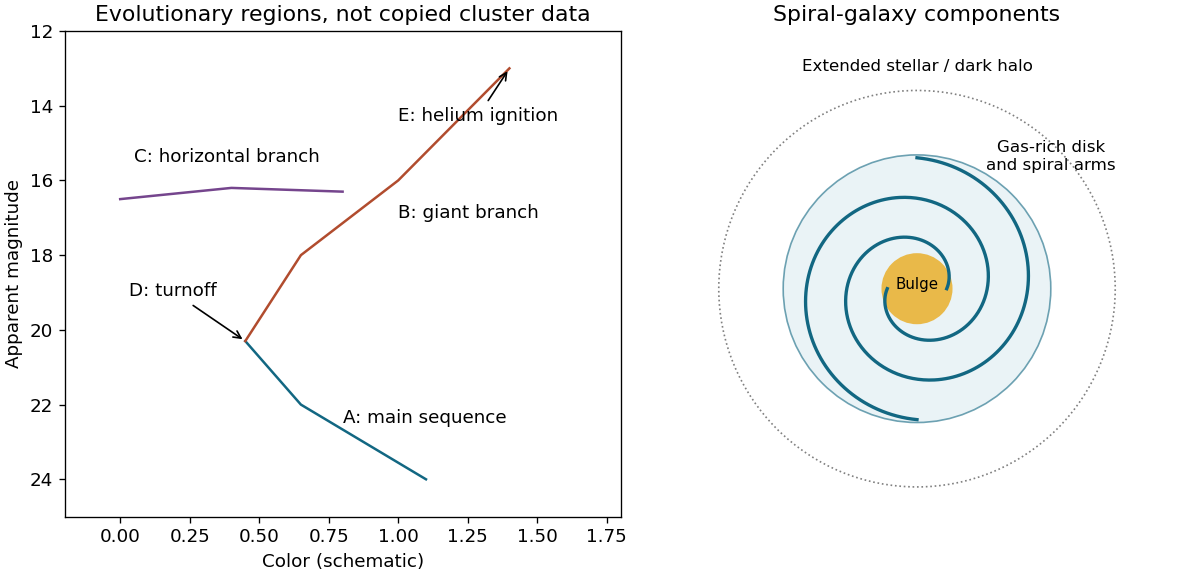
Schematic stellar evolutionary regions and spiral-galaxy components used in the solutions
. Details. 
The 21.1 cm line is neutral hydrogen's hyperfine spin-flip transition, observed with radio telescopes and interferometers in the cool/warm neutral gas disk, often beyond the bright stellar disk. The mean wavelength gives z=22.0/21.1−1≃0.0427 and, using the stated low-redshift Hubble approximation, d≃180 Mpc. A 16-arcsecond angular radius gives R≃14 kpc. For a thin circular disk, cosi=8/32, so i≃75.5∘ from face-on.
The original spectrum reaches roughly 21.98 and 22.02 cm: vlos,max≃c(0.02/22.0)≃273 km s−1. Deprojecting gives vmax≃282 kms−1. A spherical dynamical estimate M(<R)≃v2R/G gives M∼2.6×10¹¹M⊙. A thin massive disk is not spherical: its exact rotation-to-total-mass coefficient depends on radial mass profile. The no-exterior-matter assumption does not uniquely fix that coefficient, so the quoted result is the conventional order-of-magnitude dynamical estimate. Cosmological luminosity and angular-diameter distances differ at this redshift; the source's simple Hubble-distance convention is being used consistently.
The low-redshift distance gives modulus about 36.28, so MV≃−20.28 and LV≃1010L⊙. A stellar mass-to-light ratio of order one to a few would imply only 1010–several 1010M⊙ in stars, below the dynamical estimate. Gas and a dark component can supply additional mass; the precise stellar estimate requires a population-dependent mass-to-light ratio and extinction correction.
An exponential luminous disk has most of its mass within a few scale lengths. Outside that concentration a mass-traces-light model tends toward a declining, approximately Keplerian speed, not an extended flat curve. Adding a spatially extended mass distribution explains the mismatch more naturally than merely rescaling the same concentrated light profile.
Use an explicit Tully-Fisher-type scaling L∝vmax4 for comparable spiral populations and photometric band. Relative to the preceding galaxy,The exponent and normalization are empirical and have scatter; one galaxy alone does not establish the relation. Different stellar populations, inclination errors and extinction change the photometric inference.
L2∼1010(100/282)4L⊙∼1.6×108L⊙.
Ancestors (9)
- 2016
- Past exam of the short options paper shared by Prelims and Parts A and B of the physics course of the University of Oxford
- Short options paper shared by Prelims and Parts A and B of the physics course of the University of Oxford
- Physics course of the University of Oxford
- Undergraduate course of the University of Oxford
- Course of the University of Oxford
- University of Oxford
- List of universities
- Home
Discussion (0)
New discussionThere are no discussions about this article yet.
Articles by others on the same topic (0)
There are currently no matching articles.