A viscoelastic material stores part of the deformation energy and dissipates part of it. In linear viscoelasticity, a small imposed shear strain produces a stress determined by its history, . A shear step probes stress relaxation; a stress step probes creep compliance. A purely elastic solid has persistent stress after a held strain, while a Newtonian fluid relaxes that stress and creeps continuously under constant stress.
For a Maxwell model, a spring of shear modulus and a dashpot of viscosity are in series:For the convention ,The storage modulus dominates at short times or high frequencies; the loss modulus dominates at long times or low frequencies. The energy dissipated per cycle per volume is . A Kelvin-Voigt model places spring and dashpot in parallel and instead gives bounded creep : a simple illustration of a viscoelastic solid. Real materials can require a spectrum of relaxation times rather than one element.
A small-amplitude oscillatory rheometer measures stress amplitude and phase relative to imposed strain, giving and . First sweep strain amplitude to identify the linear range; control temperature, sample ageing, wall slip and instrument inertia. Frequency-dependent phase lag alone is insufficient if these apparatus effects are unresolved.
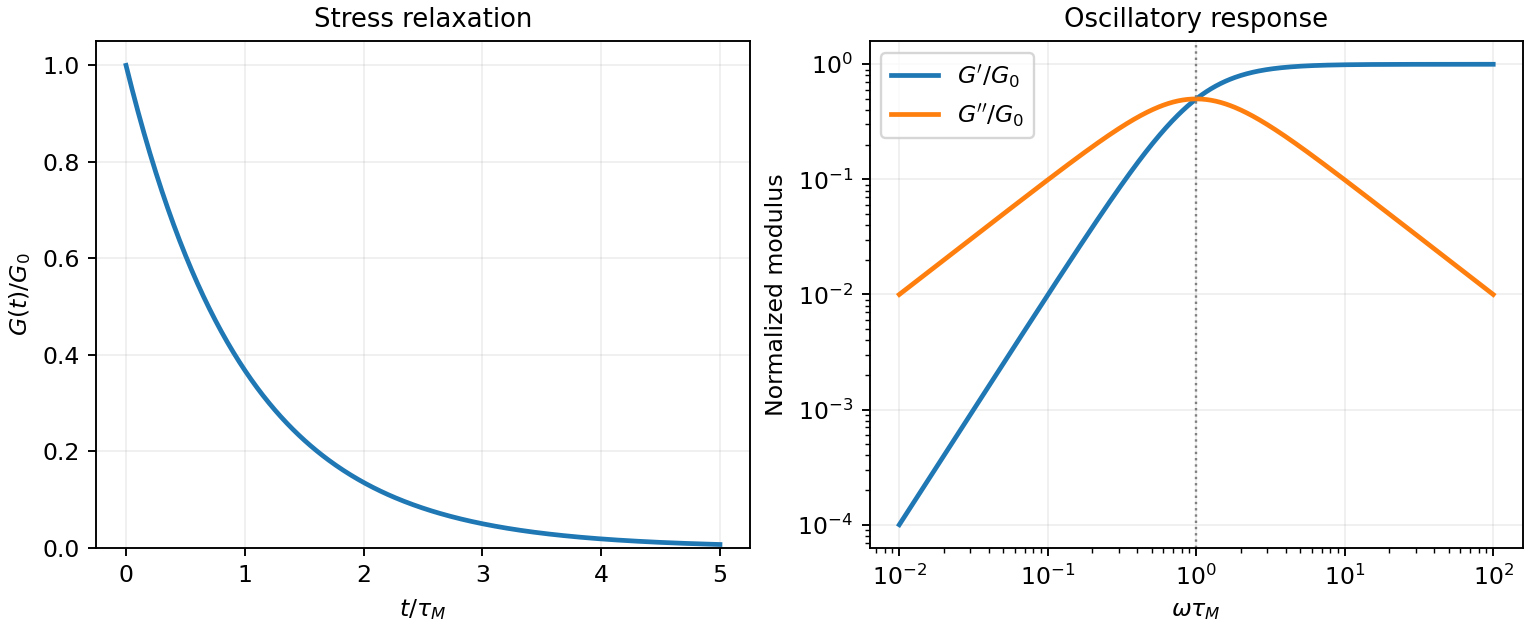
Original normalized Maxwell relaxation and frequency response
. Details. 
DLVO theory adds attractive Van der Waals forces and electric double layer repulsion to obtain an effective colloid pair potential. For two identical spheres of radius at a surface gap , a useful schematic form isHere is the Hamaker constant. For a symmetric monovalent electrolyte with number density of each ionic species, . The exponential is a simplified screened repulsion; its amplitude depends on electric potential at the surface, charge regulation and geometry. Constant-charge and constant-potential boundary conditions need not produce the same close-approach law.
A primary attractive minimum near contact may be separated from dispersed configurations by an energy barrier; a shallower secondary minimum can produce loose reversible aggregation. A barrier much larger than can give long-lived kinetic stabilization without making the dispersed state the global free-energy minimum. Adding salt shortens the Debye–Hückel screening length and can lower the barrier, allowing colloidal coagulation. Changing pH can alter surface ionization, so screening alone does not determine stability.
One can vary salt concentration while holding particle concentration, temperature and pH fixed, then follow particle aggregation using light scattering or microscopy. A solvent-only control and an independently measured surface-charge indicator help distinguish a change of screening from adsorption or charge reversal. Classical DLVO theory omits steric stabilization, hydration forces and strong ionic correlations; the formal attraction diverging at contact is cut off by molecular-scale physics.
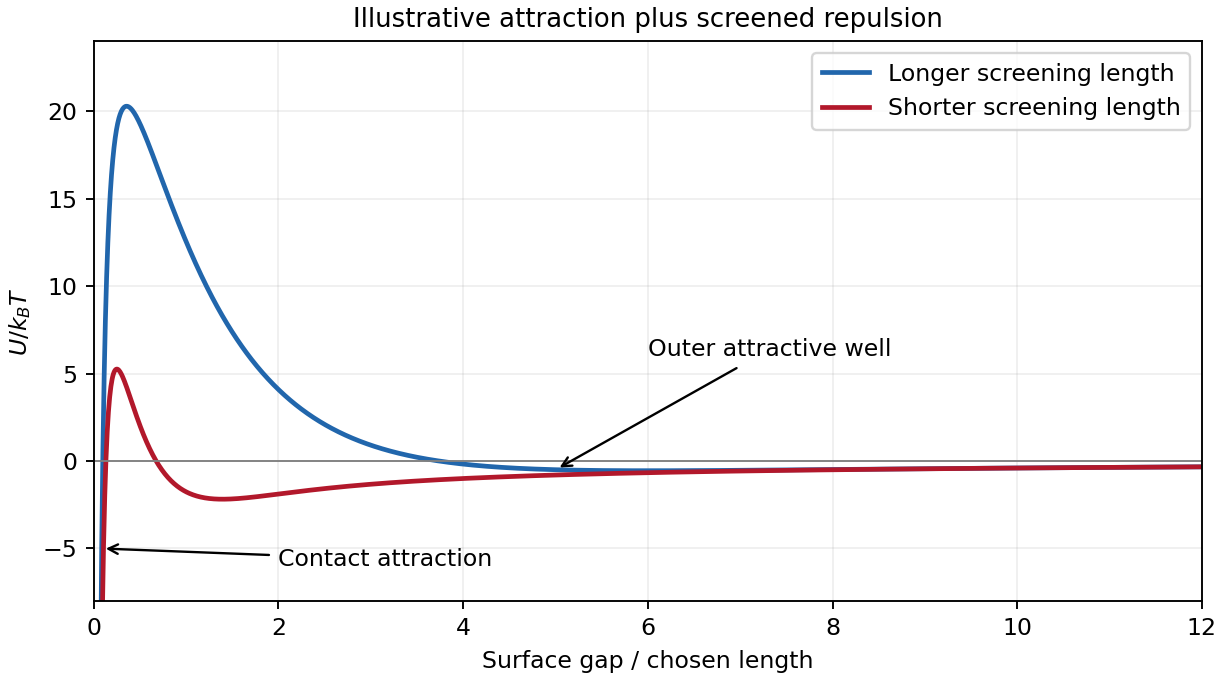
Original schematic pair potentials showing how a shorter screening length lowers a repulsive barrier
. Details. 
The coil-globule transition is the contraction of an isolated flexible polymer as solvent quality worsens. A swollen chain in a good solvent has size in the Flory approximation. At the theta temperature the effective two-segment excluded volume vanishes and . A poor solvent favors a dense polymer globule, with at fixed internal density.
The competition is visible in the scaling free energyFor , elastic cost balances two-segment repulsion to give the swollen-coil law. At , three-segment repulsion stabilizes ideal-chain scaling; for , attraction balanced by the positive three-segment term gives . The dense polymer globule also has an interfacial free energy. The scaling expression explains regimes, not all fluctuation corrections or a detailed finite-chain transition curve. A finite chain crosses over smoothly; the sharp theta-point limit refers to indefinitely long chains.
A dilute-solution light-scattering experiment can follow radius of gyration while changing temperature or solvent composition. Measure at several concentrations and extrapolate toward isolated chains; check molecular-weight distribution, reversibility and the absence of growing multi-chain aggregates. dynamic light scattering measures hydrodynamic size, which is related to but distinct from radius of gyration. A falling scattering-derived size accompanied by a rising aggregate population cannot by itself establish single-chain collapse. solvent quality controls conformation through the balance of segment interactions and conformational entropy.
Articles by others on the same topic
There are currently no matching articles.