Original paper: Public original, physical PDF pages 270–273.
TODO: user-deferred biological application. The organism-specific comparison and its three requested rescalings are intentionally left unsolved.
The tension is supplied by Stokes drag on the free bead. With bead radius , the stipulated isolated-sphere approximation givesThe trap also balances drag on the trapped bead, but that bead's drag is not an additional force transmitted through the chain. The polymer contour length is . TODO: no numerical temperature is specified for this part; the following temperature-dependent expressions are the results, and is an explicitly chosen room-temperature illustration.
For a theta solvent, Gaussian chain elasticity gives and henceThis is the mean extension along the force, rather than the unforced end-to-end distance of a polymer chain . At , ; the finite-link freely jointed chain result is , close to the Gaussian estimate.
The good-solvent force-extension scaling changes the elasticity. In the tensile blob regime, a blob has size , contains segments, and the aligned string of blobs has lengthOnly the scaling and order of magnitude of the good-solvent value are determined: solvent-dependent swelling amplitudes are not supplied. The nonlinear force law is the essential correction to extrapolating a weak-force coil spring.[ref]
Excluded Volume Effects and Stretched Polymer Chains by Philip Alan Pincus. abstract and section I, p. 386: strongly elongated good-solvent chain and restoring force proportional to extension to the power 3/2
To expose the unrealistic extrapolation, the unforced good-solvent size estimate is . Treating this coil as a linear spring with spring constant predicts at , although its required condition fails by a factor of about . Dropping the order-one factor three, as in the rough estimate , even gives . An extension beyond the polymer contour length is an artefact of extending the coil's linear response outside its range. The tensile blob estimate avoids that violation but here and , so it is only marginally within a many-segment-blob regime. finite extensibility of a polymer chain, chain drag and flow disturbance by both large beads further limit quantitative realism. The specified neglect of chain drag is a model assumption, not evidence that it is physically negligible.
For a symmetric Flory-Huggins polymer blend, the mixing free energy per lattice site isThe critical conditions and give and . ThereforeSince , heating improves miscibility: this is an upper critical solution temperature in the stipulated model. The very high value is an extrapolation of the supplied interaction-parameter fit, not evidence that an intact experimental blend can be brought reversibly to this temperature; chemical stability and the fitted temperature range must be checked before interpreting it as an accessible transition.
At , and , well into strong segregation. For the polymer-blend interface width, state the convention explicitly. In the equal-segment, long-chain square-gradient approximation,Its first integral gives , soThe inverse-central-slope width is consequentlyA convention calling the hyperbolic-tangent scale itself the width instead quotes ; these describe the same profile. The predicted interface spans only a few statistical segments, so the continuum approximation for gradients is quantitatively marginal. Intrinsic composition width and experimentally broadened width also differ because roughness and finite spatial resolution can broaden a measured profile.
A viscoelastic material stores part of the deformation energy and dissipates part of it. In linear viscoelasticity, a small imposed shear strain produces a stress determined by its history, . A shear step probes stress relaxation; a stress step probes creep compliance. A purely elastic solid has persistent stress after a held strain, while a Newtonian fluid relaxes that stress and creeps continuously under constant stress.
For a Maxwell model, a spring of shear modulus and a dashpot of viscosity are in series:For the convention ,The storage modulus dominates at short times or high frequencies; the loss modulus dominates at long times or low frequencies. The energy dissipated per cycle per volume is . A Kelvin-Voigt model places spring and dashpot in parallel and instead gives bounded creep : a simple illustration of a viscoelastic solid. Real materials can require a spectrum of relaxation times rather than one element.
A small-amplitude oscillatory rheometer measures stress amplitude and phase relative to imposed strain, giving and . First sweep strain amplitude to identify the linear range; control temperature, sample ageing, wall slip and instrument inertia. Frequency-dependent phase lag alone is insufficient if these apparatus effects are unresolved.
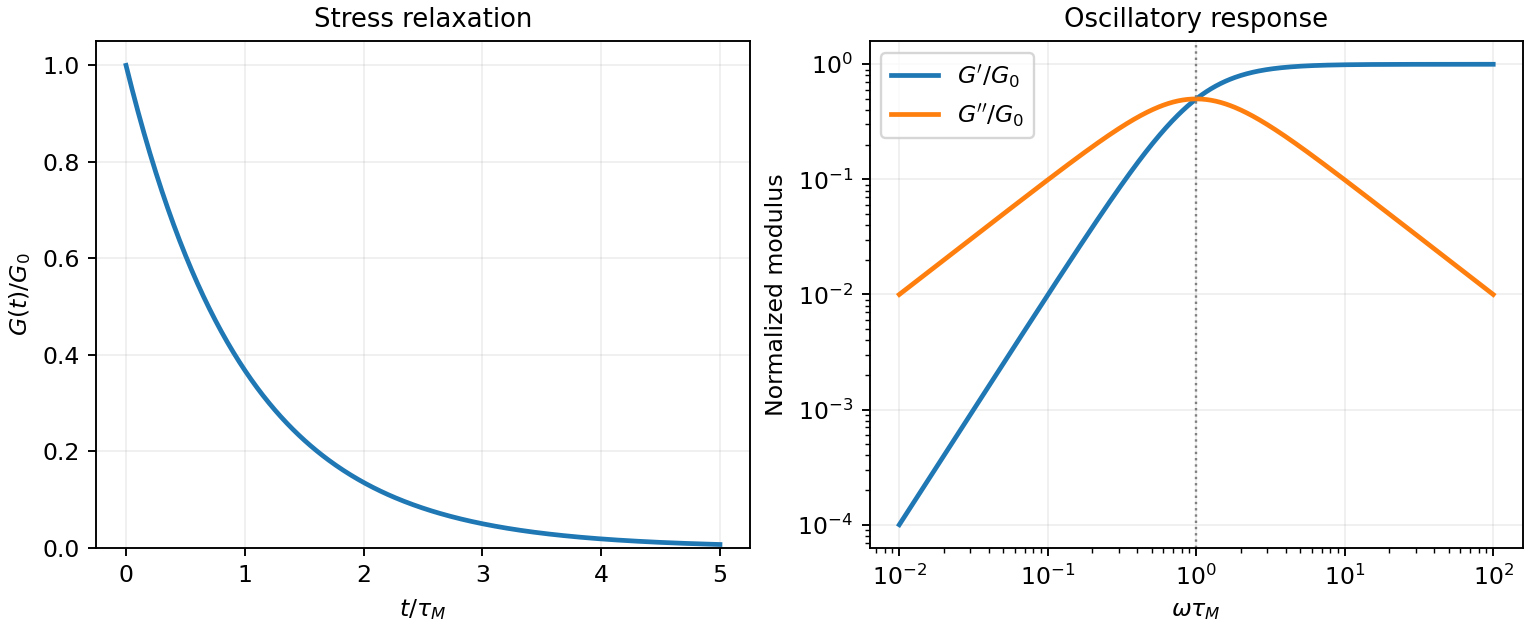
Original normalized Maxwell relaxation and frequency response
. Details. DLVO theory adds attractive Van der Waals forces and electric double layer repulsion to obtain an effective colloid pair potential. For two identical spheres of radius at a surface gap , a useful schematic form isHere is the Hamaker constant. For a symmetric monovalent electrolyte with number density of each ionic species, . The exponential is a simplified screened repulsion; its amplitude depends on electric potential at the surface, charge regulation and geometry. Constant-charge and constant-potential boundary conditions need not produce the same close-approach law.
A primary attractive minimum near contact may be separated from dispersed configurations by an energy barrier; a shallower secondary minimum can produce loose reversible aggregation. A barrier much larger than can give long-lived kinetic stabilization without making the dispersed state the global free-energy minimum. Adding salt shortens the Debye–Hückel screening length and can lower the barrier, allowing colloidal coagulation. Changing pH can alter surface ionization, so screening alone does not determine stability.
One can vary salt concentration while holding particle concentration, temperature and pH fixed, then follow particle aggregation using light scattering or microscopy. A solvent-only control and an independently measured surface-charge indicator help distinguish a change of screening from adsorption or charge reversal. Classical DLVO theory omits steric stabilization, hydration forces and strong ionic correlations; the formal attraction diverging at contact is cut off by molecular-scale physics.
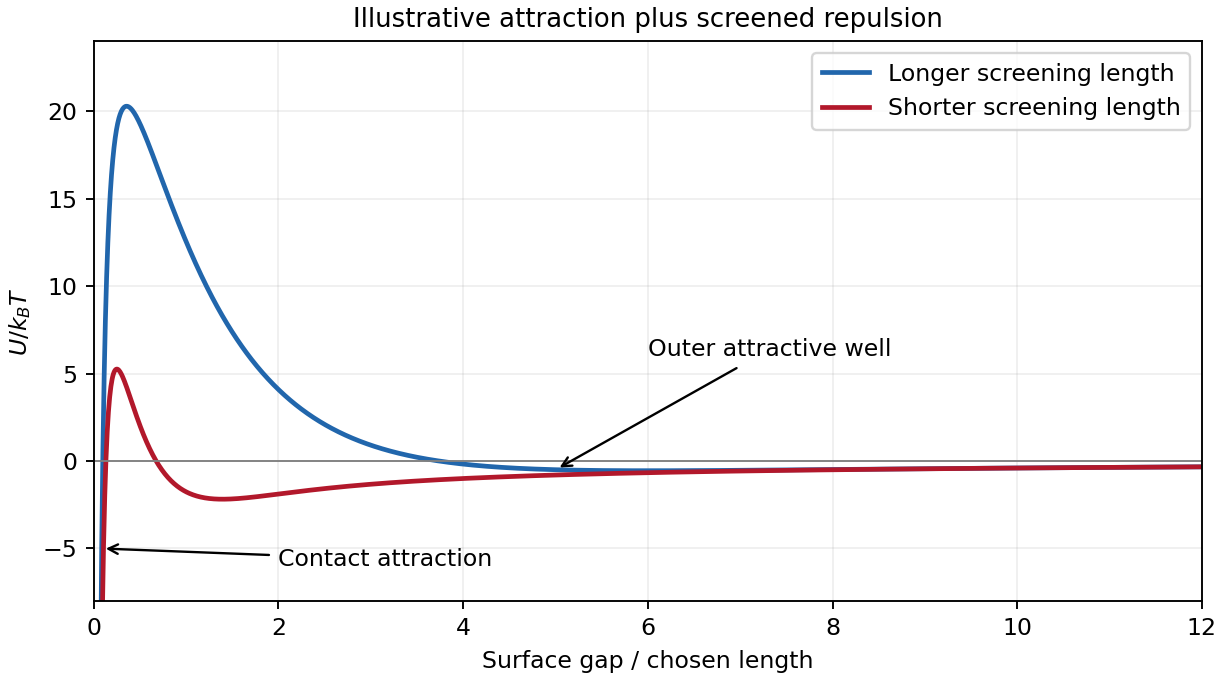
Original schematic pair potentials showing how a shorter screening length lowers a repulsive barrier
. Details. The coil-globule transition is the contraction of an isolated flexible polymer as solvent quality worsens. A swollen chain in a good solvent has size in the Flory approximation. At the theta temperature the effective two-segment excluded volume vanishes and . A poor solvent favors a dense polymer globule, with at fixed internal density.
The competition is visible in the scaling free energyFor , elastic cost balances two-segment repulsion to give the swollen-coil law. At , three-segment repulsion stabilizes ideal-chain scaling; for , attraction balanced by the positive three-segment term gives . The dense polymer globule also has an interfacial free energy. The scaling expression explains regimes, not all fluctuation corrections or a detailed finite-chain transition curve. A finite chain crosses over smoothly; the sharp theta-point limit refers to indefinitely long chains.
A dilute-solution light-scattering experiment can follow radius of gyration while changing temperature or solvent composition. Measure at several concentrations and extrapolate toward isolated chains; check molecular-weight distribution, reversibility and the absence of growing multi-chain aggregates. dynamic light scattering measures hydrodynamic size, which is related to but distinct from radius of gyration. A falling scattering-derived size accompanied by a rising aggregate population cannot by itself establish single-chain collapse. solvent quality controls conformation through the balance of segment interactions and conformational entropy.
Write for the number of grafted chains per unit area and for its dimensionless form; this separates the physical grafting density from a dimensionless coverage. A free dilute chain has size , with in a theta solvent and approximately in a good solvent. An isolated end-grafted chain loses translations and configurations that cross the substrate, but retains the same leading size exponent if the surface is nonadsorbing. When the lateral graft spacing exceeds , the layer consists of polymer mushrooms. When coils overlap, crowding stretches the chains away from the surface into a polymer brush.
The polymer mushroom-to-brush crossover isFor the stipulated statistical-segment interpretation of and , the scaling estimates areThus and respectively. The numerical constants are scaling conventions: using a radius of gyration rather than an end-to-end size changes order-one amplitudes, not the powers of .
In the Alexander-de Gennes brush model, take blobs of lateral size . Within a blob, ; beyond it, the blobs are aligned away from the wall. ThusWith coarse-grained segment volume , conservation gives the polymer-brush volume fraction through , henceThe theta-solvent brush height includes three-segment repulsion even though the effective two-segment interaction vanishes. These are scaling estimates for a roughly uniform brush, not an assertion that every chain end lies at the same height in an actual brush.
The many-segment-blob requirement gives , or . Together with overlap, the regime is . At the dense-brush packing limit, , and . Here and . If one formally continues a dense incompressible layer above this boundary, conservation would instead giveThis is the requested formal dense-layer expression, but for it gives , which violates finite extensibility of a polymer chain. There is no physically admissible continuation above this limit in the stated segment-volume model. A Kuhn length segment is not necessarily a cube of material: with an independently specified material volume per counted segment, the dense-layer law is , and the packing bound is . The data do not determine separately. The simple model therefore establishes its own breakdown, rather than a universal microscopic maximum grafting density.
grafting-to uses preformed chains whose lengths and dispersities can be characterized before attachment. As coverage rises, each incoming coil must penetrate a crowded brush and lose conformational entropy to bring its end to the surface; the growing insertion barrier limits achievable coverage. grafting-from supplies small monomers to surface-bound growing chains and avoids insertion of a whole coil. Choose grafting-from for high grafting density. Initiator coverage and reaction control still matter, and inaccessible active sites, termination and unequal growth can broaden the resulting chain-length distribution. Neither route removes the elastic and packing costs of the final brush.
A generic application is steric stabilization of synthetic colloids in a good solvent. Bringing coated particles together compresses and interpenetrates their brushes, increasing osmotic pressure and conformational free-energy cost. This repulsion can oppose aggregation. The chains must remain attached and sufficiently cover the surface; poor-solvent collapse, sparse coverage or interparticle bridging can defeat stabilization.
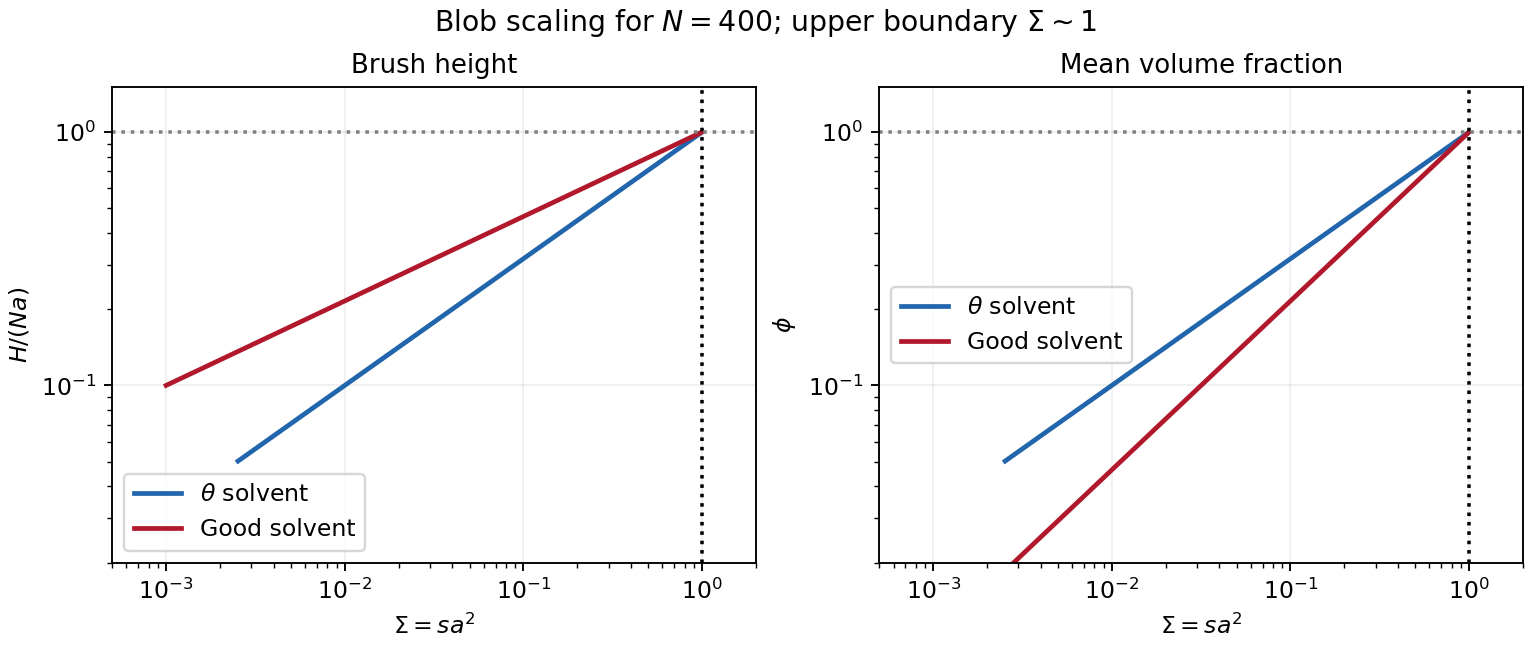
Original brush-height and volume-fraction scaling, showing the segment-packing limit
. Details. Use the Monge representation for a single-valued surface without overhangs. Its area element is ; at small slopes, and twice the mean curvature is , up to orientation sign. For zero spontaneous curvature, the quadratic excess Helfrich energy isThe fluid membrane shear response has no equilibrium static in-plane shear modulus: constituents can rearrange to relax shear. Bending and isotropic tension still cost energy; viscous shear stresses can matter during motion. A Gaussian curvature term is omitted under the stated approximation; for fixed closed-surface topology its integral is constant, but boundaries and topology changes require care. The small-slope Monge expression describes weak deformations, not an entire fully wrapped sphere.[ref]
Elastic Properties of Lipid Bilayers: Theory and Possible Experiments by Wolfgang Helfrich. section II.C, equation (12), p. 695: curvature-elastic energy; only the generic continuum mechanics is used here
For spherical-particle wrapping by a fluid membrane, integrate the spherical area element from polar angle to :Its footprint radius is , soFor a spherical surface , making the bending cost . adhesion contributes , and tension contributes . ThereforeAll three contributions are energies; and are dimensionless. This is the specified bound-patch model: deformation of the free membrane and the neck is omitted.
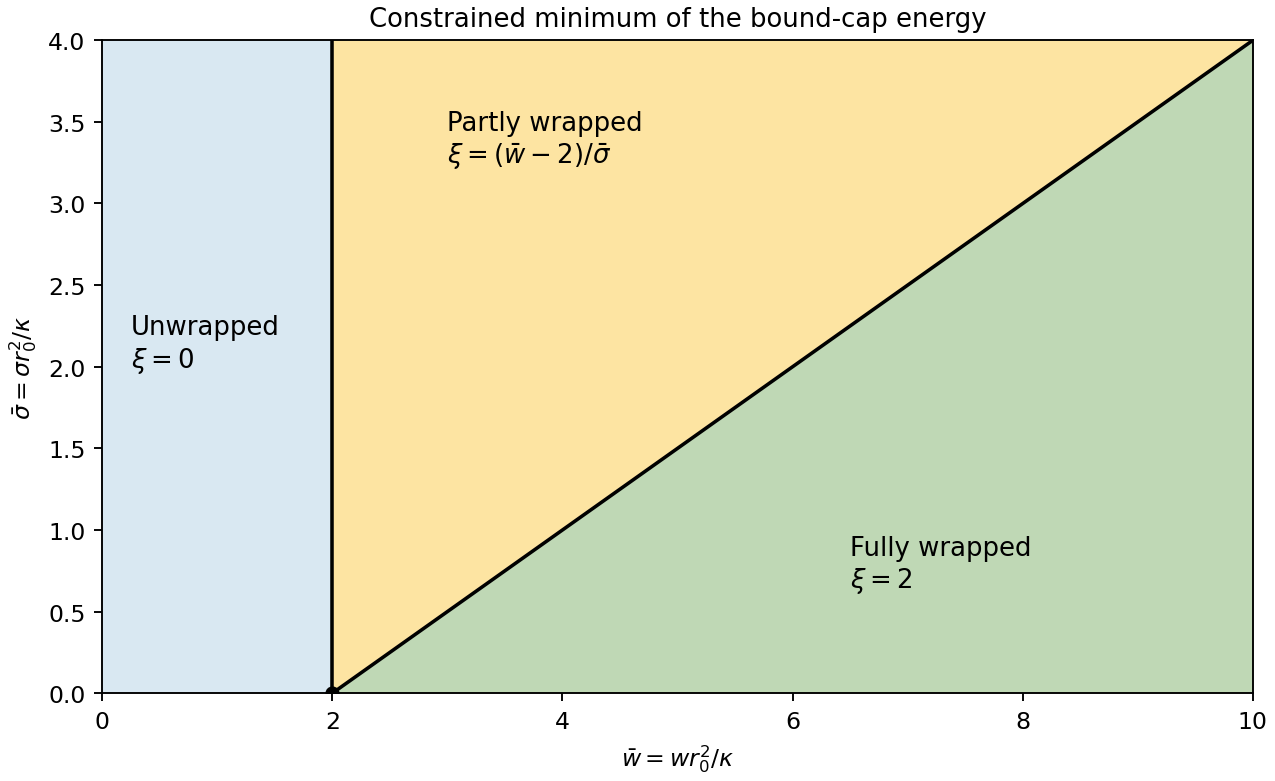
The allowed interval corresponds to no adhesion, partial wrapping and full wrapping. At , the cap covers a whole sphere and its footprint shrinks to zero. This is a closed neck in the geometric limit. It does not by itself prove membrane scission: creating a detached enclosure changes topology and involves neck physics absent from this energy.
For positive membrane tension, . Projecting the unconstrained minimum onto the allowed interval givesThe tension-dependent wrapping phase diagram boundaries are and . At zero membrane tension, the energy is linear: the minimum jumps from to as crosses , while all indentation values are degenerate at . Negative membrane tension is outside the stable-flat-membrane interpretation used here. Increasing membrane tension makes the excess area required for wrapping more expensive, broadening the partially wrapped region.


Articles by others on the same topic
There are currently no matching articles.