The critical micelle concentration is the approximate surfactant concentration above which added amphiphile predominantly joins micelles. Isolated amphiphiles expose their tails to the surrounding solvent; aggregation can reduce the unfavorable exposure, while losing translational entropy and incurring head-group and chain-packing costs. The favored aggregate minimizes the total free energy.
A mass-action model of micellization makes the concentration dependence explicit. For aggregation of monomers into one micelle, equilibrium requiresThe dimensionless thermodynamic activities therefore obeyFor a large aggregation number , a modest increase in monomer activity produces a steep increase in micelle abundance. In an ideal dilute approximation with the same reference concentration for both species, the amphiphile balance isWell below the crossover almost every amphiphile is isolated. Above it, most additional amphiphile enters micelles, so the free-monomer concentration rises only slowly. It is not exactly constant for a finite , and a small aggregate population can exist below the nominal critical micelle concentration. The experimentally sharp change is an association crossover, not an assertion that aggregation is absolutely absent below one concentration.
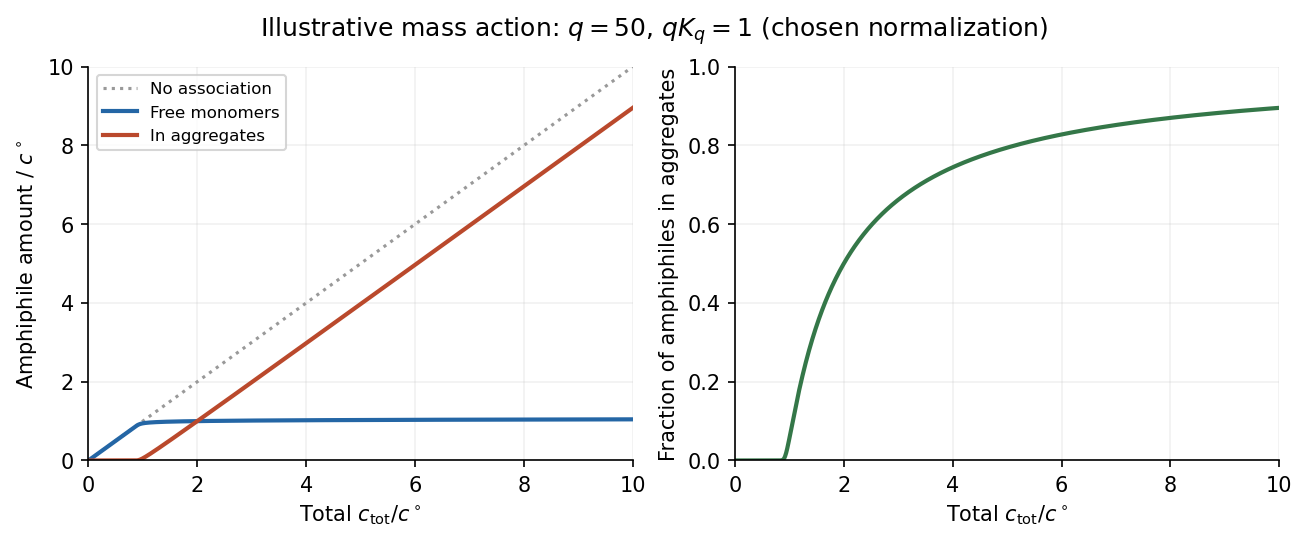

In the original illustrative model, and after choosing the arbitrary reference concentration. The normalization is a teaching choice, not a measured critical micelle concentration. The monomer curve flattens relative to total concentration, while the aggregated fraction rises rapidly.
An experimental critical micelle concentration can be estimated from a change of slope in surface tension against the logarithm of total surfactant concentration, as interfacial coverage approaches saturation and bulk aggregation becomes important. Changes in electrical conductivity for ionic surfactants, or in light scattering, supply other probes. Different observables can give slightly different operational values because the crossover has finite width. Molecular structure, temperature and ionic conditions affect the balance of chemical potentials; screening charged head groups can reduce repulsion and favor aggregation, but no universal sign of the temperature dependence should be assumed.
Articles by others on the same topic
There are currently no matching articles.