TODO: user-deferred biology. The bacterial-motion application is deferred. The following covers the Reynolds number and its general fluid-mechanical implications.
The Reynolds numbercompares advective inertia with viscous force on a specified length scale and velocity scale . Here is fluid mass density, is dynamic viscosity and is kinematic viscosity. In the Navier-Stokes equation, advective acceleration scales as , while the viscous term per unit mass scales as ; their ratio is Reynolds number.
When and unsteady fluid inertia is also negligible, the incompressible flow equations reduce to Stokes flow:Thus pressure, applied body forces and viscous stresses balance at each instant. For a translating rigid sphere, drag is proportional to velocity, , rather than the inertial scale . Given the same instantaneous geometry, reversing the imposed boundary velocities reverses the Stokes flow; there is no fluid-inertial coasting in this approximation. This statement concerns the fluid limit and does not discard a separately significant particle inertia.
A low steady Reynolds number alone does not justify dropping rapid unsteady acceleration. For forcing frequency , the additional dimensionless ratio is . No organism-specific sizes, velocities or propulsion mechanism are assumed here.
The Flory interaction parameter measures the excess cost of unlike segment contacts. In a simple lattice with coordination number , contact energies and temperature ,A positive Flory interaction parameter penalizes unlike contacts; a negative value favors them. Mixing still depends on the balance with entropy of mixing, rather than the sign of alone.
For two polymers of degrees of polymerization , let be the volume fraction of species . The binary Flory-Huggins polymer blend has mixing free energy per lattice siteThe logarithmic terms favor mixing. Their factors and arise because an entire chain translates as one object; connecting many segments greatly reduces the mixing entropy per segment. Hence long polymers can demix for a much smaller positive Flory interaction parameter than small molecules.
For composition-independent , the local stability criterion isPositive curvature means stability to small composition fluctuations, zero curvature locates the spinodal, and negative curvature means spontaneous growth of fluctuations. Actual two-phase coexistence is determined by the common-tangent construction, or equality of both species' chemical potentials; its boundary is the binodal. A locally stable but globally unfavourable homogeneous mixture can lie between the binodal and spinodal.
Setting the second and third derivatives of to zero givesFor the symmetric Flory-Huggins polymer blend, and . For a polymer solution with and long chains of species , , consistent with the theta solvent limit. An effective Flory interaction parameter can depend on temperature and composition; in the simple energetic case , heating encourages mixing, but that temperature trend is not universal.
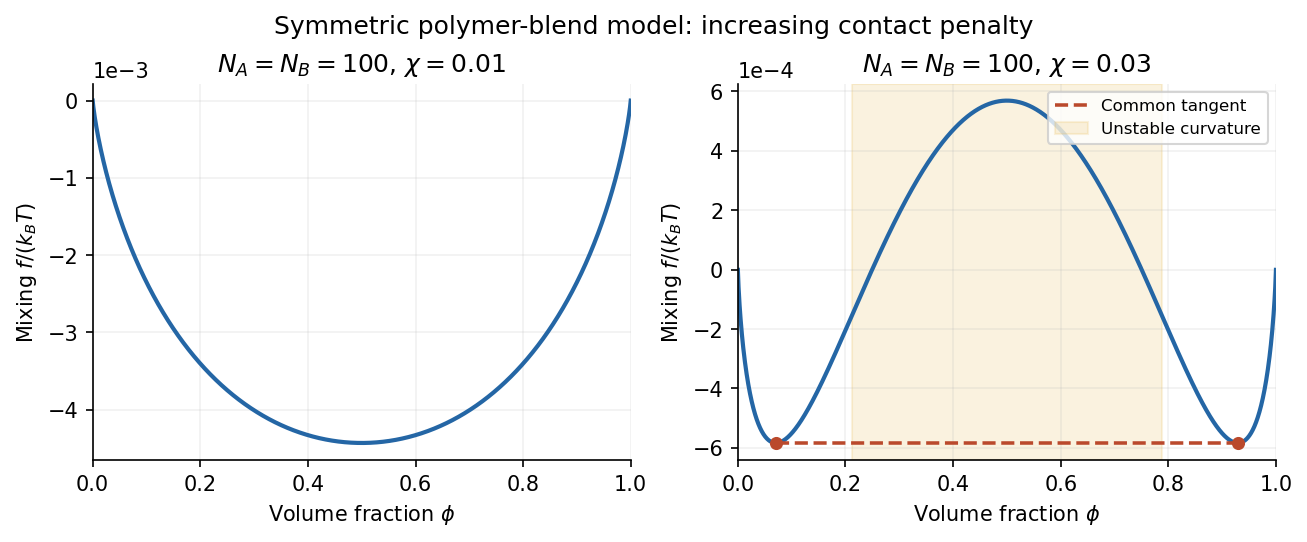
The original illustration uses stipulated . At the mixing free energy is convex, whereas at a central unstable region appears. The horizontal common-tangent construction in the latter case joins the symmetric coexisting compositions; its contacts differ from the spinodal boundaries. These are model curves, not supplied experimental data.
The critical micelle concentration is the approximate surfactant concentration above which added amphiphile predominantly joins micelles. Isolated amphiphiles expose their tails to the surrounding solvent; aggregation can reduce the unfavorable exposure, while losing translational entropy and incurring head-group and chain-packing costs. The favored aggregate minimizes the total free energy.
A mass-action model of micellization makes the concentration dependence explicit. For aggregation of monomers into one micelle, equilibrium requiresThe dimensionless thermodynamic activities therefore obeyFor a large aggregation number , a modest increase in monomer activity produces a steep increase in micelle abundance. In an ideal dilute approximation with the same reference concentration for both species, the amphiphile balance isWell below the crossover almost every amphiphile is isolated. Above it, most additional amphiphile enters micelles, so the free-monomer concentration rises only slowly. It is not exactly constant for a finite , and a small aggregate population can exist below the nominal critical micelle concentration. The experimentally sharp change is an association crossover, not an assertion that aggregation is absolutely absent below one concentration.
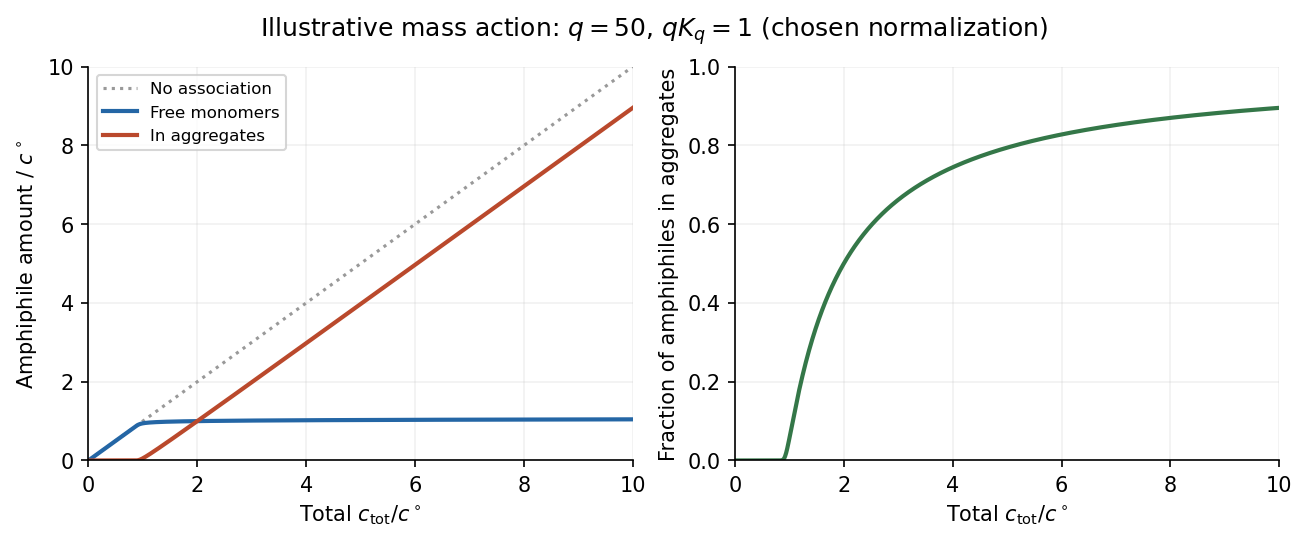


In the original illustrative model, and after choosing the arbitrary reference concentration. The normalization is a teaching choice, not a measured critical micelle concentration. The monomer curve flattens relative to total concentration, while the aggregated fraction rises rapidly.
An experimental critical micelle concentration can be estimated from a change of slope in surface tension against the logarithm of total surfactant concentration, as interfacial coverage approaches saturation and bulk aggregation becomes important. Changes in electrical conductivity for ionic surfactants, or in light scattering, supply other probes. Different observables can give slightly different operational values because the crossover has finite width. Molecular structure, temperature and ionic conditions affect the balance of chemical potentials; screening charged head groups can reduce repulsion and favor aggregation, but no universal sign of the temperature dependence should be assumed.
Articles by others on the same topic
There are currently no matching articles.