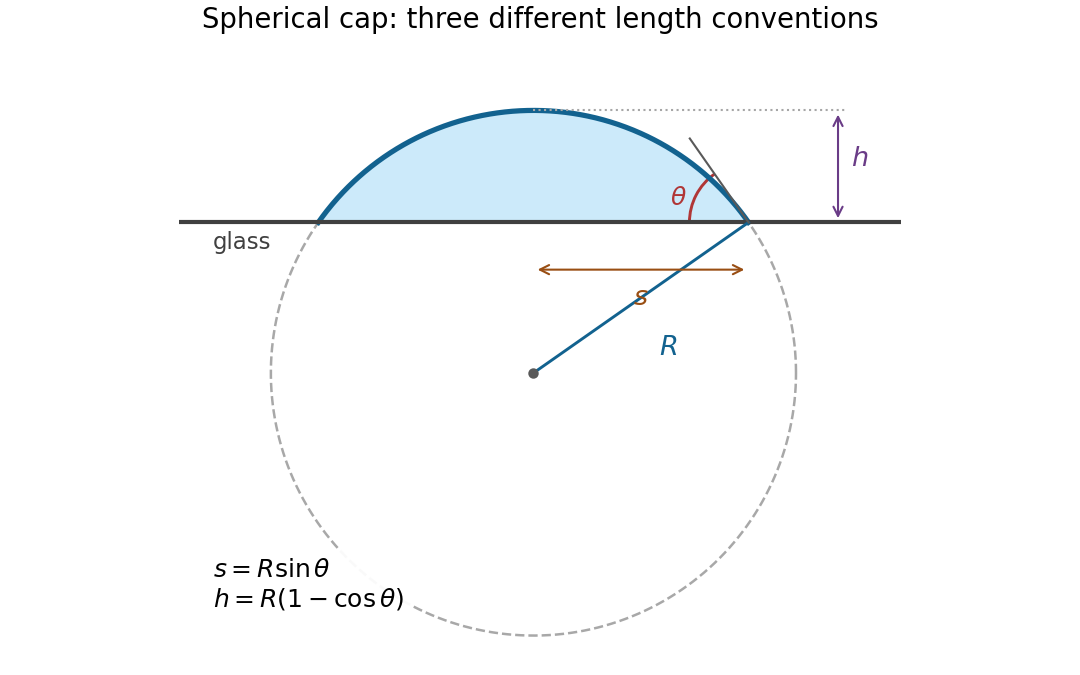
The relevant comparison is between gravity and surface tension. With the mass density difference , the Bond number and capillary length areThus the drop is small compared with the capillary length; hydrostatic pressure variations only weakly perturb its shape. The Young–Laplace equation then gives approximately constant interfacial mean curvature, and an axisymmetric drop on a uniform flat substrate is a spherical cap. The substrate selects the contact angle, measured through the water.
Write for the radius of the generating sphere, for the contact-circle radius, and for the apex height. Elementary trigonometric identities giveTaking the stated droplet radius to mean its radius of curvature, , givesThere is no diagram or explicit radius convention in the original PDF. If instead denotes the contact-circle radius, the answer is . If it denotes the radius of an equal-volume free sphere, use the volume of a spherical cap, , to obtain . The spherical cap approximation is justified in all three conventions; a unique numerical height requires specifying which radius is meant.

By definition, the relaxation modulus is the stress generated by a unit step of strain from an initially relaxed state. Set , where is the Heaviside step function, and write . Integrating the linear ordinary differential equation across the step shows that neither nor can jump: a jump would produce a Dirac delta function or its derivative, absent from the forcing. Hence .
For , a particular solution is . The characteristic equation factors asso . The initial conditions give and , whenceThe time and modulus units are those implicit in the printed coefficients. A Laplace transform check gives .
The original PDF really does put undifferentiated strain on the right-hand side. The resulting response rises from zero to one, with , rather than exhibiting ordinary stress relaxation. There is a stronger physical problem if this is intended as a passive material law: with the convention the stress-to-strain amplitude ratio isThe loss modulus would give negative cycle-averaged supplied power , contrary to passivity in linear viscoelasticity. The boxed expression is therefore the formal relaxation modulus of the equation as printed, not a claim that this equation describes an ordinary passive viscoelasticity model. No derivative of the input has been silently inserted.
Treat the liposome using the usual incompressible-tail packing model of a lipid bilayer: neglect the head-group thickness and let be the volume filling the hydrophobic part of the lipid vesicle. Both membrane leaflets have area per head group. Put , and let be the unknown outer radius. Counting molecules from the inner and outer surface areas givesEquating the total molecular volume to the volume of the spherical shell therefore givesTo prove uniqueness in the physical domain , defineIts derivative isAlso and as . By continuity and strict monotonicity, has exactly one solution with . This proves the required uniqueness without choosing among ambiguous branches of a cubic formula.
The maximum tail length is a physical admissibility bound, not automatically the actual leaflet thickness. If is the radius where the two tail regions meet, separate membrane leaflet volume balances giveThe unique candidate must satisfyIn particular is necessary. The premise that a lipid vesicle has assembled supplies this compatibility: arbitrary positive choices of need not allow any such lipid bilayer. For a very large vesicle the two thicknesses tend to , so . Setting the thickness equal to for every molecule would confuse maximum extension with actual packing. The volume-balance argument and its domain are an example of uniqueness of the packed spherical bilayer radius.
Articles by others on the same topic
There are currently no matching articles.