The generic instrument uses a magnetically responsive bead, a controllable external field and optical tracking of bead position or orientation. A field gradient supplies translational force; rotating an appropriate anisotropic field or bead moment can supply torque. For a permanent dipole,For an isotropic unsaturated induced moment with effective susceptibility contrast and bead volume , the induced magnetic bead force instead follows fromThe factor one-half accounts for inducing the moment. A spatially uniform field alone supplies no translational force; an isotropic induced moment parallel to the field supplies no orienting torque either. Saturation or magnetic anisotropy requires the corresponding magnetization model.
Position tracking needs a length calibration, and force calibration needs measured field gradients, a known reference load, or calibrated thermal fluctuations. For a generic tensioned tether of extension , small transverse displacement costs energy , so under equilibrium, small-angle and single-mode assumptions. Attachment geometry, bead rotation, wall drag and finite acquisition bandwidth can affect this calibration. These equations describe generic magnetic tweezers mechanics, without assigning a biological response.
TODO: biological single-molecule applications are user-deferred; no biological systems or protocols have been researched or solved.
Fluctuation-induced forces arise because separation changes the fluctuations available to a system and therefore changes its free energy. The force is at fixed relevant control variables, not necessarily a force from a permanent charge or dipole.
For two neutral polarizable particles, correlated electromagnetic fluctuations give a short-distance dispersion attraction of the form . Retardation changes the asymptotic distance dependence. Boundaries produce a related Casimir force; for parallel ideal conducting plates at zero temperature,The negative pressure denotes attraction. Material response, nonplanar geometry and finite temperature alter the ideal result. The effect can be described through the separation-dependent electromagnetic mode spectrum rather than by treating a divergent absolute vacuum energy as observable.[ref]
Quantum Field Theory by David Tong. Section2.3.2: Casimir effect and boundary-dependent fluctuation energy
In a classical depletion force, smaller particles or polymer coils are excluded from a region near larger surfaces. Overlap of excluded regions increases their available volume. For ideal dilute depletants of osmotic pressure , ; the resulting attraction is entropic and scales with temperature. Confined interface fluctuations can instead generate repulsion when close approach removes entropy. Near a continuous phase transition, a large correlation length makes boundary-conditioned order-parameter fluctuations produce a critical Casimir force. Its sign depends on the boundary preferences, so fluctuation forces are not universally attractive.
The useful common idea is a free-energy difference with explicit boundary conditions; quantum vacuum, thermal field and excluded-volume mechanisms have different physical fluctuations and different ranges.
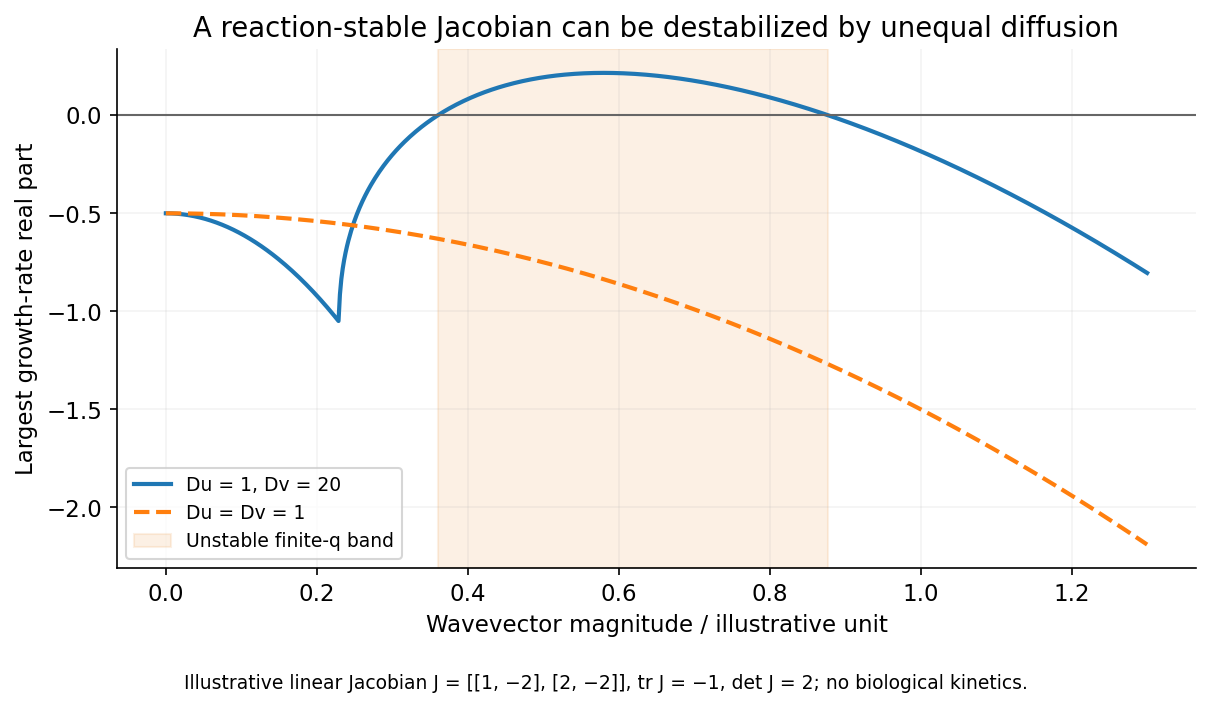
A generic chemical reaction–diffusion system couples local kinetics to spatial transport:A homogeneous stationary state satisfies . Let its reaction Jacobian be . Local well-mixed stability requires and . A Fourier perturbation of wavevector magnitude evolves under , whose determinant isSince its trace remains negative, a diffusion-driven stationary instability appears if the determinant becomes negative for some allowed wavevector. In a spatially large domain the conditions areTogether with reaction-only stability, these give a finite unstable wavelength range. Equal diffusion coefficients cannot generate this instability: they simply shift each reaction eigenvalue by . On a finite domain, an admissible spatial eigenmode must actually lie in the unstable band. Nonlinearities then determine saturation and whether a predicted pattern is stable, so a linear unstable band alone does not calculate a final pattern.[ref]
Other kinetics support travelling fronts or oscillatory waves rather than a stationary pattern. For instance, the scalar abstract equation has a pulled-front speed for a sufficiently steep invading initial profile. Here it is used as an abstract kinetics-and-diffusion example, without a biological interpretation. The ratio of diffusion time to reaction time characterizes whether spatial mixing is rapid enough to justify a well-mixed model.

Articles by others on the same topic
There are currently no matching articles.