Write and take to be the reservoir density of each monovalent ion species. Equal electrochemical potentials in equilibrium give the Boltzmann ion densities in a symmetric electrolyte,Combining this with the electrostatic Poisson equation gives the planar Poisson-Boltzmann equation,The Debye length is . If the symbol instead denotes the combined density of both species, the factor two is absent; the per-species convention above makes the normalization explicit. At , the linearized planar screening solution obeys . With and ,
The positive ions are counterions and the negative ions are co-ions. At weak potential,They approach from above and below respectively, with equal first-order excess and deficit. For stronger negative potential, interpret the source's strong-potential comparison as a statement about , since itself is negative. Counterions become strongly concentrated near the wall, while co-ions are exponentially depleted and remain nonnegative. Linearization misses this asymmetry and would eventually predict unphysical negative co-ion density. Point-ion mean-field theory itself eventually needs finite-size and correlation corrections; it provides no steric cap at arbitrarily large counterion concentration.
For steady tangential electro-osmosis, with no imposed pressure gradient and negligible inertia, the Stokes equation is . Since ,The conditions and giveThe printed constant speed is the bulk velocity outside the double layer, not the velocity at the no-slip wall. With negative the positive counterion excess drives fluid along the applied field. The far-field value is the Helmholtz-Smoluchowski electro-osmotic velocity.[ref]
Induced-Charge Electro-osmosis and Electrophoresis by Martin Z. Bazant. Section1,page1: diffuse charge, slip velocity and plug-flow limit
For the finite channel, first model the added wall as an ideally uncharged insulating boundary with no normal field on its outer side: , while . The one-charged-wall electro-osmotic channel then hasIntegrating the same force balance and enforcing givesFor , the maximum occurs atIn that limit : the velocity rises rapidly from zero at the charged wall, reaches a maximum a few screening lengths away, then falls approximately linearly to zero at the neutral wall. One charged wall does not give a symmetric plug across a channel with no-slip at the other wall.
An alternative electrode condition means a wall held at reservoir potential; it is not the same as zero surface charge. Under that convention,with . Both boundary conventions have the same leading thin-double-layer profile above. An externally imposed pressure gradient would add a pressure-driven profile; none is specified here.
For dilute nonadsorbing uncharged polymers in equilibrium or sufficiently weak flow, the entropic polymer depletion near nonadsorbing walls suppresses chain configurations near each wall. A depletion layer of order the coil radius of gyration is expected at both walls, with a bulk-like central region when is much larger than the coil size. Strong confinement rounds this into a central enrichment. Neutrality removes a direct electrophoretic force, not excluded-volume entropy. Adsorption, concentration and strong-flow migration were not specified, so this is a conditional equilibrium sketch rather than a universal flowing-polymer profile.
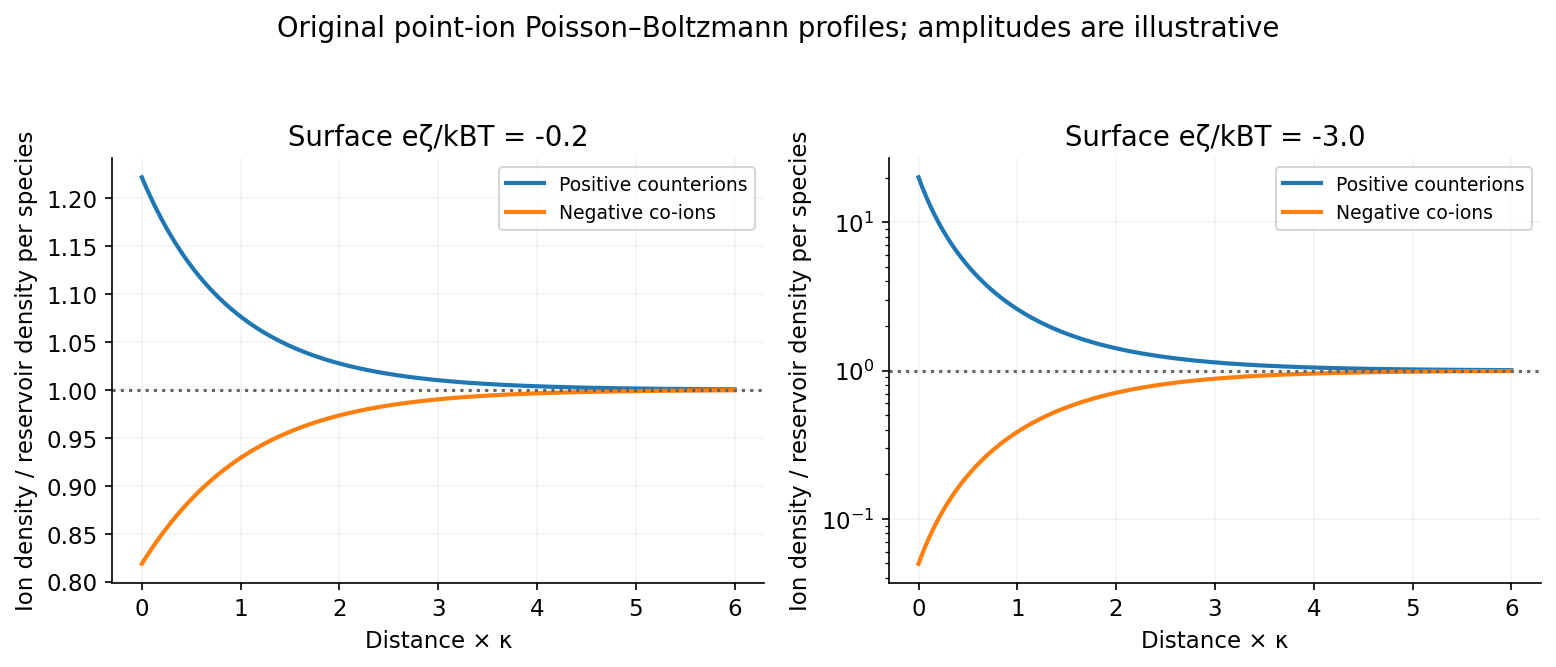
Weak screening gives symmetric first-order ion excess and deficit, while stronger potentials separate co-ion depletion from counterion accumulation
. Source. Details. 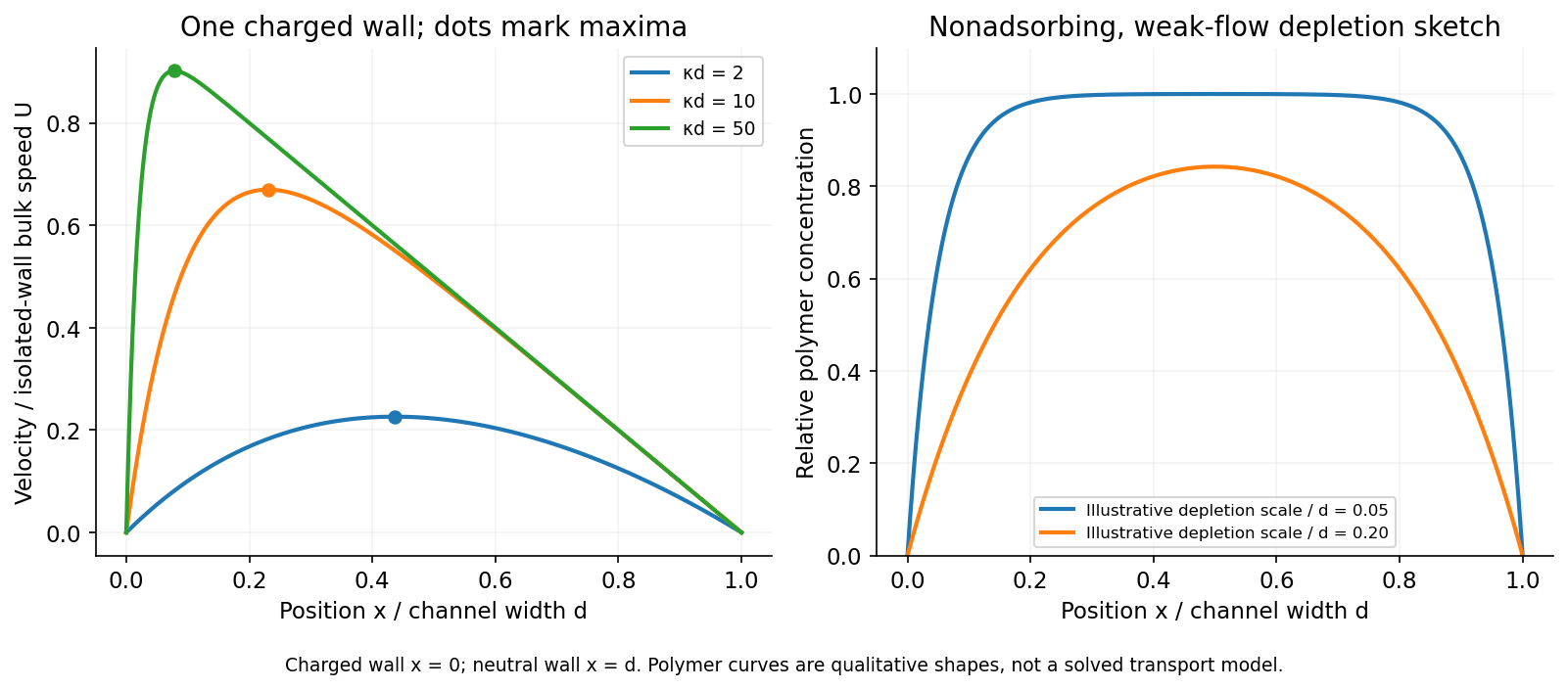
A channel driven at only one wall has an asymmetric velocity maximum; nonadsorbing polymer coils are depleted near either wall
. Source. Details. The generic instrument uses a magnetically responsive bead, a controllable external field and optical tracking of bead position or orientation. A field gradient supplies translational force; rotating an appropriate anisotropic field or bead moment can supply torque. For a permanent dipole,For an isotropic unsaturated induced moment with effective susceptibility contrast and bead volume , the induced magnetic bead force instead follows fromThe factor one-half accounts for inducing the moment. A spatially uniform field alone supplies no translational force; an isotropic induced moment parallel to the field supplies no orienting torque either. Saturation or magnetic anisotropy requires the corresponding magnetization model.
Position tracking needs a length calibration, and force calibration needs measured field gradients, a known reference load, or calibrated thermal fluctuations. For a generic tensioned tether of extension , small transverse displacement costs energy , so under equilibrium, small-angle and single-mode assumptions. Attachment geometry, bead rotation, wall drag and finite acquisition bandwidth can affect this calibration. These equations describe generic magnetic tweezers mechanics, without assigning a biological response.
TODO: biological single-molecule applications are user-deferred; no biological systems or protocols have been researched or solved.
Fluctuation-induced forces arise because separation changes the fluctuations available to a system and therefore changes its free energy. The force is at fixed relevant control variables, not necessarily a force from a permanent charge or dipole.
For two neutral polarizable particles, correlated electromagnetic fluctuations give a short-distance dispersion attraction of the form . Retardation changes the asymptotic distance dependence. Boundaries produce a related Casimir force; for parallel ideal conducting plates at zero temperature,The negative pressure denotes attraction. Material response, nonplanar geometry and finite temperature alter the ideal result. The effect can be described through the separation-dependent electromagnetic mode spectrum rather than by treating a divergent absolute vacuum energy as observable.[ref]
Quantum Field Theory by David Tong. Section2.3.2: Casimir effect and boundary-dependent fluctuation energy
In a classical depletion force, smaller particles or polymer coils are excluded from a region near larger surfaces. Overlap of excluded regions increases their available volume. For ideal dilute depletants of osmotic pressure , ; the resulting attraction is entropic and scales with temperature. Confined interface fluctuations can instead generate repulsion when close approach removes entropy. Near a continuous phase transition, a large correlation length makes boundary-conditioned order-parameter fluctuations produce a critical Casimir force. Its sign depends on the boundary preferences, so fluctuation forces are not universally attractive.
The useful common idea is a free-energy difference with explicit boundary conditions; quantum vacuum, thermal field and excluded-volume mechanisms have different physical fluctuations and different ranges.
A generic chemical reaction–diffusion system couples local kinetics to spatial transport:A homogeneous stationary state satisfies . Let its reaction Jacobian be . Local well-mixed stability requires and . A Fourier perturbation of wavevector magnitude evolves under , whose determinant isSince its trace remains negative, a diffusion-driven stationary instability appears if the determinant becomes negative for some allowed wavevector. In a spatially large domain the conditions areTogether with reaction-only stability, these give a finite unstable wavelength range. Equal diffusion coefficients cannot generate this instability: they simply shift each reaction eigenvalue by . On a finite domain, an admissible spatial eigenmode must actually lie in the unstable band. Nonlinearities then determine saturation and whether a predicted pattern is stable, so a linear unstable band alone does not calculate a final pattern.[ref]
Other kinetics support travelling fronts or oscillatory waves rather than a stationary pattern. For instance, the scalar abstract equation has a pulled-front speed for a sufficiently steep invading initial profile. Here it is used as an abstract kinetics-and-diffusion example, without a biological interpretation. The ratio of diffusion time to reaction time characterizes whether spatial mixing is rapid enough to justify a well-mixed model.
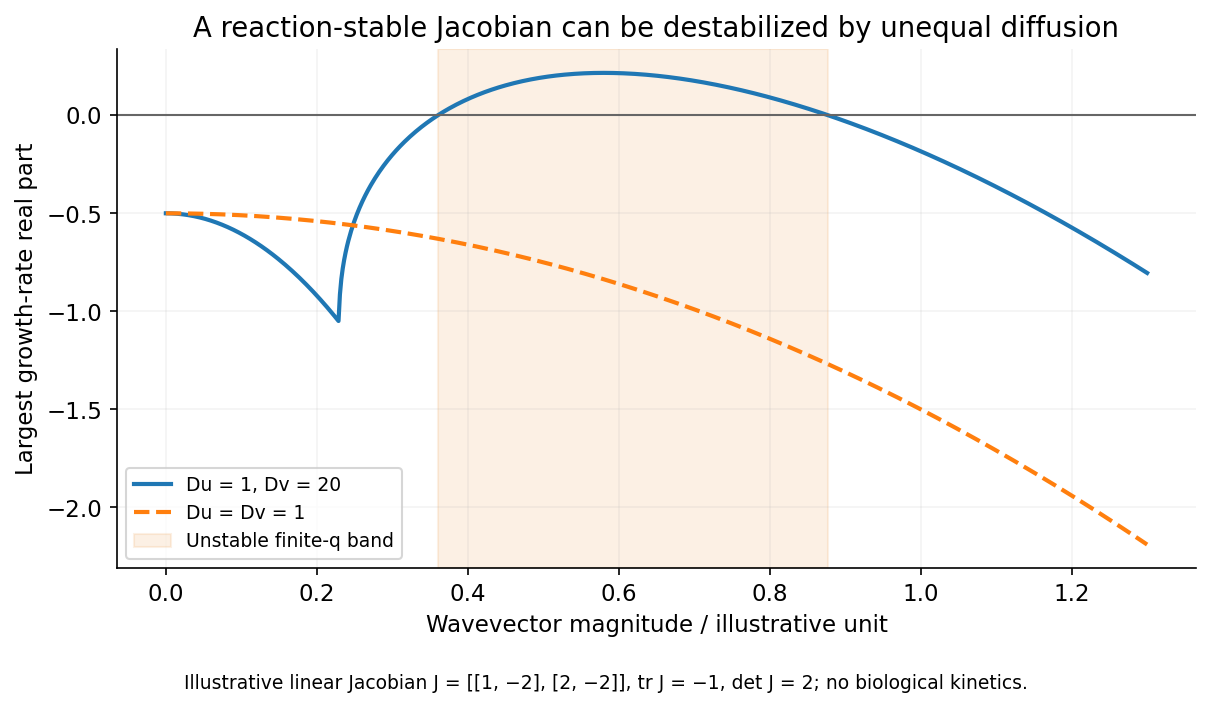
Differential diffusion can destabilize a finite band even when the uniform reaction system is linearly stable
. Source. Details. Only the separable instrument and mechanical tasks are treated here; biological operation and stepping energetics remain deferred.
For generic optical tweezers, a tightly focused laser and objective with high numerical aperture create an intensity gradient that attracts a suitable dielectric bead toward the focus. Momentum transfer also creates a scattering force; stable three-dimensional trapping requires sufficient restoring gradient force. A condenser and photodetector or camera track displacement. Near a stable focus, defines the stiffness and requires both a position calibration and a force calibration.[ref]
Observation of a single-beam gradient force optical trap for dielectric particles by Arthur Ashkin and others. Single-beam gradient trapping of dielectric particles
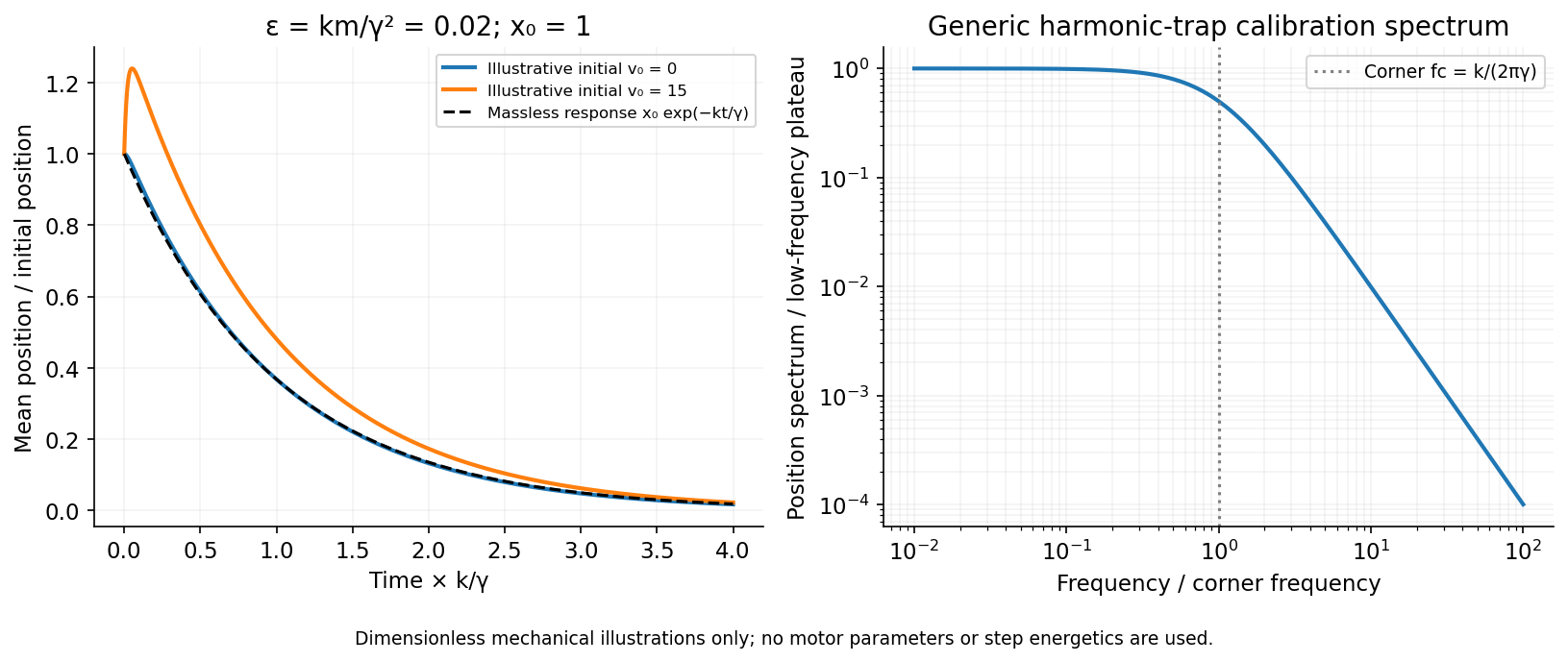
At thermal equilibrium in a harmonic well, the equipartition trap calibration is . Alternatively, fitting the overdamped harmonic-trap power spectrum gives , hence . Detector noise, finite sampling and exposure time, wall corrections to drag, and drift must be controlled rather than attributed to stiffness.
For an isolated sphere in a Newtonian fluid, define using its diameter. The supplied viscosity converts to . The generic Stokes drag calculation givesHere ; this retains the unspecified fluid density as a parameter rather than treating a density as supplied data. Stokes drag assumes an isolated no-slip sphere; nearby surfaces change the coefficient. TODO: the requested assessment of biological motor operation is deferred.
TODO: the biological stepping-energy and step-detection estimate is deferred in its entirety; no biological energy source or motor mechanism has been researched.
Ignoring biological coupling, the mechanical thermal model is the Langevin equation for a harmonic trap,For independent repeats with the specified initial conditions, the ensemble mean obeys the homogeneous damped-oscillator equation. An average over independent zero-mean force samples reduces its variance by , with a finite detector bandwidth needed to define samples of white noise. High bandwidth alone does not remove random forces; averaging independent records or sufficiently separated samples is the additional operation. A single trajectory retains thermal fluctuations. For stationary overdamped position fluctuations, a long time average over duration has approximately .
The initial-value solution of a damped harmonic trap has characteristic roots . For distinct roots,For critical damping, ,For the underdamped case the same real solution can be written , with . These describe the deterministic response or conditional mean, not the entire noisy trajectory.
For overdamped trap relaxation after an inertial boundary layer, let . The slow and fast roots areAfter , the fast exponential is negligible and the surviving amplitude is . If also , then to leading overdamped orderSmall Reynolds number justifies the linear viscous force; it does not alone prove the separate small inertial-trap parameter . Neglecting requires both rapid momentum relaxation and a negligible slow-mode amplitude shift. If , a nonzero initial velocity can leave a small slow displacement even after its own fast transient decays. The result concerns generic bead mechanics only.


Articles by others on the same topic
There are currently no matching articles.