Use and define the total four-momentum . For an inertial frame moving with velocity relative to the laboratory, the Lorentz boost givesChoose parallel to and require zero total three-momentum. ThenThis requires , so that the total four-momentum is timelike. Its invariant mass is , the total relativistic energy in the center-of-momentum frame. If all particles are exactly parallel photons, the total four-momentum is null and no finite-velocity center-of-momentum frame exists.
Sign qualification. The minus sign printed in the source describes the laboratory's velocity in the center-of-momentum frame, or the parameter of an active Lorentz boost with a plus-sign spatial rule. It is not the velocity of the center-of-momentum frame relative to the laboratory under question 1's passive convention. For example, a single particle with has its rest frame moving at . The printed would give , which is not zero. This explicitly resolves the sign rather than assigning a rest frame moving away from the particle.
By four-momentum conservation, . With the Minkowski metric, the neutral pion has , while each photon has and . Taking the Minkowski norm givesThe half-angle identity therefore yieldsThis is a measurement of the diphoton invariant mass using two photon energies and their opening angle, independent of the neutral pion's laboratory velocity.
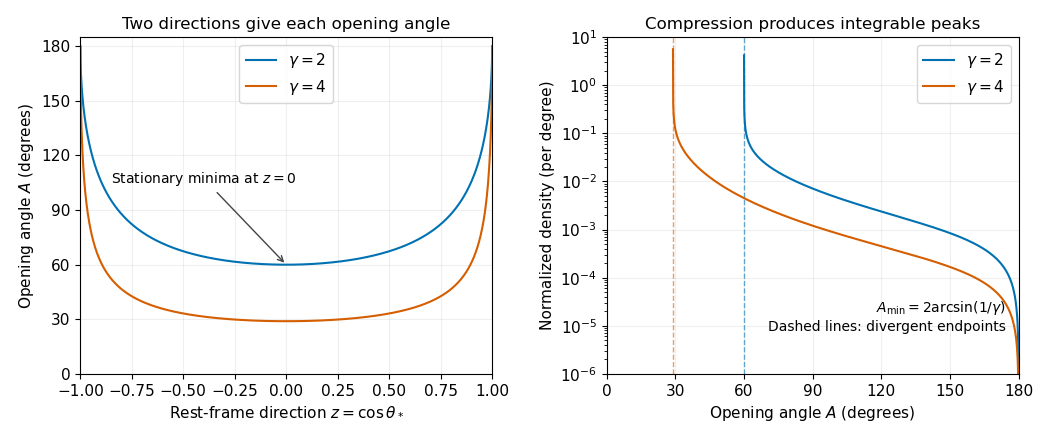
In the center-of-momentum frame, four-momentum conservation gives two opposite photon momenta, each of energy . Let , with the axis along the Lorentz boost from that frame to the laboratory. Reversing the axis specified in the source changes to and has no effect on the following product. The Lorentz transformation of four-momentum givesWriting , b now impliesThe isotropy assumption is on . Each interior opening angle has two inverse branches, and , both of which must enter the change of variables for probability densities. The positive branch has derivativeConsequently the diphoton opening-angle distribution isIts support is for , and its integral is , the integral of the original angular probability density before normalization. Thus the normalized probability density is . Omitting one inverse branch would incorrectly halve the total count.
From c, , with equality when : the photons are emitted perpendicular to the Lorentz boost axis in the center-of-momentum frame. ThereforeAt the minimum, the map is stationary: writing , its leading behavior is . A nonzero interval of uniformly distributed is therefore compressed near , producing an integrable inverse-square-root singularity in the opening-angle probability density. No differentiation of that probability density is needed. For finite , the probability density vanishes at . For the center-of-momentum frame is the laboratory and every event has : the probability distribution becomes a Dirac delta distribution, rather than the singular substitution in c. At large , in radians.

Articles by others on the same topic
There are currently no matching articles.