Source bundle pages 71–75. The cover establishes 2022 despite the attachment filename. Throughout these solutions the metric signature is , as fixed by the source's lowered time coordinate. Question 2 uses . Signs and additional assumptions needed by particular printed conclusions are explained where they arise.
Write the Lorentz transformation as . Acting on a scalar field, the chain rule gives the four-gradientFor the specified Lorentz boost, the inverse is obtained by changing to , soThese are precisely the covector component rules for the lowered coordinates. Raising the index with the Minkowski metric reverses the time component, yieldingIndeed and , the contravariant four-vector rules. Thus the index on a partial derivative with respect to an upper coordinate is lower.
The four-gradient rules from a giveThe Lorentz transformation coefficients are constant, so the partial derivatives do not differentiate them. This proves the Lorentz invariance of the d'Alembert operator:For example, the two longitudinal terms transform as , using and commuting partial derivatives. The transverse terms are unchanged. Applied to a scalar field, therefore gives a Lorentz scalar.
Take the divergence of the Ampère-Maxwell equation and use that the divergence of a curl is zero:The last step uses Gauss's law. Thus the charge continuity equation is exactlyFor a direct justification that this four-current is a four-vector, take one locally comoving population of electric charges, with rest charge density and four-velocity . Invariance of electric charge and length contraction give and , hence . Summing populations preserves the four-vector rule. In particular, and . The Lorentz invariance of its four-divergence then explains why charge conservation holds in every inertial frame. A single zero-divergence condition alone would not determine a field's transformation law; the physical charge density and current density provide the additional content.
The Lorenz gauge condition is . Substitute the electric potential and magnetic vector potential into Gauss's law:Next the Ampère-Maxwell equation, the curl of the curl identity, and the Lorenz gauge condition giveThe gradient terms cancel. Since , the time component obeys , so togetherThe four-potential can be chosen to transform as a four-vector. To make the argument rigorous, choose the retarded potential with no freely added homogeneous solution. If , this choice isThe retarded Green function is a Lorentz scalar under proper orthochronous Lorentz transformations, and is invariant. The four-vector rule for therefore proves . More generally, transform any homogeneous initial data by this same rule. Both the wave equation and the Lorenz gauge condition are then preserved.
Qualification. The wave equation by itself cannot prove the transformation rule for every independently chosen gauge potential: the d'Alembert operator has a nontrivial kernel of a linear map. For a concrete counterexample, zero sources and zero fields admit in one inertial frame and in another. Both satisfy the wave equation and the Lorenz gauge condition, but the latter is not the Lorentz transformation of zero. It is a residual Lorenz gauge symmetry, generated by . Thus the usual assertion is a covariant choice of four-potential, with a consistent gauge transformation and homogeneous data, rather than a uniqueness result from the displayed equation.
Let . The Lorenz gauge condition on the plane electromagnetic wave givesThe vacuum wave equation gives for a nonzero amplitude; equivalently and . Use the gauge transformation withBecause , this is a residual Lorenz gauge symmetry and . For a propagating plane electromagnetic wave, , so take . ThenThe second equality follows from . The electric field and magnetic field are unchanged by this gauge transformation. Thus Lorenz gauge permits a representative in radiation gauge; Lorenz gauge alone does not require the spatial amplitude of every representative to be transverse.
Use and define the total four-momentum . For an inertial frame moving with velocity relative to the laboratory, the Lorentz boost givesChoose parallel to and require zero total three-momentum. ThenThis requires , so that the total four-momentum is timelike. Its invariant mass is , the total relativistic energy in the center-of-momentum frame. If all particles are exactly parallel photons, the total four-momentum is null and no finite-velocity center-of-momentum frame exists.
Sign qualification. The minus sign printed in the source describes the laboratory's velocity in the center-of-momentum frame, or the parameter of an active Lorentz boost with a plus-sign spatial rule. It is not the velocity of the center-of-momentum frame relative to the laboratory under question 1's passive convention. For example, a single particle with has its rest frame moving at . The printed would give , which is not zero. This explicitly resolves the sign rather than assigning a rest frame moving away from the particle.
By four-momentum conservation, . With the Minkowski metric, the neutral pion has , while each photon has and . Taking the Minkowski norm givesThe half-angle identity therefore yieldsThis is a measurement of the diphoton invariant mass using two photon energies and their opening angle, independent of the neutral pion's laboratory velocity.
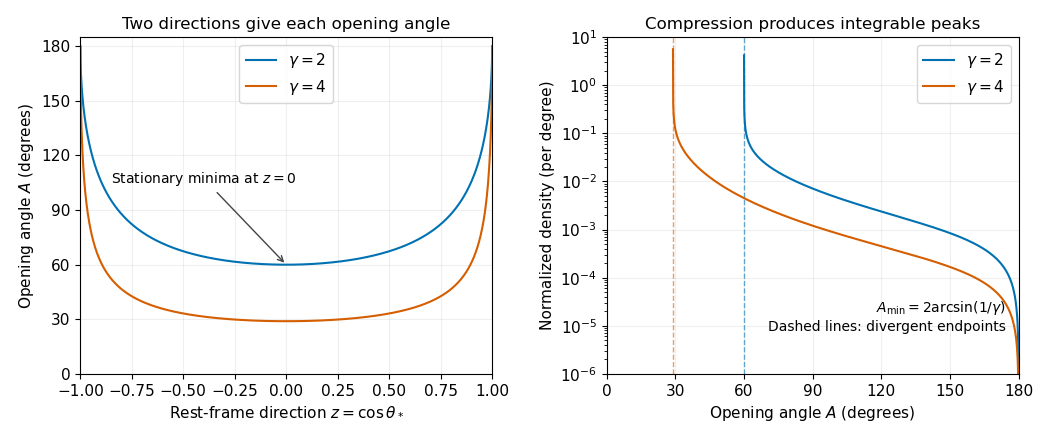
In the center-of-momentum frame, four-momentum conservation gives two opposite photon momenta, each of energy . Let , with the axis along the Lorentz boost from that frame to the laboratory. Reversing the axis specified in the source changes to and has no effect on the following product. The Lorentz transformation of four-momentum givesWriting , b now impliesThe isotropy assumption is on . Each interior opening angle has two inverse branches, and , both of which must enter the change of variables for probability densities. The positive branch has derivativeConsequently the diphoton opening-angle distribution isIts support is for , and its integral is , the integral of the original angular probability density before normalization. Thus the normalized probability density is . Omitting one inverse branch would incorrectly halve the total count.
From c, , with equality when : the photons are emitted perpendicular to the Lorentz boost axis in the center-of-momentum frame. ThereforeAt the minimum, the map is stationary: writing , its leading behavior is . A nonzero interval of uniformly distributed is therefore compressed near , producing an integrable inverse-square-root singularity in the opening-angle probability density. No differentiation of that probability density is needed. For finite , the probability density vanishes at . For the center-of-momentum frame is the laboratory and every event has : the probability distribution becomes a Dirac delta distribution, rather than the singular substitution in c. At large , in radians.

For a massive particle, the proper time is determined by the Minkowski interval along its worldline:Choose future-directed time increments. With the Lorentz factor ,We use for the source's to distinguish four-velocity from velocity . Since proper time is invariant and is a four-vector, is a four-vector, with . The rest-frame result follows immediately.
The Lorentz boost from A to B givesDivide each spatial displacement by . The velocity-addition formula isThe same result follows by transforming the four-velocity and using . The transverse velocities change because the transformed time increment depends on , even though the transverse spatial coordinates are unchanged.
For , decompose the velocity as , parallel and perpendicular to . A rotation-free Lorentz boost gives the velocity-addition formulaThese two components are orthogonal, soThe last equality is Lagrange's identity for the cross product. For physical subluminal speeds, , givingThe case follows directly or by continuity. An independent form useful for checks is , obtained from the transformed four-velocity normalization.
Let and in A. Each has Lorentz factor . The relative Lorentz factor of in the rest frame of follows from their four-velocity tensor contraction:Let be the relative speed divided by . In the rest frame of , take between the photon's propagation direction and 's velocity. The observed angular frequency is the invariant . Applying it to the emitter, whose rest angular frequency is , gives . Since ,This is a relativistic Doppler effect calculation using both emitters' and receivers' rest clocks; the time delay of reception introduces no extra factor for constant velocities.
For the direction in A, write the wave four-vector as , where is a unit vector. Equality of the emitted and received angular frequencies gives . Since the two laboratory Lorentz factors are equal, their time components cancel:Thus the complete answer in three spatial dimensions isIf propagation is additionally assumed to lie in the stars' motion plane, this reduces to either direction along the internal angle bisector, or from . Reflection exchanging the stars' laboratory velocities explains the angle bisector by symmetry. The source does not specify coplanar propagation or the stars' positions, so it does not fix the sign or exclude an out-of-plane ray. For example gives and satisfies the same no-shift condition. Initial positions can be chosen to make such a ray connect emission and reception. All these possibilities give the same rest-frame above.
For constant laboratory force and initial rest, integration gives three-momentum . The energy–momentum relation gives , and , soFor and , its speed increases monotonically, is strictly below the speed of light at every finite time, and obeys . Thus is the limiting supremum, rather than a speed attained at a finite time. The degenerate case leaves the particle at rest and does not have this limit.
With constant rest mass, and the chain rule gives . Hence the laboratory relativistic force isUse the vector triple product identity , and , to obtainThe relativistic energy is , whose time derivative is . Taking the dot product of the first expression for with gives the same quantity, because . Thus . Since , the four-force isIts tensor contraction with the four-velocity vanishes: . This orthogonality also follows by differentiating . Resolving the laboratory acceleration relative to gives and .
Metric-sign qualification. With this paper's metric signature, b givesThe minus sign in the printed Larmor formula would therefore make a positive radiative loss negative. A concrete counterexample is an instant of rest with nonzero acceleration: , so the printed expression is . That sign is appropriate for the opposite metric signature. With the convention already fixed in question 1, positive emitted power instead isAlternatively the printed negative quantity can be interpreted as the particle's signed radiative energy change, rather than the positive loss magnitude.
For fixed rest mass, resolve the acceleration parallel and perpendicular to the velocity, as in b. This givesWriting , the Liénard radiated-power formula becomes . For uniform circular motion, the acceleration is perpendicular to the velocity; for straight-line motion it is parallel. Comparing the same particle at equal relativistic energy and equal laboratory acceleration magnitude therefore givesThis particular comparison makes the linear loss larger. The familiar larger loss from bending applies to a different comparison: at equal applied laboratory force magnitude , and , giving and . Stating which quantity is held fixed is essential.
Both the muon and electron have the same electric charge magnitude. At equal kinetic energy per particle, their Lorentz factors are , so the heavier muon has the smaller Lorentz factor. At equal total relativistic energy the same ordering follows from , provided that energy is large enough to create either particle.
If the equal-acceleration comparison of c is retained, . Thus the four-way instantaneous comparison selectsFor positive , its smaller Lorentz factor reduces the power relative to an electron, and transverse acceleration reduces the power relative to longitudinal acceleration of the same magnitude. This conclusion follows from the constraint actually stated in c.
For the customary engineering comparison at equal applied force, the result changes. From c,Under that comparison the choice isIts longitudinal radiative power is smaller than an electron's by , while avoiding bending removes the extra factor. At a fixed bend radius , the circular loss is , giving the familiar suppression at fixed ultrarelativistic energy and .
An energy budget alone does not specify a unique optimization. The force, acceleration, bend radius, acceleration time, and length are otherwise unrestricted. For example, in a linear accelerator a constant small force gives radiative power proportional to , and reaching a specified final three-momentum takes time proportional to ; the total radiated energy therefore tends to zero as . One cannot infer a unique accelerator choice without an additional constraint. The standard practical preference is the second boxed answer, with its stated comparison. Muon decay introduces a separate lifetime constraint if slow acceleration is contemplated, but it was not part of the specified radiative-loss calculation.
Articles by others on the same topic
There are currently no matching articles.