The mean-field approximation replaces the fluctuating environment of each microscopic variable by a uniform average field. For spins, write and drop products between different sites. The resulting single-site problem can be solved independently, and its average spin must reproduce the assumed order parameter : this is the self-consistency equation.
It is reliable when correlated thermal fluctuations about the mean are small, for example with many interacting neighbours, long-range interactions or high spatial dimension. Near a thermodynamic critical point the quantitative test is the Ginzburg criterion. For short-range scalar ordering the upper critical dimension is four, with logarithmic qualifications at four; a two-dimensional nearest-neighbour lattice is below this and its asymptotic critical region of a phase transition is not described accurately by simple mean-field theory.[ref]
Statistical Field Theory by David Tong. §2.2.4, The Upper Critical Dimension: correlation-volume fluctuations and the Ginzburg criterion
The square lattice has coordination number of a lattice . The mean-field decoupling isAccounting for the factor in the directed-neighbour sum gives the Hamiltonian in the mean-field approximation:The constant term is necessary to correct the double counting of the interaction. Let . The one-site partition function isso . The Helmholtz free energy is thereforeThe equilibrium mean-field approximation is obtained by minimizing this expression over the allowed . The state supplies the extra in ; omitting it would instead describe the two-state Ising model. This is the Blume-Capel mean-field transition at zero single-ion anisotropy.
The self-consistency equation requires that the mean spin computed using the single-site Boltzmann distribution equals the spin used to form the effective field. With ,ThusEquivalently, differentiating part (b) gives , so stationarity of the Helmholtz free energy in the mean-field approximation is exactly this condition. Among multiple stationary points one must select the stable minimum.
At zero field, write the right-hand side of the self-consistency equation as , with . The origin is always a solution, and the slope there isThe critical crossing occurs when this equals one, givingThis is a continuous phase transition in the mean-field approximation. For ,so the positive branch is a strictly concave function, while is odd and bounded by one. For , the slope at zero is at most one and strict concavity puts below for every , leaving only the unmagnetized solution. For , it initially lies above but has ; hence there is one positive intersection and, by spin inversion symmetry, one negative intersection.
The curvature of the Helmholtz free energy in the mean-field approximation is per site. It is negative at below and positive at the nonzero intersections, identifying the ordered minima and the unstable zero solution.
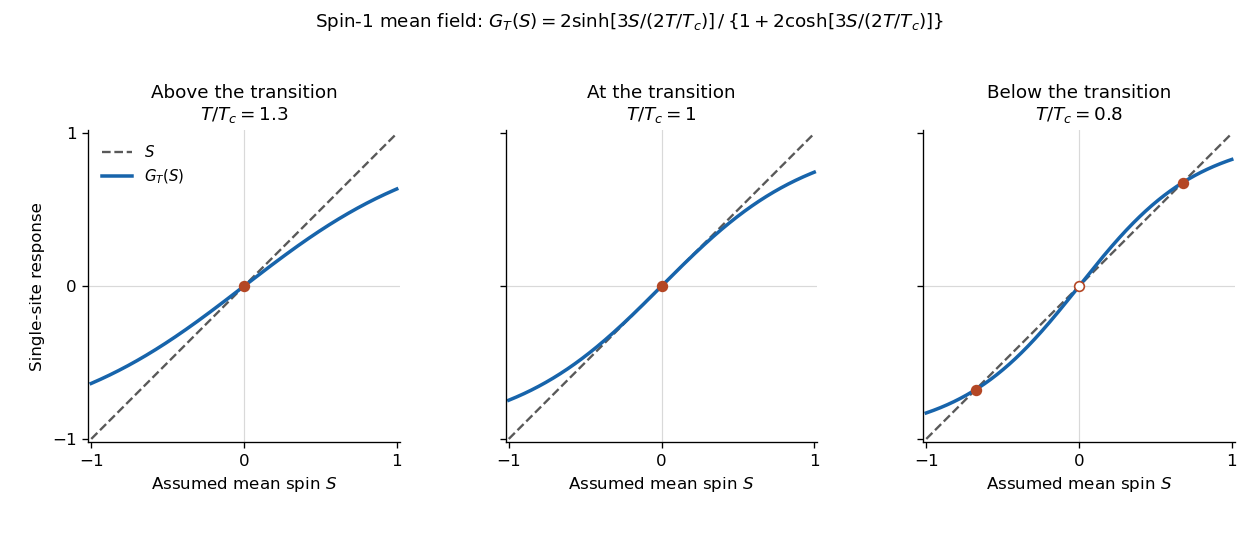
The self-consistency equation develops two nonzero order parameter branches below the mean-field critical temperature
. Details. 
The critical temperature and branches here belong to the mean-field approximation. In the exact finite system, spin inversion symmetry forces zero average magnetization at zero field; selecting a broken-symmetry phase requires the thermodynamic limit with a vanishing field of specified sign.
The small-argument Taylor series of the single-site response isLet . For a small nonzero order parameter at zero field, the self-consistency equation becomesSince and , where , this givesConsequentlyThe positive branch is the expression printed in the question, while its negative partner is required by spin inversion symmetry. The square-root behavior gives the mean-field critical exponent for the spontaneous magnetization.
The coarse-grained order parameter is a real scalar field because the microscopic spin has one component. At , spin inversion symmetry takes , so an analytic local Landau free energy contains only even powers. Near a continuous phase transition, the quadratic coefficient changes sign linearly, represented by with . A positive quartic coefficient stabilizes the density when the quadratic term becomes negative, giving the two minima below .
The ferromagnetic interaction favours neighbouring spins pointing alike, so spatial variation costs energy; its leading long-wavelength form is the positive gradient term . The source term favours alignment with the applied magnetic field and explicitly breaks spin inversion symmetry at fixed nonzero . Finally is the spin-independent background free-energy density.
The quartic sign can also be checked from part (b): its expansion containswhose quartic coefficient is positive. This is consistent with the proposed Landau-Ginzburg theory, not a tricritical truncation requiring a stabilizing sixth-order term. The microscopic square lattice is two-dimensional; the written gradient describes a profile depending on one coordinate. For general profiles, replace it by .
For a homogeneous saddle-point approximation define . With the cubic source coupling, minimizing the Landau free energy givesIts curvature is positive, so there is a unique local minimum and global minimum. The solution near hasbecause substituting this leading term makes the cubic self-interaction of order . Therefore the cubic source coupling and third-order susceptibility giveThus the first nonzero response diverges like from above. The factor is essential: the coefficient of is not itself the third derivative. This is susceptibility to the specified cubic source variable, rather than the usual third-order response to a linearly coupled field.
Articles by others on the same topic
There are currently no matching articles.