Complete the square in the potential energy. With ,The quantum harmonic oscillator is translated without changing its level spacing. If is its normalized unforced energy eigenstate, thenEquivalently, . The ground state position is centered at , and its position uncertainty remains .
A normalized oscillator coherent state is an eigenstate of the annihilation operator, . Expanding it in Fock states givesSince , , and , the variance is . Henceindependently of the complex amplitude .
For and , the commutator is the scalar . The Baker--Campbell--Hausdorff formula therefore terminates and gives the displacement operatorBecause , applying it to the Fock vacuum yields exactly the Fock state expansion above:For a general complex , its complex conjugate is required in the annihilation term. The expression with printed in the paper is valid when is real.
The quantum state is continuous through a sudden finite-force quantum quench, so it is still at . DefineThe new Hamiltonian operator is . The old Fock vacuum obeys , so the coherent state after shifting an oscillator equilibrium rotates with amplitude relative to the new equilibrium. In the original oscillator basis, the full state isOne way to obtain the phase is to writeand apply the displacement operator composition rule. The coherent-state oscillator expectation values giveThe position uncertainty stays . These mean values obey the forced classical equation, while the nonzero variance retains the quantum width.
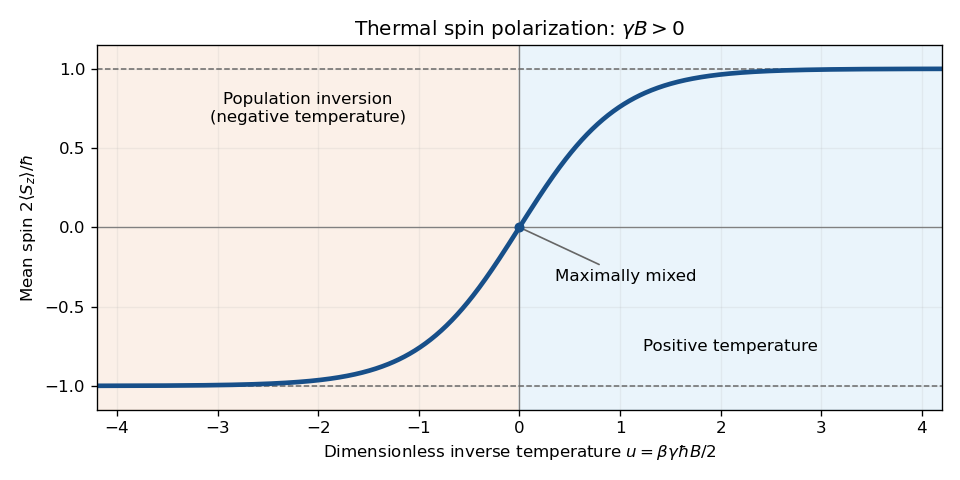
Specify the magnetic coupling before fixing its sign: let the magnetic moment be , where is a signed gyromagnetic ratio. The Zeeman effect gives . For spin one-half, , so with and ,This is the quantum Gibbs state. Its eigenvalues are , so its purity is . For nonzero level splitting it approaches a pure state as : positive inverse temperature selects the lower energy, while negative inverse temperature selects the upper one. It is a maximally mixed state at , including infinite temperature or zero magnetic splitting. At zero field the Gibbs state remains ; lowering temperature alone does not select a unique pure state from that degeneracy.
Negative temperature is meaningful for an internally equilibrated spin sector with a bounded energy spectrum and population inversion. It must be sufficiently isolated from unbounded motional degrees of freedom: the oscillator's unbounded spectrum, for instance, makes its partition sum diverge at negative inverse temperature. The two-level spin partition sum itself stays finite for either sign.
For , the quantum Gibbs state is diagonal in the basis. Its two probabilities are proportional to . ThusAt small inverse temperature, . As a function of , the normalized spin component is the smooth odd curve : it crosses zero at and saturates at . As a function of its direction is reversed if . For , positive temperature favors , while negative temperature gives the inverted population.

Articles by others on the same topic
There are currently no matching articles.