In second quantization, expand the annihilating quantized field in a complete orthonormal basis of one-particle states, . At equal times, the canonical commutation relation for bosons and the canonical anticommutation relations for fermions are, respectively,andHere is a Dirac delta distribution. Multiplying by the basis wave functions and integrating gives for bosons, or for fermions; the two-annihilator and two-creator brackets vanish in the corresponding convention.
The mode number operator and total particle number operator areThe bosonic occupation numbers are . For fermions, and the canonical anticommutation relations imply , so the fermionic occupation numbers are only and , as required by the Pauli exclusion principle.
Keeping only two modes later is a projection: the projected field bracket is , rather than the full Dirac delta distribution.
Normalize the ring modes as , with distinct and integers . Inserting into the contact interaction givesOrthogonality makes when , and zero otherwise: this is momentum conservation in the projected Hamiltonian operator. There is one all-mode-1 term, one all-mode-2 term, and four mixed terms with one particle in each mode. A pair conversion between distinct ring modes would require and therefore vanishes.
Using and yields the contact interaction between two ring modes,The factor four comes from two independent choices of ordering for the creation operators and annihilation operators. This is the two-mode projected model; a full ring contact interaction can also scatter particles into other modes while conserving total momentum.
At fixed particle number , write and . The contact interaction between two ring modes has energy eigenvaluesFor , the nonnegative product is minimized at the endpoints. ConsequentlyFor this is a two-dimensional degenerate ground state subspace. instead has the unique Fock vacuum. In this projected model, putting all particles into one traveling mode avoids the extra exchange contribution paid when both distinct modes are occupied.
For the alternative coefficients, put and . Then is again minimized at , with . Evenness of is unnecessary for this result; the balanced Fock state maximizes this attractive-interaction energy instead of minimizing it.
Add the one-particle energy term . It is diagonal in the same Fock state basis as the contact interaction between two ring modes. For , the ordered basis givesFor , the middle eigenvalue exceeds the mean of the two endpoint eigenvalues by , so it cannot be the smallest. The ground state is therefore if , and if , withIf , every normalized linear combination of the two endpoint Fock states is a ground state. The same endpoint argument works for general fixed , since the interaction contribution is a concave quadratic function of the mode occupation number.
For distinct positive integers , use normalized box modes and . Their contact interaction overlaps obeyUnlike traveling ring modes, these standing modes also allow pair conversion. For the first two box modes, or any distinct pair without a third-harmonic resonance, the contact interaction between two box modes isThe last two terms change an individual mode occupation number by two while conserving total particle number. Thus the Hamiltonian operator is not diagonal in the Fock state basis, and minimizing diagonal entries alone does not find its ground state. For example, at with no dispersion, has the lowest energy , below either unmixed endpoint's .
The wording permits modes beyond the first two. For completeness, the identity givesWhen , add ; when , add . These extra terms change an individual occupation number by one and require diagonalizing the corresponding fixed- matrix as well.
Complete the square in the potential energy. With ,The quantum harmonic oscillator is translated without changing its level spacing. If is its normalized unforced energy eigenstate, thenEquivalently, . The ground state position is centered at , and its position uncertainty remains .
A normalized oscillator coherent state is an eigenstate of the annihilation operator, . Expanding it in Fock states givesSince , , and , the variance is . Henceindependently of the complex amplitude .
For and , the commutator is the scalar . The Baker--Campbell--Hausdorff formula therefore terminates and gives the displacement operatorBecause , applying it to the Fock vacuum yields exactly the Fock state expansion above:For a general complex , its complex conjugate is required in the annihilation term. The expression with printed in the paper is valid when is real.
The quantum state is continuous through a sudden finite-force quantum quench, so it is still at . DefineThe new Hamiltonian operator is . The old Fock vacuum obeys , so the coherent state after shifting an oscillator equilibrium rotates with amplitude relative to the new equilibrium. In the original oscillator basis, the full state isOne way to obtain the phase is to writeand apply the displacement operator composition rule. The coherent-state oscillator expectation values giveThe position uncertainty stays . These mean values obey the forced classical equation, while the nonzero variance retains the quantum width.
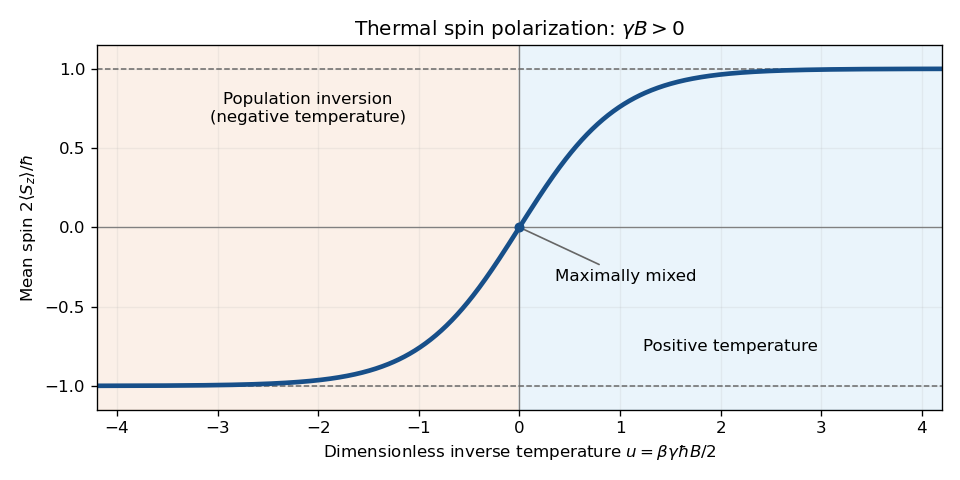
Specify the magnetic coupling before fixing its sign: let the magnetic moment be , where is a signed gyromagnetic ratio. The Zeeman effect gives . For spin one-half, , so with and ,This is the quantum Gibbs state. Its eigenvalues are , so its purity is . For nonzero level splitting it approaches a pure state as : positive inverse temperature selects the lower energy, while negative inverse temperature selects the upper one. It is a maximally mixed state at , including infinite temperature or zero magnetic splitting. At zero field the Gibbs state remains ; lowering temperature alone does not select a unique pure state from that degeneracy.
Negative temperature is meaningful for an internally equilibrated spin sector with a bounded energy spectrum and population inversion. It must be sufficiently isolated from unbounded motional degrees of freedom: the oscillator's unbounded spectrum, for instance, makes its partition sum diverge at negative inverse temperature. The two-level spin partition sum itself stays finite for either sign.
For , the quantum Gibbs state is diagonal in the basis. Its two probabilities are proportional to . ThusAt small inverse temperature, . As a function of , the normalized spin component is the smooth odd curve : it crosses zero at and saturates at . As a function of its direction is reversed if . For , positive temperature favors , while negative temperature gives the inverted population.

For a time-independent Hamiltonian operator, the time-evolution operator is , with . Insert its resolution of identity in normalized energy eigenstates:Since , the retarded quantum propagator in the question isThe Heaviside step function imposes the chosen retarded convention. If the Hamiltonian operator has a continuous spectrum, the spectral sum includes its continuum integral; it must not be restricted to bound states. The spectral resolution of a quantum propagator also shows that tends to as . With the step factor it obeys ; the corresponding Green function with a unit delta source is .
Away from the delta potential, the decaying bound state obeys . Integrating the Schrödinger equation across the attractive interaction givesFor an even exponential, the left side is . ThereforeThe normalized bound state in a delta potential is , since . The single positive solution for gives one bound state; an odd decaying wave cannot be both continuous and nonzero with this interaction.
Choose the even-channel scattering phase shift convention for . The delta potential derivative jump givesso, choosing the branch that tends to zero as ,An odd scattering eigenfunction is : it vanishes at the interaction and its derivative is continuous, so it acquires no scattering phase shift. These parity channels, with the bound state, give the continuum part of the spectral resolution of a quantum propagator.
At the origin, the normalized bound state in a delta potential contributes , and the odd scattering eigenfunctions contribute zero. The even continuum functions from the preceding part haveTheir energy is . Inserting these weights into the spectral resolution of a quantum propagator, and using evenness to extend the integral to the whole real axis, yields for This is the quantum propagator of an attractive delta potential. The printed continuum exponent has an extra factor of : its time phase must be . This correction also makes the exponent dimensionless. Oscillatory integrals are understood with an infinitesimal positive convergence factor before taking its limit.
For fixed , write . The bound contribution to the quantum propagator of an attractive delta potential remains . For its continuum, the stationary phase is at , where . The Gaussian oscillatory integral and its derivative giveConsequentlyThe continuum decays as , but the full kernel has a persistent oscillating bound state contribution and no ordinary complex limit. This expansion requires ; it is not uniform in the zero-coupling limit, where the bound state disappears and the free kernel instead decays as .
Outside a short-range scattering region, the stationary Schrödinger equation reduces to the two-dimensional Helmholtz equation. Separation in polar coordinates gives outgoing radial Hankel functions, whose large- dependence is . The same power follows from conserved probability current: a circle has length proportional to , so the squared outgoing amplitude must decrease as .
For an incident plane wave in the direction, adopt the dimensionless amplitude conventionThe phase and factor specify the definition of ; they can be absorbed into a differently normalized scattering amplitude. Here they are kept exactly so that the later two-dimensional scattering cross-section follows consistently.
The incident plane wave carries probability current . For the separated outgoing wave from the previous part,The rate through a distant arc is . Dividing by incident flux defines the differential two-dimensional scattering cross-section,Because is dimensionless, has units of length, as appropriate for scattering in a plane.
The incident plane wave is periodic in , so expand it as a Fourier series . Substitution into the Helmholtz equation, with , gives the radial Bessel differential equationRegularity at the origin selects the Bessel function of the first kind, rather than the singular second solution. ThusThe coefficients are independent of ; their values follow from matching near the origin in the next part. The completed identity is the Jacobi-Anger expansion.
For , expand . The lowest power producing the Fourier harmonic is . Meanwhile . Matching these lowest powers gives .
For negative order use and the equality of the positive and negative Fourier coefficients of this even function of . This gives . Therefore the Jacobi-Anger expansion isThe cosine form has multiplicity one for and two for every positive . Those multiplicities are essential for matching the incident plane wave.
Let and for , as required by the cosine form of the Jacobi-Anger expansion. For a central real potential, the Partial-wave S-matrix is . Splitting each shifted radial cosine into incoming and outgoing exponentials leaves its incoming coefficient unchanged and multiplies its outgoing coefficient by . Subtracting the incident plane wave givesComparing with the prescribed scattering amplitude convention yields the two-dimensional partial-wave scattering formula,Orthogonality gives and for , while all cross terms vanish. HenceThe multiplicities printed in this part are reversed. With those printed values and every , the purported free wave would be , rather than the required incident plane wave. The extra contains an incoming cylindrical wave, which cannot be absorbed into . The formulas above use the corrected multiplicities and therefore satisfy the specified scattering boundary condition.
Articles by others on the same topic
There are currently no matching articles.