Introduce three independent local parameters . A consistent convention for the three Abelian gauge transformations isIndeed, shifts by , cancelling the derivative of the scalar phase. Thus transforms by the same phase as . The two kinetic terms, the absolute-value potentials and all Abelian field strengths are invariant.
In units where the gauge coupling is , the charge vectors under the three factors areLocally this is the gauge algebra of . To interpret it globally as three compact circle groups, the charges must belong to a compatible charge lattice: in the stated unit-charge convention integer is sufficient, while arbitrary irrational is not a single-valued compact-group representation. The local transformations and mass calculation remain meaningful for general positive real as a Lie-algebra calculation, or with noncompact Abelian factors.
For this three-site Abelian Higgs chain, the potential is minimized by . Choose their phases real in a local unitary gauge. The scalar kinetic terms then givewhere Lorentz contractions are understood andThe nonzero eigenvalues of equal those ofnamely and . The third eigenvalue is zero because has rank two. Both nonzero eigenvalues are positive for .
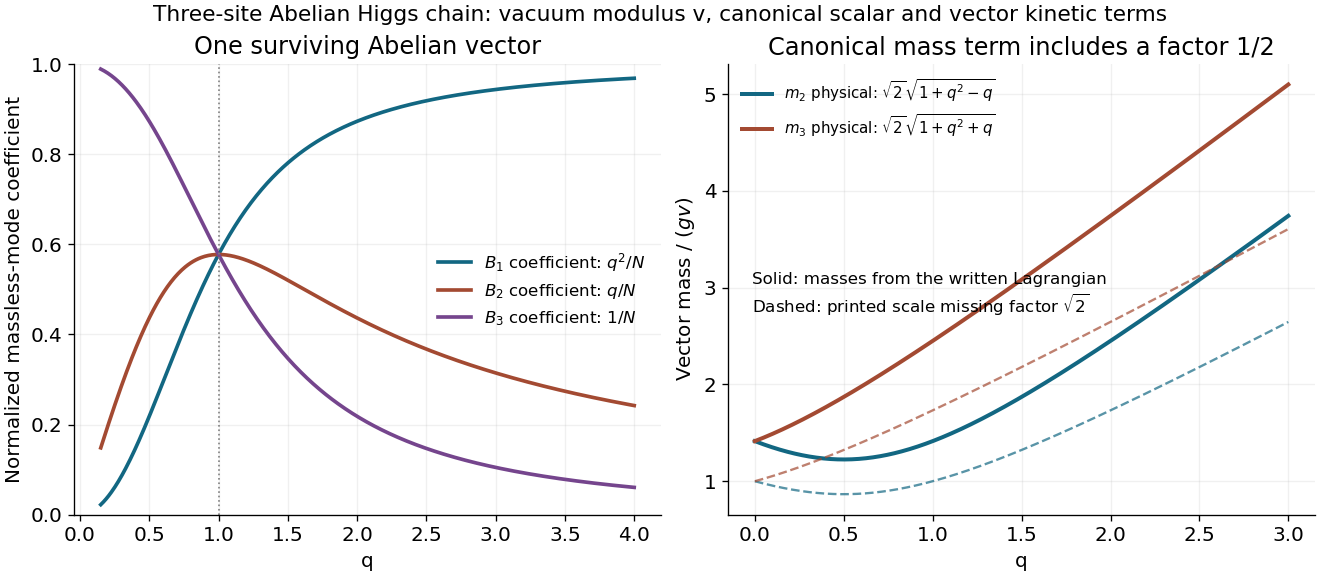
Mass-normalization correction: the canonical vector mass term is , so the Lagrangian actually gives . Its physical masses are thereforeThe printed dimensionless eigenvalue pattern is correct, but its common scale must be , not , for the written kinetic terms and vacuum value. For a concrete counterexample set and . This is a canonically normalized eigenmode and its mass term is , giving physical squared mass rather than the printed . The printed scale would require a vacuum modulus or a corresponding change in scalar normalization, neither of which is the specified potential minimum.
The unbroken transformations preserve both vacuum phases:Thus the local breaking pattern isTwo scalar phases supply the longitudinal polarizations of the two massive vector bosons; one massless vector remains. This is the Higgs mechanism, with its mass matrix fixed by the scalar charge matrix and the vacuum normalization.[ref]
Gauge Theory by David Tong. Section 2.5.2, expanding scalar kinetic terms around a condensate to obtain a vector mass
A massless eigenvector must lie in the null space of , so its coefficients satisfy and . Hence they are proportional to . The original gauge kinetic terms have the Euclidean unit matrix in species space, so normalize this vector by its ordinary squared length. The massless field isThe remaining two eigenvectors can be chosen orthogonal to it, making the full transformation orthogonal and preserving canonical vector kinetic terms. At , the formula is exactly as required. This null direction and its normalization are unaffected by the common mass-scale correction in part b.
For , the massless mode has geometrically unequal components; a matter field coupled to one end can therefore couple more weakly to this surviving vector than a field coupled to the other end. This follows directly from the eigenvector coefficients, without changing the equal microscopic gauge coupling .

Articles by others on the same topic
There are currently no matching articles.