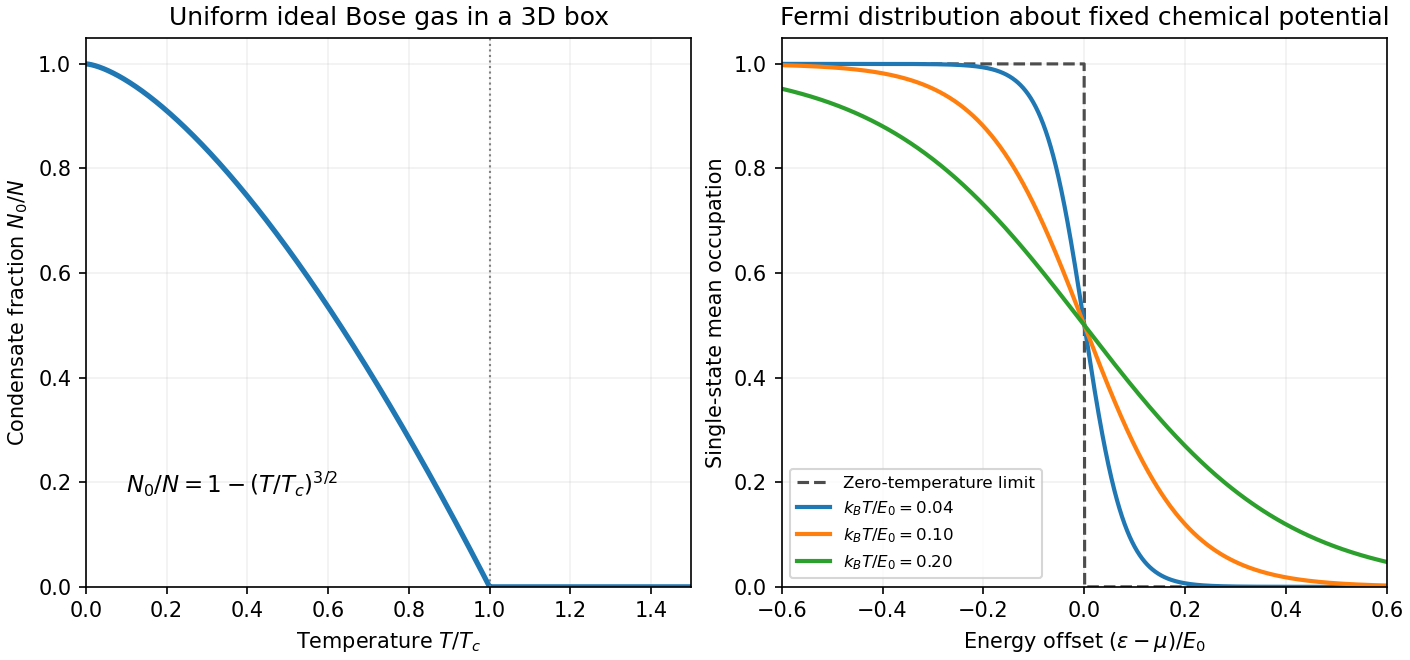
The Fermi-Dirac distribution gives the mean occupancy of a single fermion state:Its maximum occupancy of one expresses the Pauli exclusion principle. A spatial orbital with two spin states can hold two electrons because they are different single-particle states. At zero temperature, the occupation is a step at the Fermi energy ; at low nonzero temperature, occupation changes appreciably only in an energy shell of width of order about the chemical potential.
Consequently, most conduction electrons cannot absorb small thermal energies into already occupied states. Only a fraction of order participates, where . For a normal metal with a smooth density of states , including both spin states and using the total-system normalization, the Sommerfeld expansion at fixed particle number givesand thereforeFor a three-dimensional free electron gas, , so . This is much smaller than a classical equipartition estimate at . The chemical potential must adjust with temperature to maintain ; treating it as fixed while differentiating an energy integral gives the wrong fixed- calculation in general.
The lattice adds a Debye contribution at temperatures well below the Debye temperature. HenceA plot of measured against can separate the electronic intercept from the phonon slope. calorimetry must account for the heat capacity of the sample holder, heat leaks, thermal equilibration and thermometer calibration. A magnetic impurity contribution or a superconducting transition can invalidate this two-term fit; the prediction is for the normal metallic state in an appropriate low-temperature interval. Differences from a free-electron coefficient can reveal quasiparticle effective-mass enhancement or nontrivial electronic structure rather than a failure of Fermi statistics.

Articles by others on the same topic
There are currently no matching articles.