A non-ideal gas departs from because interactions and finite particle size affect its pressure. At sufficiently low number density , the virial expansion separates these corrections:The second virial coefficient has dimensions of volume per particle, while has dimensions of volume squared. These are density-series coefficients, not the coefficients of a pressure-series expansion with the same names.
For classical particles interacting through a pair potential ,Repulsion contributes positively and attraction negatively. A hard core of diameter gives , four times the geometric volume of one sphere. The factor reflects the volume excluded to the centre of a second particle together with pair counting; it is not simply the occupied geometric volume.
Expanding the Van der Waals equation at givesThe virial coefficients of the van der Waals gas are therefore and . The Boyle temperature, , makes the leading correction vanish, but does not remove the higher coefficients or turn the gas exactly ideal. More realistic potentials give temperature-dependent higher coefficients that need not equal the van der Waals values.
A useful measurement is a sequence of dilute isothermal pressure–volume observations. Plotting against exposes as the zero-density intercept and as its initial slope. Control temperature and density calibration, check equilibration and adsorption on the container walls, and vary the fitted density interval to test truncation error. One measured virial coefficient cannot uniquely reconstruct the pair potential. Near coexistence or a critical point a short density series may fail, and at quantum-degenerate densities exchange statistics add corrections even without interactions.
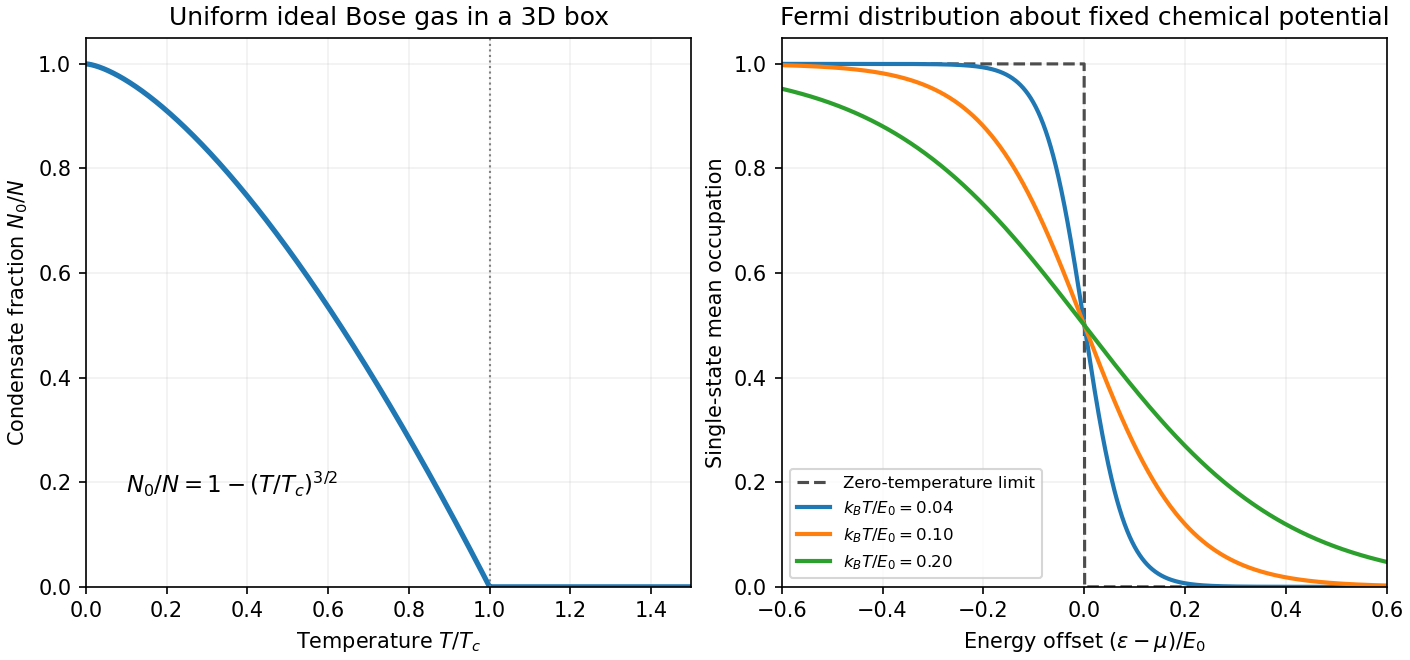
Bose-Einstein condensation is macroscopic occupation of the lowest one-particle state. It is a change in occupation statistics, not ordinary liquid formation and not a requirement that all atoms occupy one spatial point. For ideal bosons,Set the lowest one-particle energy to zero. Then , and the population of excited states in a uniform three-dimensional box isHere . As approaches zero, the excited-state population saturates at . Any excess particles occupy the ground state. In the thermodynamic limit,Thus the onset occurs when the thermal de Broglie wavelength is comparable to the mean interparticle spacing. At finite , the chemical potential remains slightly below the ground-state energy; setting it equal to zero is a thermodynamic-limit statement.
The 1995 rubidium experiment used magnetic confinement and evaporative cooling of atoms. Absorption images after trap manipulation revealed a narrow, anisotropically expanding component superposed on the broader thermal distribution; the new component grew as cooling proceeded. The thermal component supplied an internal comparison through the same imaging optics. Trap decompression and release geometry mattered, and finite imaging resolution and interactions limited direct comparison with an ideal-gas ground state.[ref]
Observation of Bose-Einstein Condensation in a Dilute Atomic Vapor by M. H. Anderson and others. Science 269, pp. 198–201, experimental preparation and velocity distributions
A narrow cloud alone is not sufficient evidence. One should check its emergence across a controlled cooling sequence, atom-number and temperature calibration, the thermal background and the predicted expansion anisotropy. These are tests of an occupation transition rather than a simple focusing artifact. The box formula above is not the exact critical-temperature or condensate-fraction formula for the trapped experiment: the trap changes the density of states, and interactions also matter. Condensation and superfluid response are related but distinct properties; the former definition is ground-state occupation.
The Fermi-Dirac distribution gives the mean occupancy of a single fermion state:Its maximum occupancy of one expresses the Pauli exclusion principle. A spatial orbital with two spin states can hold two electrons because they are different single-particle states. At zero temperature, the occupation is a step at the Fermi energy ; at low nonzero temperature, occupation changes appreciably only in an energy shell of width of order about the chemical potential.
Consequently, most conduction electrons cannot absorb small thermal energies into already occupied states. Only a fraction of order participates, where . For a normal metal with a smooth density of states , including both spin states and using the total-system normalization, the Sommerfeld expansion at fixed particle number givesand thereforeFor a three-dimensional free electron gas, , so . This is much smaller than a classical equipartition estimate at . The chemical potential must adjust with temperature to maintain ; treating it as fixed while differentiating an energy integral gives the wrong fixed- calculation in general.
The lattice adds a Debye contribution at temperatures well below the Debye temperature. HenceA plot of measured against can separate the electronic intercept from the phonon slope. calorimetry must account for the heat capacity of the sample holder, heat leaks, thermal equilibration and thermometer calibration. A magnetic impurity contribution or a superconducting transition can invalidate this two-term fit; the prediction is for the normal metallic state in an appropriate low-temperature interval. Differences from a free-electron coefficient can reveal quasiparticle effective-mass enhancement or nontrivial electronic structure rather than a failure of Fermi statistics.

Articles by others on the same topic
There are currently no matching articles.