Cyrus Samii is a political scientist at New York University whose methodological work concerns quantitative field research and causal inference. His academic biography connects the design of randomized controlled trials to empirical social research.[ref]
Affiliations and Bio by Cyrus Samii. Affiliations and Bio, methodology and field-research description

Cyrus Samii
. Portrait linked as cds_self from Samii's personal academic biography; served directly by the original website.With Peter M. Aronow, Samii studied sampling designs in which every unit can be observed but some pairs can never be observed together. The distinction matters: positive individual inclusion probabilities suffice for an unbiased estimator of a finite population total, whereas the usual Horvitz-Thompson variance estimator also needs pairwise inclusion positivity.[ref]
Conservative variance estimation for sampling designs with zero pairwise inclusion probabilities by Peter M. Aronow and Cyrus Samii. Section2, conditions1–2 and Sections2.1–2.2, observable and unobservable cross-products
An original two-unit example makes the single-draw variance identifiability obstruction explicit. Fix two unknown population values and choose one index with probabilities . The Horvitz-Thompson estimator is , soAn estimator based only on the selected index and its observed value has expected value of the form . Such an additive expression cannot equal for every pair of real values. Taking the mixed finite difference at gives zero for the additive expression butfor the desired variance. Thus a single draw permits an unbiased estimator of the total but no universally unbiased estimator of its sampling variance. Independent auxiliary randomization cannot repair this: averaging that randomness still gives functions and of the same observed data.
This is a restriction imposed by the observation mechanism, rather than a shortage of algebraic ingenuity. It motivates separating design-based inference about a total from the additional information needed to quantify its uncertainty.
Peter M. Aronow develops statistical methods for causal inference, particularly design-based inference. Yale's institutional biography identifies research on complex experimental designs, network settings and incomplete survey data alongside appointments spanning political science and statistics.[ref]
Peter M. Aronow profile by Yale School of Public Health. Titles and Biography, design-based methodological research
His joint work with Cyrus Samii studies how to estimate sampling variance when a sampling design never observes some pairs together. A missing product cannot simply be deleted from the population variance formula: doing so can produce either sign of bias. Their construction uses Young inequality to bound unobserved products by individually estimable powers and obtain a conservative variance estimator.[ref]
Conservative variance estimation for sampling designs with zero pairwise inclusion probabilities by Peter M. Aronow and Cyrus Samii. Section2.2, Proposition1; Section3.1, Proposition2; Section3.2, quadratic special case
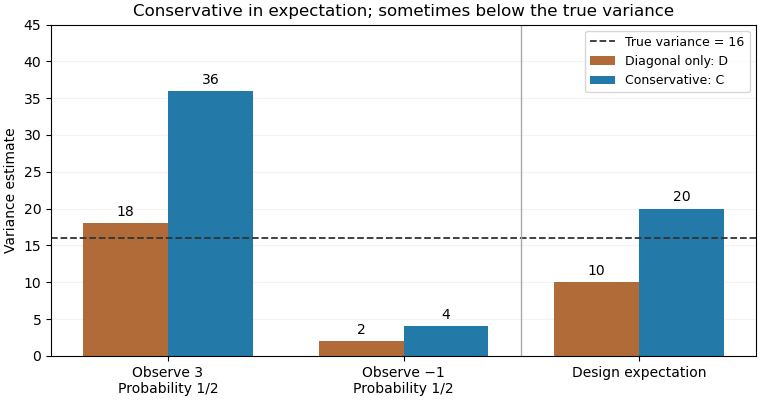
For an original exact illustration, choose one of two fixed values with equal probabilities. As in the single-draw variance identifiability obstruction, the Horvitz-Thompson estimator has true variance . Retaining only diagonal contributions gives , withOpposite signs therefore produce downward bias. The elementary inequality , obtained from , instead givesConsequently is a conservative variance estimator for this stipulated sampling design; its excess in expected value is exactly .
With , the true variance is16. The two possible values of are18 and2, averaging10; those of are36 and4, averaging20. Although , a realized value of can be below16. Conservativeness here is an expectation inequality, rather than a bound for every sample. By itself it also does not prove a specified confidence interval coverage probability.

Articles by others on the same topic
There are currently no matching articles.