Jonathan Bloom is a mathematician and teacher identified by MIT's Experimental Study Group with work in topology and redevelopment of the probability-and-statistics course 18.05. Its institutional profile connects those activities to his later computational research.[ref]
Jonathan Bloom profile by MIT Experimental Study Group. Institutional biography, topology work and redevelopment of 18.05
Bloom and Jeremy Orloff are named coauthors of Covariance and Correlation by Jeremy Orloff and Jonathan Bloom. The reading defines covariance and correlation and derives their basic properties.[ref] This documented teaching contribution offers a precise mathematical example of separating a definition from a stronger conclusion that it does not imply.
For an original example, let a random variable take values with equal probabilities and set . Thenso . Both variances are positive:and their correlation coefficient is zero. Nevertheless they are not independent random variables, becauseThe pair consists of uncorrelated random variables with exact nonlinear dependence.
This calculation explains why a covariance summary can miss a deterministic relation; it is not an empirical dataset or a claim that Bloom originated the distinction. Connecting formal properties to counterexamples is directly useful when mathematical statistics is applied to complicated data. The institutional biography documents Bloom's movement between mathematical teaching and computational work, while the named course source supplies the concrete authored contribution.
David D. Yao coauthored the 1992 work on common random numbers with Paul Glasserman. Their analysis gives conditions under which coordinated random inputs improve comparisons of simulated systems, emphasizing monotonicity and continuity of event times.[ref]
Some Guidelines and Guarantees for Common Random Numbers by Paul Glasserman and David D. Yao. Primary byline and abstract; §1
The cited primary byline retains his middle initial without expanding it.An original queueing theory calculation illustrates the event-time viewpoint. Start an initially empty, first-come-first-served single-server queue with arrivals . For service times , its single-server queue departure-time recursion isThis is the paper's service-completion recursion in renamed notation.[ref]
Some Guidelines and Guarantees for Common Random Numbers by Paul Glasserman and David D. Yao. §3, equations8–9, p894; §4.2, Example4.6, p897
With service times , the departures are . Reducing all services to gives departures using the same arrival input.At time , the first system has completed one job and the second has completed two. The states differ even though corresponding job labels and arrival times are coordinated. In a stochastic comparison, random inputs should likewise be assigned consistently to the intended jobs or events; a raw position in a mixed event list need not identify the same physical event in both simulations.
The deterministic numbers above demonstrate the recursion, not a measured variance reduction. A useful random coupling must preserve each system's marginal input law and have the response properties required for the chosen performance comparison. Shared random seeds alone do not establish those properties.
Paul Glasserman studies simulation and statistical methods. His 1992 joint paper with David D. Yao investigates when common random numbers beneficially couples comparisons of stochastic systems, including parameter-sensitivity comparisons.[ref]
Some Guidelines and Guarantees for Common Random Numbers by Paul Glasserman and David D. Yao. Primary byline; §1, pp884–885, sensitivity-analysis setting
An original finite-difference example shows how the noise scale can depend on coupling. For , let , where has an exponential distribution of mean and variance one. Since , its expectation derivative is . Using the same for both parameter values giveswhose variance is regardless of positive .
If the two simulations instead use independent random variables with that same exponential law, the estimator remains unbiased but has varianceFor chosen and , this is , compared with under the shared-input coupling. Averaging independent replicate pairs divides either variance by their number. These are exact properties of the stipulated linear simulation model, not benchmark measurements.
The useful cancellation occurs because the two outputs respond smoothly to the same random input. Other models can give a less favourable covariance or discontinuous response. The paper's conditions, rather than the act of reusing a seed alone, justify its general variance-reduction conclusions. Common random numbers explains the underlying covariance identity and a counterexample where sharing inputs makes a comparison noisier.
Thomas Stützle researches computational optimization, including local search and algorithm configuration. His author-maintained IRIDIA homepage describes the irace configuration software and its use of racing algorithms.[ref] He also coauthored Iterated Local Search by Helena R. Lourenço and others with Helena Ramalhinho Dias Lourenço and Olivier C. Martin.[ref]
The modular iterated local search framework keeps the embedded local search distinct from a local-search perturbation and the subsequent acceptance decision. That separation makes a solver's settings part of the experimental description rather than incidental implementation detail.
An original budget comparison illustrates a configuration pitfall. Suppose setting A takes per objective evaluation and setting B takes , with all other costs neglected. In a budget they can perform and evaluations respectively. Comparing both after evaluations instead gives B twice as much time. Neither evaluation count nor elapsed time is inherently the wrong budget; the comparison must state which resource is constrained. These are hypothetical costs, not irace timings.
This is why algorithm configuration and algorithm selection are related but distinct: one tunes a parameterized solver, while the other chooses among candidates for an instance. A useful evaluation records the tuned parameters, computational budget and held-out instances alongside solution quality.
Olivier C. Martin coauthored the 2001 survey Iterated Local Search by Helena R. Lourenço and others with Helena Ramalhinho Dias Lourenço and Thomas Stützle. Its title page identifies him with Université Paris-Sud, Orsay. The survey describes searching over outputs of an embedded optimizer, rather than treating every feasible solution as an equally likely search state.[ref]
Iterated Local Search by Helena R. Lourenço and others. Title page; §1, reduced search space; §2.1, general framework
An original finite example distinguishes uniformly chosen starting states from uniformly chosen local minima. Let a deterministic local search operator map six possible starts as follows:Here are its three possible locally optimized outputs. A uniform random start reaches them with probabilities , and , not each. This follows simply by counting the starts mapped to each output. It is a chosen abstract optimizer map, not a claim about a particular benchmark landscape.
In iterated local search, a local-search perturbation followed by induces another transition mechanism on those outputs. Its probabilities depend on both components. Consequently a chain of locally optimized candidates is not automatically a uniform sample of local minima, nor does it automatically have a prescribed equilibrium distribution. The optimizer and transition rule must be specified before making such sampling claims.
Helena Ramalhinho Dias Lourenço is a researcher in combinatorial optimization, scheduling and routing. Her UPF profile explicitly gives this full name and explains her earlier publication name Helena R. Lourenço.[ref] Under that earlier name, she coauthored the iterated local search survey with Olivier C. Martin and Thomas Stützle.[ref]
One part of their framework is the iterated local search acceptance rule. An original abstract example shows why acceptance can change where the search reaches. Suppose three locally optimized candidates have costs , and the fixed perturbation-plus-improvement map sends to and to . Starting at , accepting only a strictly lower cost rejects and repeats the same failed transition. Accepting every candidate instead follows , reaching cost after two transitions. This chosen example illustrates a possibility, not a general guarantee for the always-accept rule.
The survey's actual travelling salesman problem comparison measured mean excess tour length over ten independent runs, each with a 120-second budget on a Pentium266MHz computer. For instance fl3795, Table3 reports excesses of percent for random restart, percent for always accepting the new locally optimized candidate and percent for the improving-only rule.[ref] That experiment favoured the improving-only rule under its specified setup, even though the abstract example above shows why that rule can sometimes block progress. The problem, embedded search and evaluation budget all matter.
Yoram Singer coauthored the 2011 AdaGrad paper with John Duchi and Elad Hazan. Their adaptive gradient methods use past subgradients to change the geometry of later optimizer updates.[ref]
An unconstrained diagonal specialization uses a diagonal AdaGrad accumulatorwith learning rate and stabilization outside the square root. The accumulator is part of the optimizer state.[ref]
For an original supplied-gradient example, let the current accumulator be , the current gradient be , and choose , . These accumulator values include the current gradient. The next displacement isThe identical current gradient coordinates produce different movements because their histories differ. Plain gradient descent with the same learning rate would move by . This calculation exposes the mechanism without asserting that either update improves every possible objective function.
The example also explains why saving only the parameter vector is insufficient to reproduce a later adaptive step. Two runs at the same , receiving the same , can move differently if their stored accumulators differ.
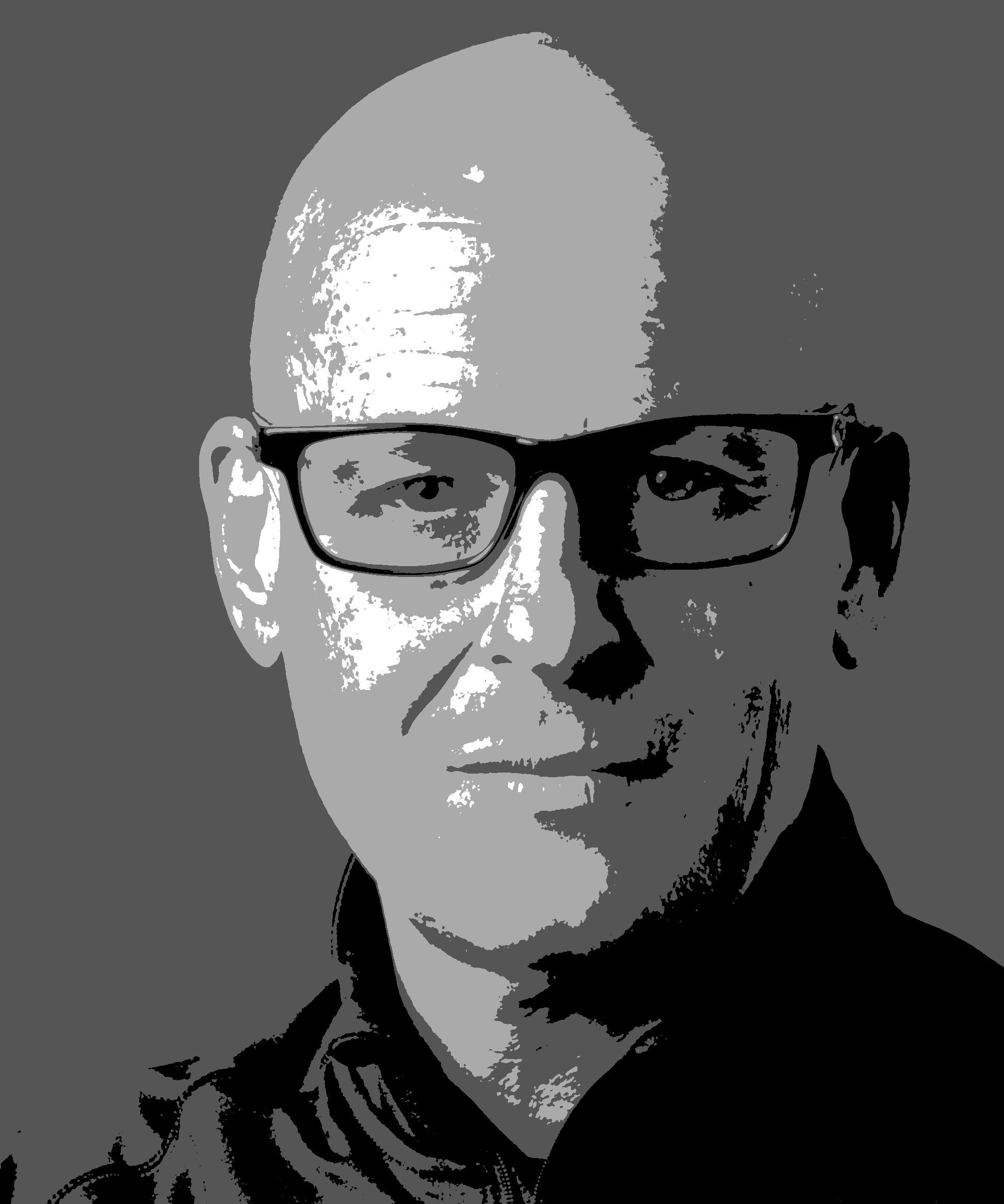
Yoram Singer, portrait linked from his personal research homepage
. [ref]Yoram Singer personal research homepage. Named homepage and linked portrait
Elad Hazan coauthored the 2011 AdaGrad paper with John Duchi and Yoram Singer. The work analyzes adaptive gradient methods in online learning and stochastic optimization, using accumulated subgradients to adapt the update geometry.[ref]
A useful theoretical benchmark is cumulative regret. For loss functions , sequential choices and one fixed comparator , it isThis compares whole sequences of losses against one fixed decision, rather than demanding improvement after every update.[ref]
Adaptive Subgradient Methods for Online Learning and Stochastic Optimization by John Duchi and others. Section 1.1, regret definitions and sublinear-regret goal
For an original two-action example, let the losses of action A over three rounds be and those of action B be . A learner choosing A, B, B incurs total loss . Always choosing A also costs , while always choosing B costs . The learner therefore has zero cumulative regret against the best fixed action, even though it still suffered a positive loss in the third round. Choosing the best action separately in every round would give total loss zero, but that is a different comparator.
Likewise, if a hypothetical guarantee has the form for a fixed constant , division by gives . This elementary implication explains how a growing total cumulative regret can coexist with a shrinking average gap. It does not establish such a guarantee for an arbitrary optimization algorithm.

Elad Hazan institutional profiles at Princeton. Named research portal and portrait
Lloyd N. Trefethen is a mathematician working in numerical analysis. His author-maintained homepage records work at Oxford and a subsequent applied-mathematics appointment at Harvard. His book Spectral Methods in MATLAB by Lloyd N. Trefethen teaches spectral methods through short executable programs, connecting approximation accuracy with numerical solutions of differential equations.[ref][ref]
Spectral Methods in MATLAB by Lloyd N. Trefethen. Author's book page: forty programs and demonstrations of spectral accuracy
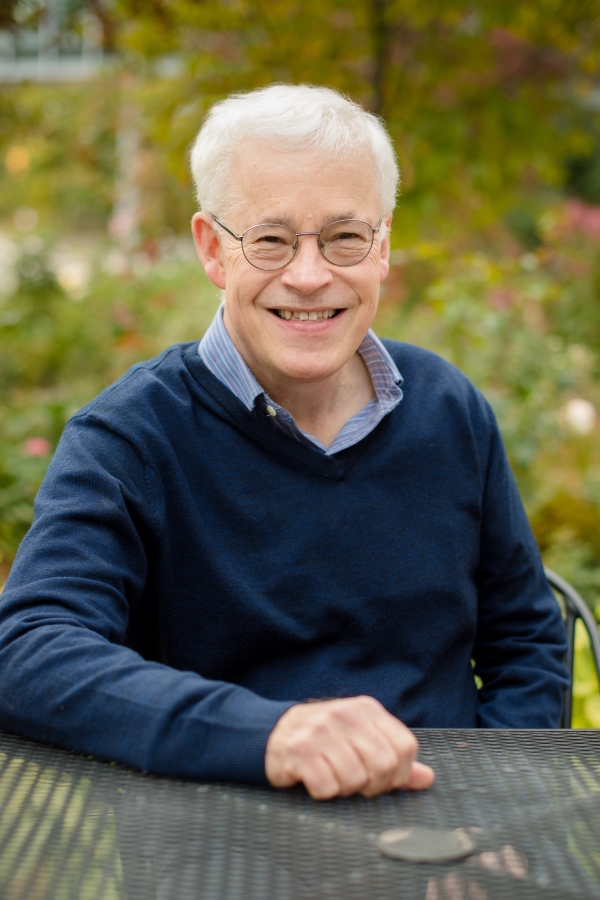
Lloyd N. Trefethen
. Portrait credited to Sarah Bird on Lloyd N. Trefethen homepage.An instructive theme is that an approximation's smoothness affects how efficiently its coefficients decay. A Fourier series representation of a smooth periodic function can be differentiated through its coefficients, but unresolved oscillations can still produce aliasing. High accuracy for one smooth test function does not establish that every sampled input is equally well represented.[ref]
Spectral Methods in MATLAB by Lloyd N. Trefethen. Author's description of programs comparing spectral accuracy for varying smoothness
For a concrete illustration, sampling on sufficiently many equally spaced points over a full period permits its trigonometric interpolant to reproduce the function exactly, and coefficient differentiation gives . With only four equally spaced points, the samples instead match ; differentiating that interpolant gives . The calculation illustrates the attraction of spectral methods and the need to state their resolution assumptions. It is an original example of the numerical questions made tangible by his computational exposition.
Stuart P. Lloyd developed conditions and an iterative procedure for minimizing squared error in quantization. His paper Least Squares Quantization in PCM by Stuart P. Lloyd, published in 1982, identifies Bell Laboratories as his affiliation and records a presentation of part of the work in 1957. The motivating problem was pulse-code modulation: representing a signal sample by one of finitely many reconstruction values.[ref]
Least Squares Quantization in PCM by Stuart P. Lloyd. Page 129, author footnote and introduction
The central conditions have a clear interpretation. For fixed reconstruction values, assign an input to a nearest value. For fixed assignment regions of positive probability, place each reconstruction value at the corresponding conditional expectation. Alternating these operations gives Lloyd's algorithm; neither operation increases the mean squared error, but this does not guarantee the global optimum from every initialization.[ref]
Least Squares Quantization in PCM by Stuart P. Lloyd. Sections IV–VI: best quanta, best partition and an algorithm
For an original example, take a continuous uniform distribution on and two reconstruction values. Splitting at zero gives conditional means and , whose midpoint is again zero. The mean squared error isUsing the single reconstruction value zero instead gives . This concrete improvement explains the optimization objective: preserve signal amplitudes accurately with a limited collection of values.
V. Balakrishnan is a theoretical physicist associated with the Indian Institute of Technology Madras. Its institutional profile identifies research in quantum dynamics, stochastic processes and dynamical systems, including random walks on hierarchical structures and recurrence statistics.[ref]
https://physics.iitm.ac.in/research/quantuminformationandquantumoptics/balakrishnan.html. IIT Madras, V. Balakrishnan, areas of interest and current research
His Physical Applications of Stochastic Processes by V. Balakrishnan connects probability calculations to physical motion. A particularly instructive example is the fixed-step isotropic random flight: independent directions give zero mean displacement but a mean squared displacement proportional to the number of steps. Shrinking the step length and duration together then produces a finite diffusion coefficient and a diffusion equation description.[ref]
Physical Applications of Stochastic Processes by V. Balakrishnan. Lecture 4, section 2.11, printed pages 35–39: random flights and diffusion limit
The example illustrates a recurring scientific distinction in his exposition: an average position, a typical displacement and a probability density answer different questions. Cancellation of displacement vectors does not eliminate the spreading of individual trajectories. IIT Madras's account of the chair established in his honor also identifies contributions to continuous-time random walks and recurrences in dynamical systems.[ref]
https://www.iitm.ac.in/happenings/press-releases-and-coverages/iit-madras-launches-v-balakrishnan-institute-chair. Institutional announcement, 19 July 2022: research contributions and teaching
Arnab Sen is a mathematician working in probability theory and mathematical physics. His own biography identifies a Berkeley doctorate completed in 2010, subsequent research at Cambridge, and work at the University of Minnesota. His research includes random graphs, random matrices and disordered models in statistical physics.[ref]
With Nathanaël Berestycki and Christophe Garban, he developed a new state space and topology for the coalescing Brownian flow and proved an probabilistic invariance principle for coalescing random walks under a finite-variance assumption. The theorem connects discrete particle systems with a continuum stochastic flow.[ref]
Coalescing Brownian flows: A new approach by Nathanaël Berestycki and others. Abstract and Introduction: new state space, topology and finite-variance invariance principle
The physical picture is simple even though convergence of an entire flow is subtle: particles wander separately until meeting, then continue as one. Tracking only the position of one particle misses when two histories merge. A framework for the whole collection must retain that interaction.

Christophe Garban is a mathematician whose research connects probability theory with statistical physics. His institutional and personal pages identify work on percolation, phase transitions and scaling limits, with a professorship at Lyon 1 beginning in 2014.[ref]
His work with collaborators constructs limiting measures for pivotal sites, clusters and interfaces in critical planar percolation. A pivotal site is a location whose state can change a macroscopic connectivity event. Counting such locations requires a scale-dependent normalization before a nontrivial continuum limit emerges. The resulting measures make sensitivity to microscopic changes part of the limiting geometry.[ref]
Pivotal, cluster and interface measures for critical planar percolation by Christophe Garban and others. Abstract and Introduction: pivotal measures, conformal covariance and cluster/interface measures
With Nathanaël Berestycki and Arnab Sen, he also constructed a state-space description yielding convergence from coalescing random walks to a coalescing Brownian flow with only finite variance of the increments. This connects his study of continuum random geometry with interacting stochastic paths.[ref]
Coalescing Brownian flows: A new approach by Nathanaël Berestycki and others. Abstract: finite-variance invariance principle and topology motivated by planar percolation
Nathanaël Berestycki works in probability theory, connecting stochastic motion with random geometry. His University of Vienna homepage identifies research on Brownian motion, the Gaussian free field, Liouville quantum gravity and interacting particle systems.[ref]
https://homepage.univie.ac.at/nathanael.berestycki/. Author homepage, What I do and institutional identification
With Christophe Garban and Arnab Sen, he introduced a topology for the coalescing Brownian flow and obtained convergence from coalescing random walks under finite variance of the increments. The state-space choice makes the continuum limit accessible without stronger moment assumptions previously needed in other descriptions.[ref]
Coalescing Brownian flows: A new approach by Nathanaël Berestycki and others. Abstract and Introduction: comparison of moment assumptions and flow topology
A useful distinction is between convergence of finitely many trajectories and convergence of a whole random flow. Starting particles at many locations creates a shared pattern of meetings and mergers. A continuum description has to preserve the consistency of those histories, rather than merely fit the distribution of one endpoint.
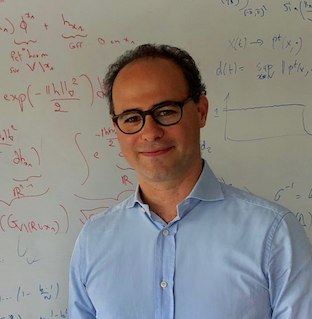
Martin Hairer is a mathematician whose work joins probability theory and analysis. He developed regularity structures to give precise meaning to classes of singular stochastic partial differential equations. His EPFL biography identifies this work as central to his 2014 Fields Medal.[ref]
https://www.epfl.ch/labs/propde/prof-martin-hairer/. Institutional biography and principal publications
The motivating obstacle is that a noisy solution can be too irregular for the nonlinear operations appearing in its own equation. Smoothing the input makes an ordinary equation possible, but the resulting solutions need not converge when the smoothing is removed. Regularity structures replace ordinary polynomial local expansions with expansions tailored to the singular input and organize the necessary corrections. The theory proves convergence of appropriate corrected approximations for the equations it covers.[ref]
A theory of regularity structures by Martin Hairer. Abstract and Introduction: local expansions, nonlinear operations and renormalized approximation
His An Introduction to Stochastic PDEs by Martin Hairer gives a complementary starting point through the stochastic heat equation and mild solutions. Integrating the heat evolution against a random driving term clarifies why solving a noisy equation requires specifying both the evolution operator and the interpretation of the noise.[ref]
An Introduction to Stochastic PDEs by Martin Hairer. Sections 2 and 5: motivating equations and stochastic convolution

Leonid Pestov is a mathematician associated with inverse problems for waves and geometry. With Gunther Uhlmann, he proved boundary rigidity for compact simple two-dimensional Riemannian manifolds: boundary-to-boundary distances determine the interior metric up to a change of coordinates fixing the boundary.[ref]
The ambiguity is physical as well as mathematical. Relabeling interior points does not change the travel time between labeled boundary points, so no reconstruction using only those times can distinguish the relabeling. The theorem shows that, under its geometric assumptions, this is the entire ambiguity. Pestov's institutional lecture description also concerns reconstructing coefficients of a wave equation from observations, connecting the geometric theorem with travel-time and wave-imaging measurements.[ref]
https://ias.hkust.edu.hk/events/inverse-problems-for-wave-equation-and-imaging. 2017 institutional event record, mathematical identity and lecture abstract
Gunther Uhlmann studies inverse problems, imaging and partial differential equations. His research asks how measurements made outside an inaccessible region constrain its internal coefficients or geometry. His institutional research account identifies applications to medical imaging and the structure of Earth.[ref]
With Leonid Pestov, he proved a two-dimensional boundary rigidity theorem: for a compact simple Riemannian manifold, boundary distances recover the metric up to a boundary-fixing diffeomorphism. The qualification prevents confusing a recoverable physical geometry with a unique coordinate description.[ref]
This gives a precise version of the imaging question “can travel times reveal the interior?” It also explains why assumptions about ray geometry matter: if measurements never probe a hidden region, changing that region need not change the data.

Gunther Uhlmann, portrait identified on his University of Washington page
. Yaiza Canzani works in spectral geometry, studying how the geometry of a space controls eigenfunctions and eigenvalues of its Laplace operator. Her research account includes bounds for eigenfunction concentration, averages over submanifolds and spectral counting remainders.[ref]
https://canzani.web.unc.edu/research/. Publications and research topics
Her Analysis on Manifolds via the Laplacian by Yaiza Canzani develops the geometry behind this spectral language. On a circle, for example, the modes , and have nonnegative Laplace eigenvalues and . Their oscillation scale grows with , making the link between shape, frequency and eigenvalue tangible. On a general Riemannian manifold, the corresponding questions concern how waves concentrate and how geometry changes their allowed modes.[ref]
Analysis on Manifolds via the Laplacian by Yaiza Canzani. Eigenfunction examples and variational characterization of the spectrum
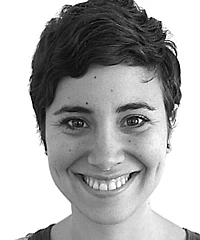
Roman Vershynin studies high-dimensional probability theory and its applications to data. His High-Dimensional Probability by Roman Vershynin develops tools including concentration inequalities, random-matrix estimates and generic chaining, which turn geometry and independence into bounds that hold simultaneously over many directions.[ref]
High-Dimensional Probability by Roman Vershynin. First edition, random matrices and Chapter 8, chaining
A representative question is how many random observations are needed to preserve information about a high-dimensional object. Controlling one fixed direction is easier than controlling every direction at once, so the geometry of a whole family of directions becomes part of the probability calculation. His research page describes this connection between probability and mathematical data science; his author-hosted expository work also treats geometric methods for constrained estimation.[ref][ref]
https://arxiv.org/abs/1405.5103. Author's Estimation in high dimensions: a geometric perspective, abstract

Roman Vershynin, portrait identified by the linked author, institutional or Commons source
. Thomas S. Richardson develops graphical approaches to causal inference and statistical models, including ways to reason when some variables are hidden. His institutional research description lists graphical models, model selection, Bayesian inference and causal models.[ref]
He is a coauthor of Nested Markov Properties for Acyclic Directed Mixed Graphs by Thomas S. Richardson and others. The work represents observable constraints of hidden-variable directed graphs using a nested Markov model. Its motivation is that eliminating a hidden cause can leave more than ordinary conditional independence restrictions among the measured variables.[ref]
Nested Markov Properties for Acyclic Directed Mixed Graphs by Thomas S. Richardson and others. Introduction and characterization of marginal hidden-variable models
For example, a hidden common cause of two observed variables can be represented by a bidirected edge in a latent projection. The graph records a possible dependence source without pretending that the common cause itself was measured. Such representations separate what observations constrain from what remains unidentifiable.
Robin J. Evans studies causal inference, graphical models and the behavior of statistical models after hidden variables are marginalized. His work on margins of Bayesian networks characterizes algebraic restrictions that are not captured by a list of conditional independences alone.[ref]
With Thomas S. Richardson and other collaborators, he coauthored Nested Markov Properties for Acyclic Directed Mixed Graphs by Thomas S. Richardson and others. A central idea is to describe constraints on the observed distribution without committing to an identifiable parameter for every unobserved mechanism.[ref]
This matters when two models agree on ordinary independence tests yet differ in other restrictions on probabilities. Separating these cases can improve both model interpretation and estimation: a convenient parameterization of the observed model need not identify the underlying hidden causal story. His institutional personal-page redirect leads to his research-group site.[ref]

Elliot Anshelevich studies algorithms for networks with decentralized or strategic decision makers. His institutional research description includes network formation, algorithmic game theory, approximation algorithms and computational questions about collective choice.[ref]
He is a coauthor of The Price of Stability for Network Design with Fair Cost Allocation by Elliot Anshelevich and others. The paper asks how good the best stable network can be when each user can individually change routes and shared edge costs are divided among their users. This separates the best equilibrium's cost from the worst equilibrium's cost, formalized by price of stability and price of anarchy.[ref]
The Price of Stability for Network Design with Fair Cost Allocation by Elliot Anshelevich and others. Introduction and network-design model
The question is useful for a designer who can recommend a network but cannot prevent unilateral departures. A low-cost recommendation is sustainable only if no user can improve by leaving it; computing a cheap network and understanding its incentives are therefore different parts of the problem.

Elliot Anshelevich, portrait identified by the linked author, institutional or Commons source
. Anirban Dasgupta studies algorithms for large datasets, networks and related learning problems. His IIT Gandhinagar profile identifies large-scale data algorithms and social networks among his research interests.[ref]
He coauthored The Price of Stability for Network Design with Fair Cost Allocation by Elliot Anshelevich and others and Near-Optimal Network Design with Selfish Agents by Elliot Anshelevich and others. These works connect network optimization with individual route choices. A centrally cheap collection of paths may fail to persist if users can reduce their own payments by switching; conversely, a stable collection need not minimize the total cost.[ref]
The algorithmic challenge is to control both quantities at once: computational work required to find a network and inefficiency introduced by decentralized decisions. That is a concrete bridge between approximation guarantees and strategic behavior.

Anirban Dasgupta, portrait identified by the linked author, institutional or Commons source
. Jon Kleinberg studies algorithms and networks, including how the link structure of information can reveal useful organization. His work on the HITS algorithm assigns separate authority and hub scores to web pages: an authority is supported by good hubs, while a hub points to good authorities.[ref]
https://www.cs.cornell.edu/info/people/kleinber/sciam99.html. Author's Hypersearching the Web, hub/authority definition and iterative procedure
If when page links to page , the updates take the form and , with normalization. Combining them gives a power iteration on for authority scores and on for hub scores. Thus the apparently circular verbal definition becomes a numerical eigenvector problem rather than an infinite regress. Link structure supplies a ranking signal, not a guarantee of truth.
With Éva Tardos, Kleinberg also wrote the algorithms textbook Algorithm Design; his institutional page identifies network structure as a central research theme.[ref]

Jon Kleinberg, portrait identified by the linked author, institutional or Commons source
. Éva Tardos studies algorithms and the efficiency of systems in which participants act for themselves. Her work with Tim Roughgarden quantified inefficiency in selfish routing, relating equilibrium traffic to a centrally optimized flow.[ref][ref]
How Bad is Selfish Routing? by Tim Roughgarden and Éva Tardos. Network-routing model and inefficiency bounds
A small example shows the issue. Route one unit of traffic over two parallel links, one with latency when carrying flow and one with fixed latency one. The selfish equilibrium sends everything over the first link, giving total latency one: no user can improve by switching to the other link. Splitting traffic equally gives total latency , which minimizes . The equilibrium-to-optimum ratio is .
This is a precise price of anarchy calculation. It demonstrates why individually sensible choices can create avoidable aggregate delay and why a guarantee about an optimization algorithm does not automatically describe an uncoordinated network.

Éva Tardos, portrait identified by the linked author, institutional or Commons source
. Tom Wexler works on approximation algorithms, game theory and networks. The author information accompanying Near-Optimal Network Design with Selfish Agents by Elliot Anshelevich and others identifies these research interests and his association with Denison University. It also verifies that this is the coauthor of the strategic network-design work.[ref]
A simple shared-cost example illustrates the kind of incentive question involved. Suppose each of two users can buy a private link costing four or use a common link costing six, split equally if both use it. Both choosing the common link is stable and costs six overall. Both choosing private links is also stable: switching alone to the common link would cost six rather than four. The latter arrangement costs eight despite having no profitable unilateral move.
The contrast motivates separate analysis of the best and worst Nash equilibria. Network-design work asks how cost-allocation rules and algorithms can find efficient stable outcomes, rather than assuming every stable outcome is socially cheapest.[ref]
The Price of Stability for Network Design with Fair Cost Allocation by Elliot Anshelevich and others. Introduction, stable recommendations and best equilibrium

Tim Roughgarden studies the interaction between algorithms, economic incentives and computational limits. His work on selfish routing, including collaboration with Éva Tardos, asks how much efficiency is lost when network users minimize their own delays.[ref]
His Intrinsic Robustness of the Price of Anarchy by Tim Roughgarden develops a framework in which certain inefficiency bounds persist beyond a particular equilibrium description. The proof controls the aggregate cost of specified unilateral deviations, making the bound applicable to broader patterns of behavior such as appropriate learning outcomes.[ref]
Intrinsic Robustness of the Price of Anarchy by Tim Roughgarden. Introduction and robust price-of-anarchy framework
This distinction is useful: proving that an optimal outcome exists, that an equilibrium exists and that observed adaptive behavior stays efficient are three different claims. A robustness argument states which behavioral conditions are actually sufficient for its guarantee. Columbia's institutional profile identifies algorithmic game theory and the design and limitations of algorithms as his research areas.[ref]
Tim Roughgarden, portrait identified by the linked author, institutional or Commons source
. Davar Khoshnevisan is a mathematician whose work concerns probability theory, particularly random fields and stochastic partial differential equations. His institutional page lists research on long-time behavior and well-posedness of randomly forced equations, as well as geometric properties of their solutions.[ref]
His Topics in Probability: Lévy Processes by Davar Khoshnevisan develops how processes with stationary independent increments are decomposed and described by their exponents. For instance, the notes distinguish increasing jump processes through the Laplace exponent of a subordinator of a subordinator, connecting an abstract stochastic process to an explicitly computable transform.[ref]
Topics in Probability: Lévy Processes by Davar Khoshnevisan. Lectures 7–8, compound Poisson component and Laplace exponent

David Pollard is a statistician whose research and exposition concern weak convergence, empirical processes and stochastic processes. Yale's institutional profile identifies these specialties, together with statistical asymptotics and econometrics.[ref]
A recurring scientific issue in his writing is how bounds for one random quantity become simultaneous bounds for a whole indexed family. His Measurability Woes by David Pollard explains why pointwise almost-sure agreement does not automatically provide a single exceptional set valid at every index. That distinction matters when a supremum or an entire sample path enters an argument. His author page lists Convergence of Stochastic Processes (1984) and Empirical Processes: Theory and Applications (1990), followed by broader notes on probability methods.[ref]
https://www.stat.yale.edu/~pollard/. Books and manuscripts
[ref]Henry Rouanet worked on statistics for researchers in psychology and the social sciences, emphasizing interpretable methods for analyzing actual data. His own account describes that aim and organizes his work by statistical problem rather than by an abstract sequence of prerequisites.[ref]
https://helios2.mi.parisdescartes.fr/~lerb/rouanet/WelcomePage.html. Author's account of his scientific work
With Brigitte Le Roux, he wrote Geometric Data Analysis by Brigitte Le Roux and Henry Rouanet. Its treatment of correspondence analysis and principal component analysis expresses multivariate data as weighted clouds in Euclidean geometry. The choice of weights and metric specifies which departures count as large; the resulting picture is part of the statistical model, not simply an illustration added afterward.[ref]

Brigitte Le Roux studies geometric data analysis, including correspondence analysis and principal component analysis. Her research account describes investigations of how principal axes change when observations, weights or the underlying Euclidean geometry are modified. This stability question asks which apparent structures survive a change in the analysis, rather than treating every fitted axis as intrinsic to the data.[ref]
https://brigitte-le-roux.com/en/recherches/. Geometric Data Analysis: Foundations, stability and sensitivity of principal axes
Her joint book with Henry Rouanet, Geometric Data Analysis by Brigitte Le Roux and Henry Rouanet, develops the weighted-cloud approach through correspondence analysis, Euclidean clouds and principal component analysis. It connects the linear algebra of projections with explicit choices about representation of multivariate observations.[ref]

Andrey Shilnikov studies bifurcation theory and dynamical systems. With Leonid Pavlovich Shilnikov, he authored an account of the Shilnikov bifurcation, explaining how a homoclinic orbit to a saddle-focus can produce complicated dynamics. The construction connects local contraction and expansion near an equilibrium with a global return of its unstable manifold.[ref]
Shilnikov Bifurcation by Leonid Pavlovich Shilnikov and Andrey Shilnikov. Saddle-focus and Shilnikov theorem sections
Leonid Pavlovich Shilnikov developed the theory of Shilnikov bifurcations associated with a saddle-focus. The Shilnikov bifurcation explains a route to chaos through the return of an unstable manifold to the same equilibrium. His joint account with Andrey Shilnikov describes the role of the saddle quantity in distinguishing stable periodic behavior from more complicated nearby dynamics.[ref]
Shilnikov Bifurcation by Leonid Pavlovich Shilnikov and Andrey Shilnikov. Shilnikov theorem section
Gabriel Paternain works on the interaction between differential geometry, dynamical systems and inverse problems. His notes with Will J. Merry connect the geodesic flow and Anosov flows to the X-ray transform and boundary rigidity. The guiding reconstruction problem asks how much of an interior Riemannian metric can be determined from measurements of trajectories or distances at the boundary.[ref]
Will J. Merry coauthored notes with Gabriel Paternain on inverse problems in geometry and dynamical systems. They develop geodesic flows, the Anosov flows and Livšic theorem as tools for reconstruction. A recurring idea is to infer information about a function or a Riemannian metric from integrals along trajectories, rather than from direct measurements at every interior point.[ref]
E. B. Vul is a coauthor, with Yakov Sinai and Konstantin Khanin, of a 1984 study of Feigenbaum constants using thermodynamic formalism. The work connects the scaling behavior of period doubling with methods developed for statistical mechanics. The initials identify the cited byline; they are retained here without assuming an unverified expansion of the name.[ref]
Feigenbaum universality and the thermodynamic formalism by E. B. Vul and others. Byline and article subject, Russian Mathematical Surveys 39(3), 1–40
Konstantin Khanin coauthored a study connecting Feigenbaum constants with thermodynamic formalism, together with E. B. Vul and Yakov Sinai. This places the repeated scaling of period-doubling dynamics in a framework related to statistical mechanics, connecting detailed orbit geometry with collective scaling descriptions.[ref]
Feigenbaum universality and the thermodynamic formalism by E. B. Vul and others. Byline and article subject, Russian Mathematical Surveys 39(3), 1–40
Yakov Sinai contributed to the study of Feigenbaum constants through thermodynamic formalism, in joint work with E. B. Vul and Konstantin Khanin. Their 1984 paper connects universal period-doubling scaling with methods of statistical mechanics, illustrating how probabilistic and geometric descriptions of a dynamical system can reinforce each other.[ref]
Feigenbaum universality and the thermodynamic formalism by E. B. Vul and others. Byline and article subject, Russian Mathematical Surveys 39(3), 1–40
Nicolás Rivera coauthored, with Richard Pymar, an analysis of the density process of the noisy voter model. The process averages binary opinions using the stationary distribution of an underlying Markov chain. Their results identify different limiting behaviors as graph size and noise vary, linking the graph geometry and copying dynamics to the form of macroscopic fluctuations.[ref]
Richard Pymar studied the noisy voter model with Nicolás Rivera. They analyzed the stationary-mass-weighted density of vertices holding one opinion, rather than only individual vertex states. By varying graph size and the noise parameter, their work describes transitions between different limiting probability distributions for this collective observable.[ref]
Prasad Tetali coauthored the spectral profile method for bounding mixing time of a Markov chain with Sharad Goel and Ravi Montenegro. It refines a single spectral gap by considering functions supported on sets of different stationary masses. This makes the geometry of small sets useful for quantifying convergence to the stationary distribution.[ref]
Ravi Montenegro contributed, with Sharad Goel and Prasad Tetali, to bounds on mixing time of a Markov chain using the spectral profile. Their approach adapts Faber-Krahn inequalities to finite Markov chains and compares the resulting bounds with conductance of a Markov chain methods. It captures information at multiple set sizes that a single bottleneck estimate can miss.[ref]
Mixing Time Bounds via the Spectral Profile by Sharad Goel and others. Introduction and Sections 1.2 and 2.2
Sharad Goel coauthored a method for estimating mixing time of a Markov chain through the spectral profile, with Ravi Montenegro and Prasad Tetali. Their analysis gives upper and lower convergence bounds and applies them to several families of graphs. The central mechanism is to track how relaxation changes with the stationary mass of a function's support.[ref]
Eric Vanden-Eijnden developed the geometric minimum action with Matthias Heymann. The method computes likely transition paths between states exhibiting metastability in weakly noisy dynamical systems. Reformulating the Freidlin--Wentzell action on curves removes an unnecessary dependence on the speed at which a candidate path is traversed, making the free-time optimization more tractable.[ref]
Matthias Heymann coauthored the geometric minimum action with Eric Vanden-Eijnden. Their algorithm minimizes a geometric form of the Freidlin--Wentzell action to calculate rare transition paths and the quasipotential. Examples include a bistable stochastic differential equation and a genetic-switch Markov jump process, showing how one variational principle applies to different stochastic models.[ref]
Richard Nickl coauthored nonparametric Bernstein-von Mises theorems with Ismaël Castillo for the Gaussian white noise model. Their work explains when Bayesian credible sets can also have asymptotically correct frequentist coverage probability. The result connects the limiting posterior geometry with efficient inference on an unknown function, rather than only a fixed finite-dimensional parameter.[ref]
Ismaël Castillo studied nonparametric Bernstein-von Mises theorems with Richard Nickl. In the Gaussian white noise model, they constructed Bayesian credible sets with asymptotically exact frequentist coverage under stated assumptions. Their analysis also treats functionals, illustrating how an infinite-dimensional unknown function can still yield well-calibrated inference for particular observable quantities.[ref]
Bodhisattva Sen coauthored improved risk bounds for isotonic regression with Sabyasachi Chatterjee and Adityanand Guntuboyina. Their analysis shows that the least-squares estimator adapts to the number of constant pieces of a monotone signal. The work also provides local minimax lower bounds, helping distinguish an estimator's limitations from limitations inherent in the data.[ref]
Adityanand Guntuboyina contributed to risk bounds for isotonic regression with Sabyasachi Chatterjee and Bodhisattva Sen. They quantified how the error of the monotone least-squares estimator depends on the shape of the true sequence. Nearly flat signals permit faster estimation than uniformly increasing signals, an example of adaptation to structure without specifying that structure in advance.[ref]
Improved Risk Bounds in Isotonic Regression by Sabyasachi Chatterjee and others. Abstract and Introduction, equations (5)–(6)
Sabyasachi Chatterjee coauthored improved risk bounds for isotonic regression with Adityanand Guntuboyina and Bodhisattva Sen. The monotone least-squares estimator achieves a range of rates depending on the underlying sequence, including nearly parametric behavior for constant signals. Their local minimax analysis explains why more rapidly varying monotone signals are intrinsically harder to estimate.[ref]
Articles were limited to the first 100 out of 536 total.
Articles by others on the same topic
There are currently no matching articles.