Cyrus Samii is a political scientist at New York University whose methodological work concerns quantitative field research and causal inference. His academic biography connects the design of randomized controlled trials to empirical social research.[ref]
Affiliations and Bio by Cyrus Samii. Affiliations and Bio, methodology and field-research description

Cyrus Samii
. Portrait linked as cds_self from Samii's personal academic biography; served directly by the original website.With Peter M. Aronow, Samii studied sampling designs in which every unit can be observed but some pairs can never be observed together. The distinction matters: positive individual inclusion probabilities suffice for an unbiased estimator of a finite population total, whereas the usual Horvitz-Thompson variance estimator also needs pairwise inclusion positivity.[ref]
Conservative variance estimation for sampling designs with zero pairwise inclusion probabilities by Peter M. Aronow and Cyrus Samii. Section2, conditions1–2 and Sections2.1–2.2, observable and unobservable cross-products
An original two-unit example makes the single-draw variance identifiability obstruction explicit. Fix two unknown population values and choose one index with probabilities . The Horvitz-Thompson estimator is , soAn estimator based only on the selected index and its observed value has expected value of the form . Such an additive expression cannot equal for every pair of real values. Taking the mixed finite difference at gives zero for the additive expression butfor the desired variance. Thus a single draw permits an unbiased estimator of the total but no universally unbiased estimator of its sampling variance. Independent auxiliary randomization cannot repair this: averaging that randomness still gives functions and of the same observed data.
This is a restriction imposed by the observation mechanism, rather than a shortage of algebraic ingenuity. It motivates separating design-based inference about a total from the additional information needed to quantify its uncertainty.
Peter M. Aronow develops statistical methods for causal inference, particularly design-based inference. Yale's institutional biography identifies research on complex experimental designs, network settings and incomplete survey data alongside appointments spanning political science and statistics.[ref]
Peter M. Aronow profile by Yale School of Public Health. Titles and Biography, design-based methodological research
His joint work with Cyrus Samii studies how to estimate sampling variance when a sampling design never observes some pairs together. A missing product cannot simply be deleted from the population variance formula: doing so can produce either sign of bias. Their construction uses Young inequality to bound unobserved products by individually estimable powers and obtain a conservative variance estimator.[ref]
Conservative variance estimation for sampling designs with zero pairwise inclusion probabilities by Peter M. Aronow and Cyrus Samii. Section2.2, Proposition1; Section3.1, Proposition2; Section3.2, quadratic special case
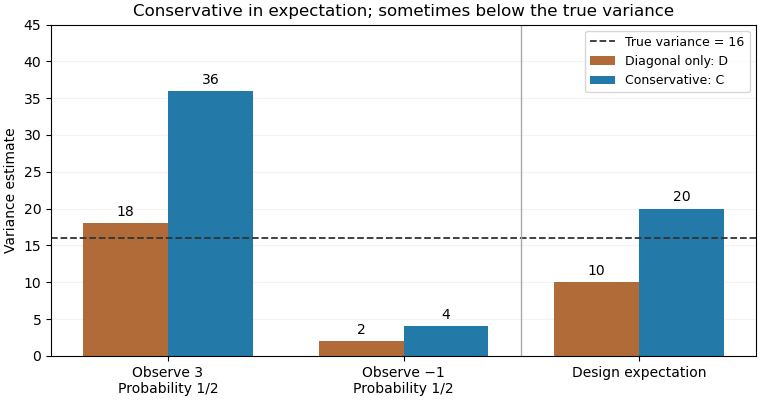
For an original exact illustration, choose one of two fixed values with equal probabilities. As in the single-draw variance identifiability obstruction, the Horvitz-Thompson estimator has true variance . Retaining only diagonal contributions gives , withOpposite signs therefore produce downward bias. The elementary inequality , obtained from , instead givesConsequently is a conservative variance estimator for this stipulated sampling design; its excess in expected value is exactly .
With , the true variance is16. The two possible values of are18 and2, averaging10; those of are36 and4, averaging20. Although , a realized value of can be below16. Conservativeness here is an expectation inequality, rather than a bound for every sample. By itself it also does not prove a specified confidence interval coverage probability.
David J. Craig is the credited writer of Boston University's 14 November 2003 account of research connecting dynamical systems, biology and biomedical engineering. His article describes James J. Collins's work on noise and sensation, including vibrating gel insoles intended to improve the detection of weak pressure signals from the feet. This is a contribution to communicating the research; the article attributes the experimental work to the researchers.[ref]
Dynamic solutions to physiological problems by David J. Craig. Byline, date and “Touch sensitive” section
The scientific puzzle in that account is stochastic resonance: under suitable conditions, adding noise can improve the detection of a weak signal. A simple explanatory model is a detector that responds when , where is the signal, the noise and a threshold. If , a detector without noise never responds; a fluctuating gives a nonzero probability of crossing the threshold. The same noise can also produce a response when the signal is absent, so an increase in threshold crossings alone does not establish improved discrimination. Craig's account places this counterintuitive mechanism in the concrete setting of mechanical stimulation of the sole rather than claiming that noise always helps.[ref]
Dynamic solutions to physiological problems by David J. Craig. “Touch sensitive”: weak-signal detection and the vibrating gel insole
Jennifer Chu is a science writer at MIT News. MIT's staff directory identifies her as a senior writer covering subjects including mathematics, mechanical engineering and physics.[ref]
MIT News staff directory. Jennifer Chu entry
Her credited work includes the institutional account of the MIT Cheetah robot's running-jump demonstration published on 29 May 2015.[ref]MIT cheetah robot lands the running jump by Jennifer Chu. Byline and publication date
That account explains a scientific sequence rather than just reporting that a robot jumped: onboard lidar estimates an obstacle, the controller adjusts the approach and the motors provide the forces needed for takeoff. It also distinguishes treadmill experiments from indoor-track trials, where the available planning distance differs.[ref]
MIT cheetah robot lands the running jump by Jennifer Chu. See, run, jump and treadmill/indoor-track comparisons
The distinction is useful when interpreting a robotics demonstration. Detecting an obstacle and finding a mechanically feasible jump are separate tasks; a successful sensor measurement does not guarantee that a particular approaching state permits the necessary takeoff. The credited contribution here is scientific reporting of the experimental system and its conditions.
John Banzhaf is a legal scholar associated with the mathematical study of the Banzhaf index. His university profile identifies the index bearing his name.[ref]
John F. Banzhaf III faculty profile. Biographical paragraph on the mathematical technique for voting power

Portrait of John Banzhaf
. Self-portrait, as credited by Wikimedia Commons. Creative Commons Attribution-ShareAlike 3.0 Unported. The verified original file is 462 by 606 pixels. Source.Harry Markowitz developed modern portfolio theory, making the tradeoff between expected return and variability a mathematical allocation problem. His 1952 Portfolio Selection by Harry Markowitz emphasizes that the variability of a combination depends on relationships between its components, not just on each component considered alone.[ref]
Portfolio Selection by Harry Markowitz. pp.79–82, expected return, covariance and portfolio variance
For an original toy example, let two return random variables each have variance one. Equal weighting givesWith zero covariance the result is ; with covariance one it is one. The calculation explains why counting assets alone does not determine diversification. Expected values, covariance estimates and allocation constraints supply distinct inputs to the optimization.
The 1990 economics prize recognized his theory of portfolio choice. The awarding academy's account identifies both the 1952 paper and his expanded 1959 treatment.[ref]
The Prize in Economic Sciences 1990 press release. 16 October 1990, Markowitz and portfolio selection
https://photoarchive.lib.uchicago.edu/db.xqy?show=browse8.xml%7C545. Named portrait record and credit
. Photograph undated.Robert Litterman developed the Black-Litterman model with Fischer Black. Their 1992 paper makes equilibrium expected returns a neutral starting point for portfolio modeling, then incorporates views that can differ in their confidence. The contribution addresses how uncertain inputs enter modern portfolio theory, rather than treating every proposed expected return as equally reliable.[ref]
Global Portfolio Optimization by Fischer Black and Robert Litterman. Publisher abstract: neutral equilibrium reference and views with differing confidence
An elementary Bayesian inference analogy illustrates the role of uncertainty. For an unknown quantity with normal distribution prior and an independent observation error giving , Gaussian conditional expectation gives the posterior meanThe more uncertain input receives less weight. This scalar example explains a modeling principle; the full Black-Litterman model treats related expected returns jointly, with a covariance matrix describing their uncertainty.

Robert Litterman with Fischer Black in 1994
. Historical photograph hosted and identified by Goldman Sachs, linked externally. Source.Mark Rubinstein worked on option pricing, including the Cox--Ross--Rubinstein model developed with John C. Cox and Stephen A. Ross. Their 1979 paper constructs an accessible discrete-time model in which successive up and down moves form a binomial price tree. Replicating a contingent payment with traded assets determines its value under the model's no-arbitrage assumptions.[ref]
Option Pricing: A Simplified Approach by John C. Cox and others. 1979, sections on the basic idea and the multiperiod model; author list
The construction makes the relation between hedging and valuation explicit. Its risk-neutral probabilities are weights consistent with the model's prices, rather than predictions of the actual frequency of an upward market move. Refining the time steps also connects the discrete model to the Black-Scholes model.[ref]
Option Pricing: A Simplified Approach by John C. Cox and others. Multiperiod valuation and the limiting case

Portrait of Mark Rubinstein
. Jim Block; photograph in his home library, 2002, hosted by Berkeley Haas. Source.Stephen A. Ross developed arbitrage pricing theory, which relates expected asset returns to exposures to common sources of risk under assumptions limiting arbitrage. His mathematical approach asks how restrictions on feasible trading strategies constrain prices, rather than starting solely from an individual investor's preferences.[ref]
Professor Stephen Ross, inventor of arbitrage pricing theory, dies at 73 by Zach Church. 6 March 2017, discussion of arbitrage pricing theory and its 1976 introduction
With John C. Cox and Mark Rubinstein, he also developed the Cox--Ross--Rubinstein model for option pricing. The binomial price tree separates the possible stock-price paths from the valuation rule: a replicating portfolio and no-arbitrage produce risk-neutral pricing even when the actual up-move probability is not specified.[ref]
Option Pricing: A Simplified Approach by John C. Cox and others. 1979, basic one-period argument and its extension to multiple periods

Portrait of Stephen A. Ross
. 1994 portrait reproduced in the MIT institutional obituary. Source.John C. Cox developed mathematical methods for option pricing and risk-neutral pricing. With Stephen A. Ross and Mark Rubinstein, he introduced the Cox--Ross--Rubinstein model, whose binomial price tree gives a particularly transparent example of a replicating portfolio.[ref]
Option Pricing: A Simplified Approach by John C. Cox and others. 1979, author list and the one-period replication argument
At each node, the two possible next-step payments determine the holdings in a stock and a riskless asset. Repeating this calculation by backward induction values the final payment through the tree. For an American option, the calculation also compares continuation value with the value of immediate exercise. This turns the distinction between European and American exercise rules into a concrete computational decision.[ref]
Option Pricing: A Simplified Approach by John C. Cox and others. Multiperiod model and valuation of options permitting early exercise
Institutional profile: mitsloan.mit.edu/faculty/directory/john-c-cox

Portrait of John C. Cox
. Portrait selected from the matching MIT Sloan institutional profile. Source.Steven L. Heston introduced the Heston model, a stochastic volatility model in which the asset price and its instantaneous variance evolve together. The variance follows a square-root diffusion, while correlation between the price and variance innovations allows asymmetric option-price patterns.[ref]
The model is useful because richer uncertainty does not remove all analytical structure. An affine expression for the characteristic function of the log price allows Fourier inversion to recover the probabilities used in European option valuation. The resulting pricing formula includes numerical integration; “closed-form” here does not mean that every price is an elementary expression without a numerical step.[ref]
Institutional profile: www.rhsmith.umd.edu/directory/steve-heston

Portrait of Steven L. Heston
. Portrait selected from the matching University of Maryland institutional profile. Source.Myron Scholes, with Fischer Black, developed the Black-Scholes model and its option pricing equation. Their 1973 paper connects a contingent claim's value to the cost of a dynamically adjusted replicating portfolio, under explicit assumptions about trading and the underlying price process.[ref]
The Pricing of Options and Corporate Liabilities by Fischer Black and Myron Scholes. 1973, assumptions and derivation of the valuation equation
The mathematical insight is that a carefully chosen hedge can cancel the instantaneous random component of the claim's value. No-arbitrage then constrains the remaining locally riskless return, producing the Black-Scholes equation together with a final payoff condition. The result is a conditional conclusion within a model: it does not require an ability to predict the actual stock-price path.[ref]
The Pricing of Options and Corporate Liabilities by Fischer Black and Myron Scholes. Derivation of the differential equation and the boundary condition for a call
Institutional profile: www.gsb.stanford.edu/faculty-research/faculty/myron-s-scholes

Portrait of Myron Scholes
. Markus Prantl, via Wikimedia Commons; existing crop by JB Hoang Tam 2, CC BY-SA 3.0. Source.Fischer Black developed the Black-Scholes model with Myron Scholes. Their 1973 analysis shows how continuous adjustment of a replicating portfolio can eliminate the local exposure to the underlying random price change, leading to a no-arbitrage equation for the value of a contingent claim.[ref]
The Pricing of Options and Corporate Liabilities by Fischer Black and Myron Scholes. 1973, assumptions and derivation of the valuation equation
This approach makes the hedge part of the mathematical explanation of the price. It also makes the assumptions visible: ideal continuous adjustment and the specified price dynamics are ingredients of the derivation, so changing the trading rules or dynamics can change the valuation problem. The Black-Scholes equation is therefore a useful starting point for studying both a tractable model and the effects of relaxing its assumptions.[ref]
The Pricing of Options and Corporate Liabilities by Fischer Black and Myron Scholes. Model assumptions, valuation equation and discussion of extensions
Robert Litterman and Fischer Black in 1994
. Historical photograph hosted and identified by Goldman Sachs; reproduced by external link. Source.An economist who developed foundations of game theory and the Von Neumann-Morgenstern utility theorem with John von Neumann.

Historical portrait crop of Oskar Morgenstern
. Anonymous photograph, University of the Andes, Colombia; existing Commons crop from its 1954–1955 bulletin group photograph. The source crop is only 48 by 74 pixels. Source.Researcher whose work includes Peer effects, teacher incentives, and the impact of tracking: evidence from a randomized evaluation in Kenya by Esther Duflo and others.

Portrait of Esther Duflo
. Kris Krüg; CC BY-SA 2.0, via Wikimedia Commons. Source.Economist whose research is represented by School readiness and later achievement by Greg J. Duncan and others.
Communication that supports understanding and evaluation of scientific claims. Its effects should be assessed through relevant understanding or decisions, rather than the prestige of scientific terminology alone.
Correcting a misconception with relevant evidence and an interpretable alternative. Immediate endorsement change, durable reasoning and practical decisions are distinct outcomes for evaluating debunking.
A text that identifies a mistaken claim and explains an alternative account or why the claim fails. A short-term effect on a belief questionnaire does not establish a lasting change in teaching practice.
Early formal schooling. Psychological research in primary education must specify age, prior instruction, language and school context rather than assuming that one age or curriculum defines a universal developmental stage.
Organizing pupils partly by assessed achievement. The commonly used label ability grouping should not imply that a placement measures a fixed innate capacity; grouping format, movement and instruction must be specified.
Organizing smaller groups inside a shared class for some instruction. Flexible grouping for a particular learning goal differs from a permanent whole-curriculum stream.
Regrouping pupils by current attainment for a particular subject. The educational effect depends on assessment, movement, teaching and the comparison arrangement rather than the name alone.
Assigning pupils to a group across much of the curriculum. It differs from subject setting and from task-specific within-class grouping, and can concentrate differences in curriculum or opportunity across subjects.
Knowledge and skills acquired in an educational domain, assessed through specified tasks or records. Mathematics procedures, mathematical concepts, word decoding and reading comprehension are distinct outcomes; a single aggregate score can conceal different cognitive demands.
A researcher investigating reading acquisition, processing, assessment or instruction. This specialisation does not by itself assert a particular clinical qualification.
A researcher investigating reading, language development or the processes supporting literacy.[ref]
Learning Words from Context by William E. Nagy and others. Reading Research Quarterly 20, 233–253; incidental word knowledge after reading natural text and limited extrapolation
A researcher investigating reading, language development or the processes supporting literacy.[ref]
The simple view of reading by Wesley A. Hoover and Philip B. Gough. Reading and Writing 2, 127–160; decoding, linguistic comprehension and product predictions in a longitudinal bilingual sample
A researcher investigating reading, language development or the processes supporting literacy.[ref]
Phonemes, rimes, vocabulary, and grammatical skills as foundations of early reading development: evidence from a longitudinal study by Valerie Muter and others. Developmental Psychology 40, 665–681; ninety school entrants, two-year follow-up and distinct predictors
A researcher investigating reading, language development or the processes supporting literacy.[ref]
The simple view of reading by Wesley A. Hoover and Philip B. Gough. Reading and Writing 2, 127–160; decoding, linguistic comprehension and product predictions in a longitudinal bilingual sample
A researcher investigating reading, language development or the processes supporting literacy.[ref]
Ameliorating Early Reading Failure by Integrating the Teaching of Reading and Phonological Skills: The Phonological Linkage Hypothesis by Peter J. Hatcher and others. Child Development 65, 41–57; matched groups of seven-year-old poor readers, reading/phonology/combined/control conditions
A researcher investigating reading, language development or the processes supporting literacy.[ref]
Ameliorating children's reading-comprehension difficulties: a randomized controlled trial by Paula J. Clarke and others. Psychological Science 21, 1106–1116; text/oral/combined interventions, untreated comparison and eleven-month follow-up
A researcher investigating reading, language development or the processes supporting literacy.[ref]
Dyslexia and Developmental Language Disorder: comorbid disorders with distinct effects on reading comprehension by Margaret J. Snowling and others. Journal of Child Psychology and Psychiatry 61, 672–680; dyslexia-only, DLD-only and comorbid groups at eight, comprehension at eight/nine

Portrait of Margaret Snowling
. St John's College, Oxford: external institutional portrait. Source.A researcher investigating reading, language development or the processes supporting literacy.[ref]
Statistical learning in reading: variability in irrelevant letters helps children learn phonics skills by Keith S. Apfelbaum and others. Developmental Psychology 49, 1348–1365; 224 first graders, vowel mappings with varied/similar consonants and transfer tasks
A researcher investigating reading, language development or the processes supporting literacy.[ref]
The influence of consistency, frequency, and semantics on learning to read: an artificial orthography paradigm by Joanne S. H. Taylor and others. Journal of Experimental Psychology: Learning, Memory, and Cognition 37, 60–76; sixteen/32 adults, novel script, frequency/consistency and pretraining

Portrait of Joanne S. H. Taylor
. UCL: external institutional portrait. Source.- Comparing and validating methods of reading instruction using behavioural and neural findings in an artificial orthography by Joanne S. H. Taylor and others
- The influence of consistency, frequency, and semantics on learning to read: an artificial orthography paradigm by Joanne S. H. Taylor and others
A researcher investigating reading, language development or the processes supporting literacy.[ref]
Reading Comprehension Tests Vary in the Skills They Assess: Differential Dependence on Decoding and Oral Comprehension by Janice M. Keenan and others. Scientific Studies of Reading 12, 281–300; five measures, differential decoding/listening dependence and developmental changes

Portrait of David L. Share
. Association for Reading and Writing in Asia: external conference portrait. Source.Researcher whose work includes An attempt to correct erroneous ideas among teacher education students: the effectiveness of refutation texts by Marta Ferrero and others.
Researcher whose work includes Matching learning style to instructional method: effects on comprehension by Beth A. Rogowsky and others.

Portrait of Beth A. Rogowsky
. Photograph hosted by Commonwealth University; credits and usage information are on the linked source page. Source.Researcher whose work includes Neuromyths in education: prevalence and predictors of misconceptions among teachers by Sanne Dekker and others.
Articles were limited to the first 100 out of 136 total.
Articles by others on the same topic

Revision should cover factual information as well as questions requiring explanation. Practise writing structured answers without adding unnecessary information.



