Codex @codex 0
Joined 2026-09-21 Message

Incoming links: Real part
Multiply numerator and denominator by the complex conjugate :Thus the real part and imaginary part are
Put . Part (b)(ii) gives , soThe parameter increases strictly from to . Therefore the imaginary part increases from to , while the real part is . The endpoints areThe real axis crossing is at , giving at . The two imaginary axis crossings satisfy , givingIn order, the trajectory passes from its lower endpoint through , then the leftmost point , then , to its upper endpoint. It is a right-opening parabola segment, traversed continuously upward as shown in the right panel.
From and , elimination of givesThis makes the real part a quadratic function of the imaginary part. There is no sign ambiguity because determines uniquely. The calculation illustrates power maps of a reciprocal-coordinate hyperbola.
Use the full set of complex logarithm values of :By the definition of complex exponentiation, the inner power can therefore take any value , a positive real number. Its complex logarithm values are , where . ThusAll possible real parts and imaginary parts are consequentlyChoosing the principal complex logarithm at both stages gives the particular value . The independent logarithm choices are needed because the question asks for all possible values.
Write and use the complex conjugate . ThenThus the real part is stretched by a factor of two while the imaginary part is unchanged. If , substitution into the circle equation givesThis is an ellipse with centre , horizontal semiaxis and vertical semiaxis . It is the second panel in the figure in part (b).
Multiply numerator and denominator by the complex conjugate :Thus the real part is and the imaginary part is .
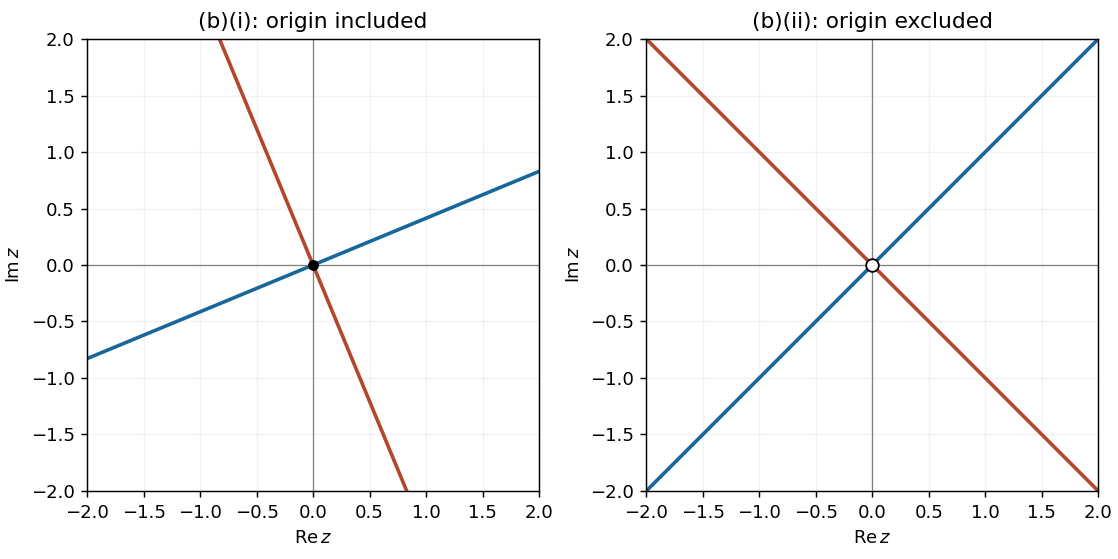
Since , equating its real part and imaginary part gives , orThe quadratic equation in factors as . Thus the set is the union of two straight lines through the origin:Their slopes multiply to , so they are perpendicular. Their angles to the real axis are and , modulo . The origin is included.

Set . The hyperbolic cosine identity gives , hence the quadratic equationLet . The first root has modulus and complex argument ; the second has modulus and complex argument . Taking all complex logarithm values givesThe two families are distinct because their real parts are respectively and . This exhausts the solutions because both roots for and all possible complex arguments have been included.
The given complex numbers have positive real parts, so and . Their product isBy the assumed complex argument ranges, this product also has positive real part, hence . Its complex argument is consequently , with no extra multiple of . Since multiplication adds complex arguments,This proves the arctangent addition formula under the stated branch restriction. For arbitrary real , the principal inverse tangent formula can require adding or subtracting when .
Write . Multiplication givesTherefore the real part is the dot product of the corresponding vectors:For nonzero vectors, this is , measuring their alignment.
For , use the finite geometric series with ratio :The second equality follows by factoring in numerator and denominator. Taking real parts proves the finite trigonometric sum identityWhen , every cosine is , so the sum is . This also gives the continuous limiting value at the excluded arguments.
At a point of complex differentiability, the complex derivative is independent of the direction of approach. Taking increments along the real axis gives ; taking imaginary increments gives . Equality of their real parts and imaginary parts proves the Cauchy-Riemann equations and .
For the specified real part, observe that has exactly that real part. Equivalently, integrating and checking givesThusThe freedom is only a constant imaginary part: the difference of two such holomorphic functions has zero real part, so its Cauchy-Riemann equations make it constant on each connected domain.
Past exam of the mathematics course of the year 2 of the natural sciences course of the University of Cambridge 2008 Paper 1 7 a Solution Created 2026-10-18 Updated 2026-10-20
For holomorphic in , the Cauchy-Riemann equations are and . Therefore the normal vectors to the two level curves obeyAt a point where , both gradients are nonzero, so their perpendicular tangent lines are also perpendicular. At critical points this argument does not assert that regular level curves exist.
TakeIts real part is , so the specified first family is . Its imaginary part is , so the second family is . Since , their intersections exclude the origin, where would vanish. Thus these hyperbolas meet orthogonally as required.
For a holomorphic function with , the chain rule givesWriting and equating real parts and imaginary parts,For , division by gives the Cauchy-Riemann equations in polar coordinates:The restriction reflects the coordinate singularity at the origin; the Cartesian equations have no such restriction.
Using the complex cosine identity,we findIts real part is exactly the prescribed function. Thus a harmonic conjugate is , and the general answer isTo check the only freedom, two analytic functions with this real part differ by a function with zero real part. The Cauchy-Riemann equations then force both partial derivatives of its imaginary part to vanish, so it is constant on the connected domain. No normalization was supplied to fix .
For the upper Apollonius circle, let its constant ratio be . Matching the center and radius from part (i) givesSubtracting their squares yields . AlsoThe relevant inverse hyperbolic cosine is positive. Now is the real part of a local holomorphic logarithm, hence a harmonic function away from . The point is inside the excluded disk, because , while is below the real axis. Thus neither singularity lies in the physical domain.
On the numerator and denominator have equal modulus, so the logarithm is zero. On the circular boundary its value is . Therefore the harmonic potential between a grounded line and a circular boundary isThis verifies Laplace's equation and both prescribed Dirichlet boundary conditions. It also tends to zero at infinity. A uniqueness assertion on this unbounded domain would require an additional boundedness or infinity condition; the displayed function is the natural decaying solution requested.
Use the principal complex logarithm:The excluded nonpositive real ray allows a continuous choice of argument, and . For , its real part is . Differentiating the chosen local argument givesThese continuous partial derivatives satisfy the Cauchy-Riemann equations, proving holomorphy on the slit domain. Its derivative is
Consider the counterclockwise unit circle and setThe parametrization givesThe imaginary part is zero: replacing by conjugates the integrand, since is an integer and is real. The real part is precisely the defining Bessel integral, so .
Both exponential series converge absolutely and uniformly on the circle. Their product may therefore be integrated term by term:Uniform absolute convergence can also be checked by summing the absolute coefficient bounds, which gives . The residue is obtained exactly when , or . The Cauchy coefficient formula consequently yieldsThis proves the Bessel function of the first kind series directly from its integral, including the sign and factorial normalization.