Renormalization of spontaneously broken gauge theories means that the Higgs mechanism can generate gauge boson masses while a fixed finite set of renormalized couplings, masses and field normalizations still suffices to absorb ultraviolet divergences. The symmetry constrains the counterterms even when the chosen vacuum expectation value hides it. This makes radiative corrections to the electroweak interaction calculable after inputs have been fixed by renormalization conditions.
A useful distinction is between choosing variables that display the physical particles and choosing variables that display good power counting. Unitary gauge removes the would-be Goldstone bosons from the explicit fields. R-xi gauge keeps them and the required Faddeev-Popov ghosts in intermediate Feynman diagrams, exposing simpler large-momentum behavior. The physical scattering amplitude must agree after all contributions and counterterms have been included consistently.
In Renormalizable Lagrangians for massive Yang-Mills fields (1971), Gerard 't Hooft constructed spontaneously broken gauge theories with massive gauge bosons. His worked SU(2) gauge theory with an adjoint Higgs field leaves a massless photon; it is a demonstration model, not the full chiral Standard Model. The gauge fixing, Faddeev-Popov ghosts and Ward identities connect renormalizability with physical unitarity.[ref]
Renormalizable Lagrangians for massive Yang-Mills fields by Gerardus 't Hooft. §§3–5, pp. 171–177; Eqs. (3.8)–(3.14)
Regularization and renormalization of gauge fields (1972), by Gerard 't Hooft and Martinus J. G. Veltman, developed dimensional regularization with recursive subtraction of ultraviolet subdivergences. It continued Feynman integrals in the dimension, keeping the relevant Ward identities in non-anomalous cases; its final section examined quantum anomalies. The procedure does not make an inconsistent chiral gauge theory consistent: gauge anomaly cancellation remains essential.[ref]
Regularization and renormalization of gauge fields by Gerardus 't Hooft and Martinus Justinus Godefridus Veltman. §1, pp. 189–191; §4, pp. 198–205; §6, pp. 206–208
The organizing proof outline is to use good large-momentum propagators, subtract every divergent subgraph, and constrain the remaining local divergences by the Ward identities. A finite family of allowed counterterms must close under this operation at every loop order. The same identities must remove unphysical intermediate contributions from physical amplitudes. Power counting alone establishes neither closure nor these cancellations. Modern BRST symmetry packages these restrictions; the scalar subtraction below illustrates only locality.
Consider one massive gauge field with after Higgs mechanism. For this comparison perform a Wick rotation and take a real nonzero momentum in Euclidean space . The transverse and longitudinal orthogonal projectors areHere “longitudinal” means parallel to the off-shell four-momentum, not the physical longitudinal polarization of an on-shell massive gauge boson. The R-xi gauge quadratic vector operator and its inverse areMultiplication verifies , since and . The unitary gauge vector operator lacks the gauge fixing derivative term in the longitudinal sector, givingThus every eigenvalue of falls as at fixed finite positive , whereas has the constant longitudinal eigenvalue . Unitary gauge consequently obscures ordinary power counting; this is not a failure of the physical theory.
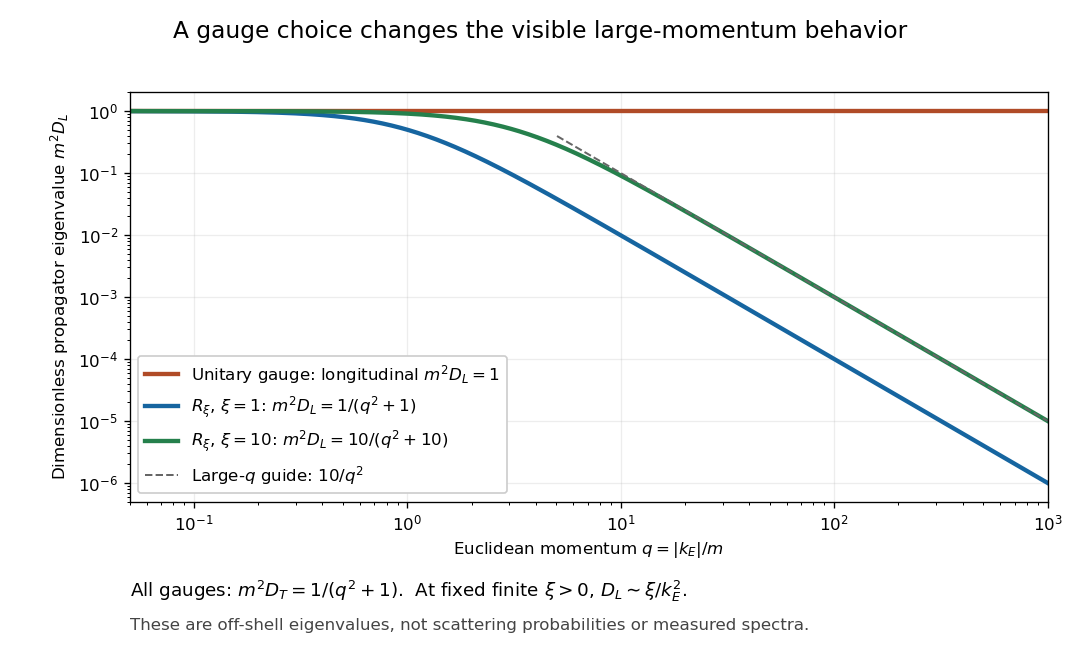

For a worked comparison choose . The dimensionless longitudinal eigenvalue is in unitary gauge, at , and at . Its crossover is : taking first gives a constant, whereas taking first gives zero. The two limits do not commute. Contracting the propagator between conserved external conserved currents projects away , but one cannot impose that simplification separately on every internal line of an interacting Non-Abelian gauge theory.
The following scalar toy isolates one step in renormalization: removing a local divergence while retaining a finite dependence on a physical mass. For and a sharp cutoff regularization in Euclidean space with momentum bound , define the dimensionless Feynman integralThis is a zero-external-momentum scalar bubble integral stripped of coupling and combinatorial factors. Using the three-sphere area and reduces the integral toThe antiderivative follows by writing . At large the divergent part is , with the logarithm's dimensionful argument understood only within the displayed ratios. It has no external-momentum dependence. In a four-scalar-field vertex this structure can therefore be removed by a local operator proportional to , rather than a momentum-dependent nonlocal interaction.
Choose the fixed reference mass and subtract . If the loop contribution to a chosen four-point vertex coefficient is , choose the additive counterterm in that same coefficient as , where includes its stated diagram factors. This defines a finite subtraction prescription:The renormalization condition for this toy loop contribution is . The reference mass stays fixed when is varied; finite dependence on survives. A different finite subtraction changes the renormalization scheme, and the defined renormalized coupling must change consistently.
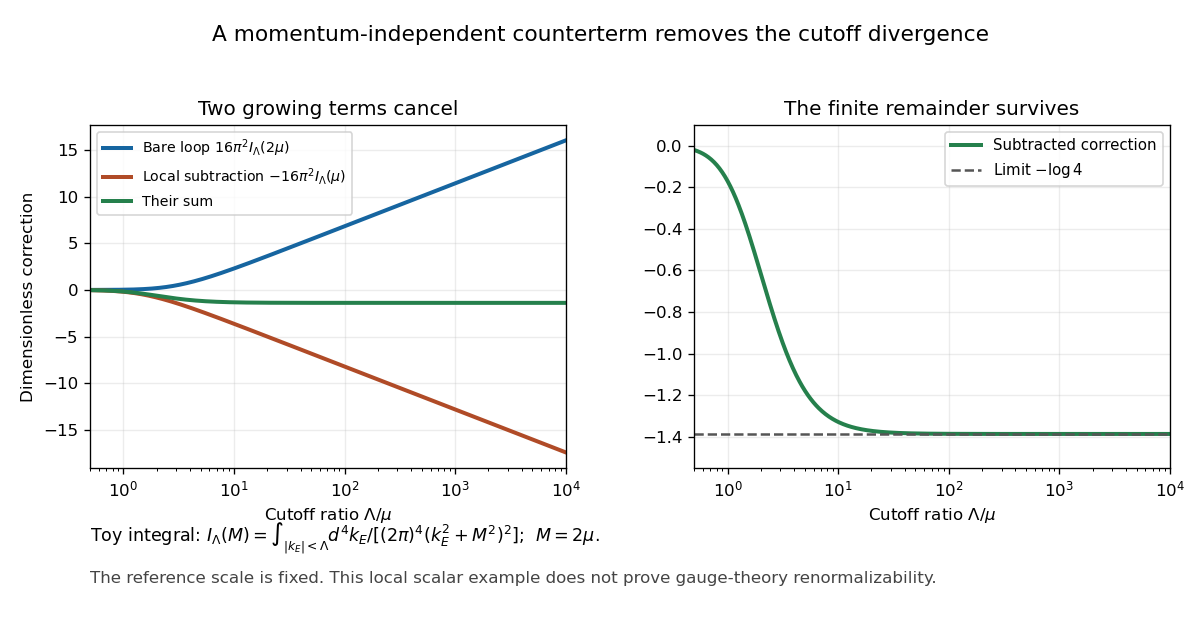

For , the limiting result is . At , the exact regulated difference is about ; at , it is about . Expanding the exact expression gives the leading residual in . This explicitly separates finite-cutoff error from the chosen finite renormalization condition.
A sharp cutoff regularization is convenient for this scalar demonstration, but shifts of a divergent loop momentum can change its integration domain. A gauge theory calculation cannot assume that it preserves the Ward identities. The toy contains no interacting gauge bosons, ghost loops or overlapping ultraviolet subdivergences, so its successful subtraction does not prove Non-Abelian gauge theory renormalizability.
The 1999 recognition of Gerard 't Hooft and Martinus J. G. Veltman concerned the theoretical quantum structure of the electroweak interaction.[ref] Renormalizability makes repeated radiative corrections predictive from a fixed set of inputs. It does not imply that the perturbation series converges, nor that renormalization alone chooses the correct particle content or excludes all physics beyond the Standard Model.
The Gargamelle collaboration prepared an experimental test by exposing its heavy-liquid bubble chamber to neutrino and antineutrino beams at CERN. The readout selected events producing hadrons without an identified muon or Electron, compared with events containing a charged lepton. Its 1974 report assessed alternative origins from neutrons and long-lived neutral kaons, finding them insufficient to explain the sample. That supported neutral currents; it did not isolate a radiative correction or demonstrate renormalizability.[ref]
The distinction matters when using the tree-level electroweak gauge-boson masses:Beyond tree level, self-energies, interaction vertices and counterterms alter how chosen input observables predict another observable. The Weinberg angle then needs a specified renormalization scheme; inserting its value from one convention into a formula from another can create an apparent discrepancy. A meaningful higher-order test must state both its independent experimental inputs and the calculated loop order.
Articles by others on the same topic
There are currently no matching articles.