Here means the real- or complex-valued functions continuous on , smooth on , with every interior derivative having a continuous extension to the endpoints; endpoint values of derivatives are these extensions. On this space of smooth functions on a compact interval, defineThese finite-valued seminorms increase with and separate points. In fact every is a norm, since it includes . The terminology seminorm includes norms; it does not assert that every measurement has a nontrivial kernel of a seminorm. Smooth convergence means for every fixed , equivalently uniform convergence of every derivative separately. It does not demand one tolerance or one convergence index that works for all orders simultaneously. The maximum convention is equivalent to the derivative supremum norm convention using a finite sum, since .
For a worked example, gives , , , and for . The linear functional obeys and is continuous. Similarly, differentiation is a continuous linear operator for smooth convergence, because .
The space of smooth functions on a compact interval is complete for this seminorm topology. A Cauchy sequence has uniform limits for its derivatives of each order. Passing to the limit in the fundamental theorem of calculus identitygives , so and belongs to the same space. This is the completeness of the smooth-function metric argument; the metric there and the increasing- metric above induce the same smooth topology and the same Cauchy sequences.
Smooth convergence on a compact interval requires uniform convergence of the functions and of their derivatives of every order separately, as measured by the derivative seminorms. The need for several scales is visible inFor , because lies in . The derivative has supremum norm one for every , already at . Thus converges uniformly to zero, but fails the test for smooth convergence to zero. Andreas Buttenschoen, Applied Functional Analysis, spaces of continuous and differentiable functions discusses this example and the family of smoothness measurements.
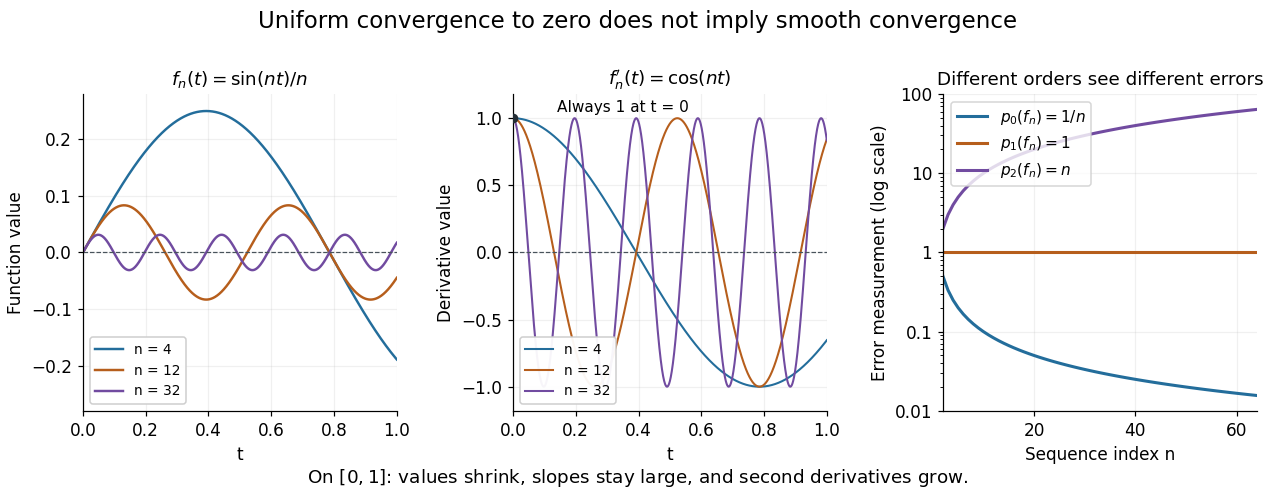

More generally, for any fixed , has but for . If a norm induced the smooth topology, its continuity would give for some finite , while continuity of for would give . Substituting contradicts these two bounds. Smooth convergence therefore cannot be reduced to one norm. Its beauty is that every finite order can be controlled without fixing a final order in advance.
Articles by others on the same topic
There are currently no matching articles.