Laser spectroscopy uses a tunable laser to interrogate energy levels through photon absorption, stimulated emission or fluorescence. A narrow optical source is useful only if the sample and readout preserve the information: Doppler broadening can hide closely spaced spectral lines even when the source itself is narrow.
Doppler-free saturation spectroscopy pairs a strong pump with an opposed weak probe. Shared populations produce a narrow Lamb dip within the Doppler broadening of a spectral line.
Take a single isolated optical transition of angular frequency . Both beams have laboratory angular frequency , with laser detuning . Let the pump travel along , the probe along , denote an atom's -velocity, and be the approximate vacuum wavenumber; is the speed of light. To first order in , the laser detunings in the atom's frame areThe pump addresses atoms near , while the probe addresses atoms near . For the same transition, simultaneous exact resonance requires both expressions to vanish: adding and subtracting gives and . The selected atoms can still have substantial transverse velocity. Finite natural linewidth admits a narrow interval of longitudinal velocities; a warm gas has not been cooled.
This is velocity selection, not cancellation of each atom's Doppler shift within a single absorption event. Changing laser detuning selects different atoms for ordinary photon absorption, but only near line centre do these two selected classes overlap. Laser cooling instead changes the distribution of the atoms' velocities through repeated momentum transfer.
Arthur Leonard Schawlow's 1981 lecture describes an external-cell arrangement: a beam splitter makes opposed beams, an optical chopper interrupts the pump, and a lock-in amplifier reads the probe detector with the chopper reference. Pump-on reduces absorption and raises the detector signal; scanning the laser finds the narrow resonance. Its first application used iodine; pressure and laser jitter limited the resolution.[ref]
Spectroscopy in a New Light by Arthur Leonard Schawlow. Schawlow, Spectroscopy in a New Light, pp. 39–40, Fig. 2
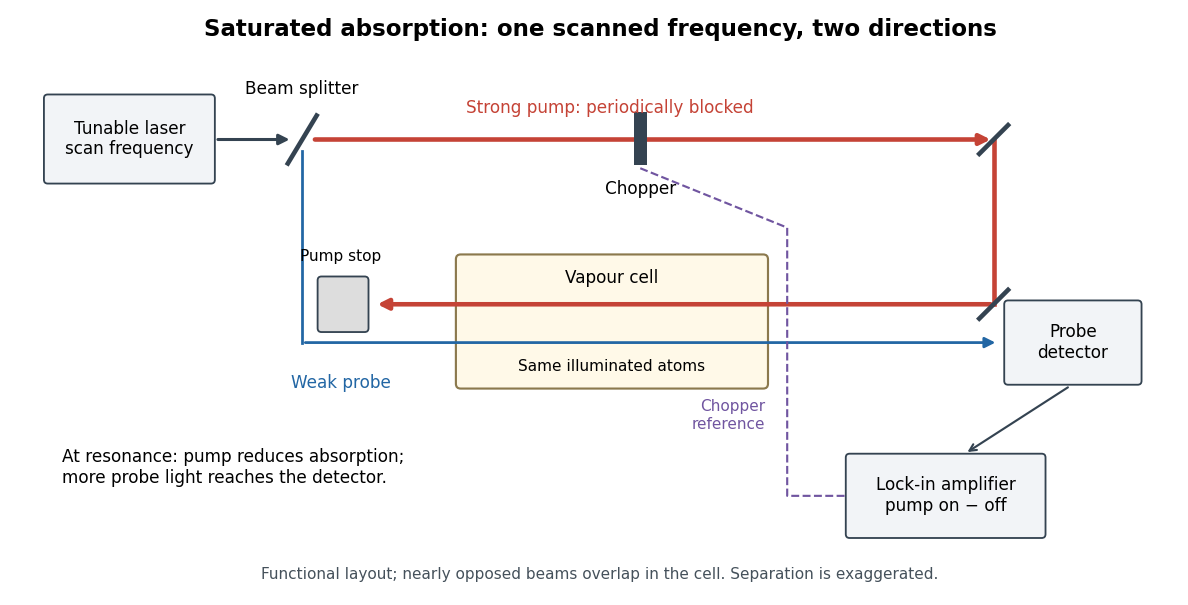
Counterpropagating pump and probe with synchronous transmission readout
. Original functional drawing of the cited external-cell principle. Beam separation is exaggerated; this is not a reconstruction of the pulsed sodium apparatus. Details.
For an original detector model, let be the probe power reaching a photodetector without sample attenuation and let be the sample's probe optical depths. After subtracting a stable detector background, the transmitted powers areA positive synchronous change means less probe photon absorption, provided incident probe power is stable and scattered pump light is excluded. For small optical-depth changes the fractional signal is approximately . A lock-in amplifier's voltage also depends on gain, reference phase and chopping waveform; it is not automatically this dimensionless ratio.
Useful controls are blocking the pump, detuning far from the feature, reversing or adjusting beam alignment, and repeating the scan at several pump light intensities. Frequency calibration, sample pressure, transit through the beams and laser frequency fluctuations must be assessed separately. Nearly opposed beams leave a residual Doppler shift: for wave vectors , the simultaneous-resonance condition gives . Exact opposition removes this transverse sensitivity in the first-order model.
Choose a closed two-level system, equal stimulated absorption and emission strengths, a monochromatic pump, and no extra dephasing. Let be the lower and upper populations, and let spontaneous emission remove upper population at rate . In this convention the natural linewidth is full width at half maximum in angular frequency, its half width at half maximum is , and its full width at half maximum in hertz is . All below are angular detunings.
Let be the on-resonance saturation parameter. An effective stimulated transition rate that reproduces the monochromatic steady response isHere describes each stimulated direction, while describes irreversible spontaneous emission. The rate equation gives the steady populations; it is not a description of transient Rabi oscillations. Setting givesand the population difference relevant to net weak-probe photon absorption isThe pump depletes the lower population by , but reduces the population difference by : stimulated emission contributes as well as missing ground-state absorbers. On resonance, gives , , ; gives , , . As , the two populations approach , rather than producing a population inversion. Far off resonance, and .
For moving atoms use in these pump-prepared populations. A weak counterpropagating probe interrogates them near . A simple population-only approximation to its absorption coefficient averages the weak-probe Lorentzian line shape times over the Maxwell-Boltzmann velocity distribution. It neglects interference between the beams, changes of velocity during illumination, and multilevel optical pumping. Those restrictions matter for real alkali chemical atoms.
In the two-level saturation population model, and the population-difference reduction reach half their resonant values at . Their half width at half maximum is therefore and their full width at half maximum is in angular frequency, or in hertz. This is power broadening: stronger excitation addresses a wider range of detunings even though the lifetime has not changed.
Increasing improves the local population-difference reduction but broadens the response. From to , this reduction increases from to , while the width increases from to . The contrast approaches a limit and the width keeps growing. This single-atom width is not automatically the width of a velocity-averaged pump–probe feature.
For example, if the distribution of velocities is approximately constant across the narrow resonant classes, the population-only overlap integral contains two Lorentzian line shapes: a probe of half width and a pump hole of half width . Their centres in are separated by . The convolution of these profiles has half width in that separation, so its full width at half maximum as a function of is . Even this simplified pump–probe width differs from the single-atom power broadening formula. Finite Doppler broadening and coherent or multilevel effects require further analysis.
The narrow reduction in photon absorption near the common resonance of opposed beams. The Doppler-free absorption line model illustrates its sign and contrast; the same feature appears as increased probe transmission.
Construct an original illustrative spectrum using ordinary frequency detuning . Write the longitudinal Doppler shift in frequency units as , where . Choose a normal distribution with standard deviation and a weak-probe Lorentzian line shape with half width at half maximum :Thus . Choose and natural linewidth , so . The Gaussian-only full width at half maximum is ; the averaged profile also includes the finite Lorentzian line shape width.
Add a deliberately phenomenological Lamb dip:Here is the absorption coefficient normalized to the pump-off line-centre value. The factor is chosen, not inferred from populations or a fit. The dip's assigned full width at half maximum borrows the single-atom power broadening scale purely to illustrate contrast versus width. It is not the preceding overlap integral or a fit to historical spectra. There are no crossover features in this isolated-transition toy spectrum.
For , the subtracted dip has depth and width ; for , depth and width . Its half-depth points are . Measure that width relative to the curved background , not a horizontal line through the total absorption minimum.
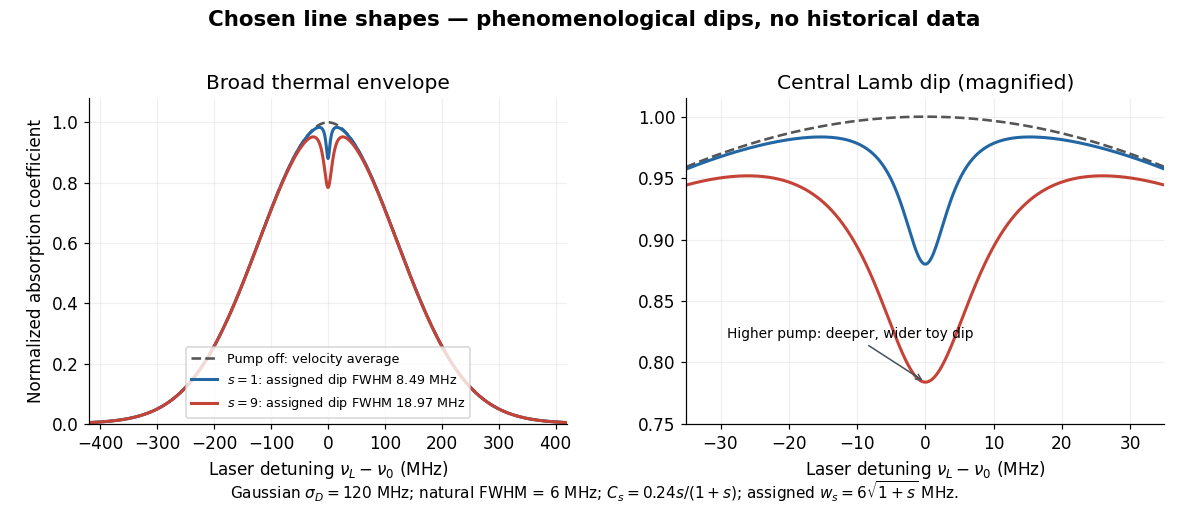
Chosen Doppler envelope and phenomenological Lamb dips
. Original numerical Gaussian velocity average with two explicitly chosen Lorentzian absorption dips. Every numerical setting is illustrative. The right panel magnifies line centre; these curves are not experimental data or fits. Details.
For a chosen cell optical depth , the line-centre pump-off transmission is . At it is . The transmitted probe therefore increases by about percent relative to pump off. Absorption contrast, transmission contrast and spectral width are three different quantities.
Two allowed optical transitions sharing a lower quantum state can produce an extra saturation spectroscopy feature even where there is no additional energy level difference. Approximate their wavenumbers by the same , and let their angular frequencies be . A pump resonant with one transition and an opposed probe resonant with the other satisfysoExchanging the two transitions selects the opposite velocity. Both beams can then modify the same shared population, producing a crossover near the midpoint. This requires the relevant velocities to be occupied and the transitions to be connected by the population dynamics; not every pair must produce a visible feature. Strength and sign depend on optical pumping and the multilevel structure. Assigning every narrow feature to a separate atomic transition would therefore give false energy levels.
Theodor W. Hänsch, I. S. Shahin and Arthur Leonard Schawlow reported pulsed dye laser saturation spectroscopy of sodium D lines in 1971. They resolved hyperfine structure; delaying the probe revealed persistent changes in ground-level distributions of velocities from optical pumping. Added argon allowed observation of collisional recovery. These measurements probe population memory as well as line positions.[ref]
High-Resolution Saturation Spectroscopy of the Sodium D Lines with a Pulsed Tunable Dye Laser by Theodor W. Hänsch and others. Hänsch, Shahin and Schawlow, 1971, abstract; published September 13
The two-level saturation population model explains depletion in a closed transition; the delayed multilevel optical pumping signal needs additional populations and time dependence. A measured Doppler-free saturation spectroscopy feature can still contain natural linewidth, power broadening, pressure broadening, finite interaction time, imperfect alignment and laser spectral width. The word “Doppler-free” removes a particular thermal broadening mechanism, not every limit on resolution.
Arthur Leonard Schawlow's 1981 recognition concerned laser spectroscopy.[ref] Theodor W. Hänsch received a distinct award in 2005 for precision laser spectroscopy.[ref]
Physik-Nobelpreis 2005 an Theodor W. Hänsch by Max Planck Society. Max Planck Society, October 4, 2005, opening and award explanation
Articles by others on the same topic
There are currently no matching articles.