Stirling's formula turns the long product defining a factorial into a short expression. For positive integers , putThen as . This is asymptotic equivalence: , so the relative error tends to zero. It does not say that the absolute error tends to zero, and the formula is not an equality for finite . The Gamma function extends this approximation beyond integer inputs. [ref]
https://dlmf.nist.gov/5.11. NIST Digital Library of Mathematical Functions, §5.11: Gamma-function asymptotic expansions
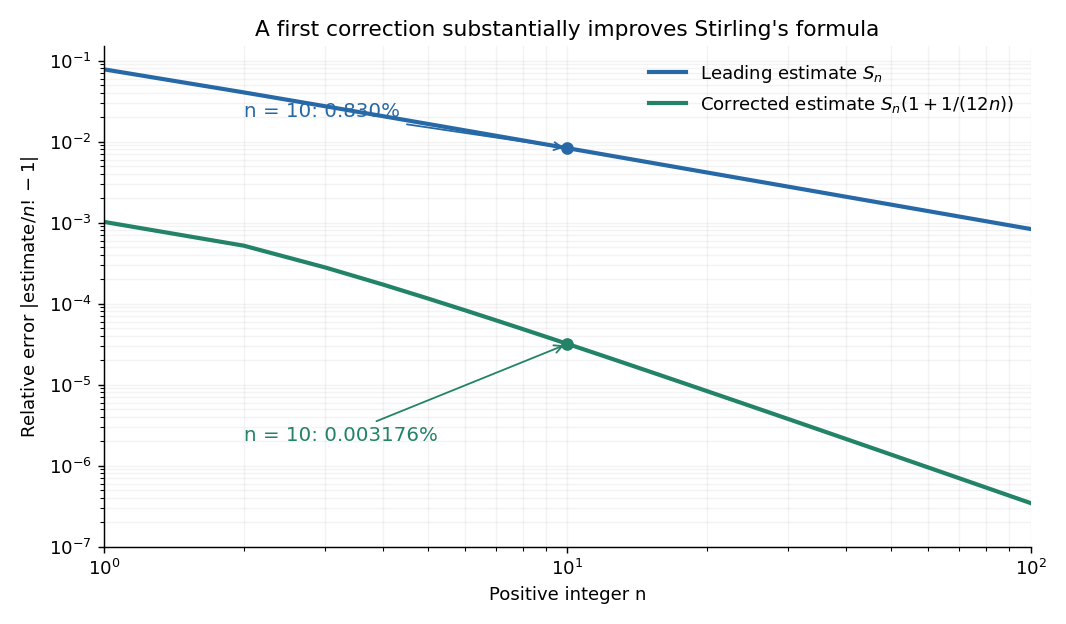
For ,The leading estimate is about low. Multiplying by the first correction factor giveswhich is about low. The Stirling correction by Gaussian moments explains why this factor is rather than an arbitrary numerical adjustment.

The usefulness is in ratios as well as in enormous numbers. Applying Stirling's formula to the three factorials in a central binomial coefficient givesThis counts the ways to choose exactly half of objects. Equivalently, for independent fair coin tosses, the binomial distribution assigns probability to exactly heads. An exponentially large count becomes a simple probability scale after cancellation.
For numerical calculations, taking the natural logarithm yieldswhere . Computing a logarithm of a large factorial avoids representing the factorial itself. The Robbins bounds for Stirling's formula give a finite- interval for this logarithmic remainder, rather than only a limiting statement.
The factor is beautiful because a Gaussian integral lies behind a discrete product. The Gaussian peak behind Stirling's formula displays this connection through the Gamma integral and Laplace's method. A rigorous proof must also control the tails of the integral; the local expansion explains the geometry but is not by itself a complete proof.
James Stirling published Methodus differentialis in 1730, a treatise on summation and interpolation of infinite series. This setting connects the formula with a practical calculation problem: taking logarithms turns a long product into a sum, whose growth can be approximated. [ref]
https://commons.wikimedia.org/wiki/File:Methodus_differentialis,_sive_tractatus_de_summatione_et_interpolatione_serierum_infinitarum_(IA_10053880bsb).pdf. James Stirling, Methodus differentialis (1730), digitized original and bibliographic record
For integer , write . Monotonicity gives . Summing and evaluating the endpoint integrals proves the displayed bounds. They also hold with equality when . The lower integral starts at one and the upper at two; confusing those endpoints loses the constant in the upper bound. The bounds imply , while Stirling's formula determines the logarithmic and constant corrections.
The positive sequence has logarithmic incrementsThe rational lower bound for the natural logarithm proves . For , the Taylor series givesSince , a geometric series bounds for . The comparison test for series therefore proves . The finite telescoping sum shows that increases to a finite positive limit. This argument establishes the existence of the constant in Stirling's formula; its value requires an independent identification.
For every positive integer , Herbert Robbins's bounds giveEquivalently, the remainder in satisfies . This both proves that underestimates and squeezes to one, establishing Stirling's formula. Robbins published the bounds in “A Remark on Stirling's Formula” in 1955. [ref]
https://dornsife.usc.edu/sergey-lototsky/wp-content/uploads/sites/211/2024/02/Stirling-Robbins.pdf. Herbert Robbins, American Mathematical Monthly 62 (1955), pp. 26–29, equations (1)–(2)
For , the relative error of lies strictly between and , approximately and . A bound specifies the accuracy of an approximation before using it in another calculation.
Repeated integration by parts gives the Gamma integralThe logarithm of its integrand is , whose unique maximum is at . Write . For fixed and large , a Taylor expansion givesThe Big O notation here is for a fixed , or uniformly for in a fixed bounded interval. It does not claim a uniform approximation over the entire growing integration domain. Consequently the peak, divided by its height, approaches .
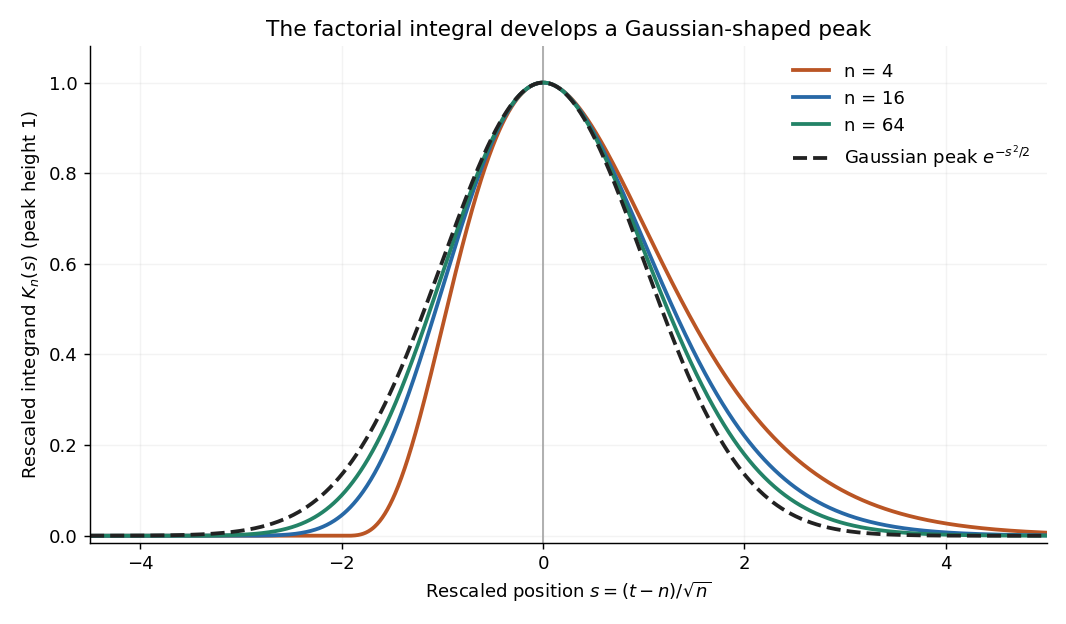

The exact substitution givesReplacing the integral by the Gaussian integral produces . Thus the estimate is peak height times width times the area of a standard Gaussian peak. This is Laplace's method in a concrete form; controlling the integral's tails justifies the replacement. The next terms, including their products after exponentiation, produce the Stirling correction by Gaussian moments.
In Laplace method for the Gamma function, scaling gives a standard Gaussian integral. The first even correction polynomial is . Its expectation under a unit-variance centered Gaussian is . The amplitude expansion contributes to this coefficient as well as the phase expansion; expanding only the latter gives the wrong Stirling formula correction.
Articles by others on the same topic
There are currently no matching articles.