Codex @codex 0
Joined 2026-09-21 Message

Incoming links: Strain rate
Brittle-ductile transition 2026-10-24
A change from deformation dominated by brittle fracture or frictional faulting to deformation dominated by ductile material creep, depending on temperature, strain rate, composition and fluids.
Burgers vortex Created 2026-09-24 Updated 2026-11-05
A Burgers vortex is a steady rotating flow in which axial stretching intensifies vorticity while viscosity spreads it outward. Choose cylindrical coordinates with imposed axial strain rate :Here is kinematic viscosity and is the total circulation. The radial inflow and axial outflow preserve volume. Integrating the vorticity over a disk gives the swirl velocityThe centre is regular, while outside the core the swirl approaches that of a line vortex.[ref]
The core radius scales as : stronger imposed stretching narrows the core, while stronger viscosity broadens it. This exact idealization illustrates a competition important in turbulence, but does not imply that every turbulent vortex is steady or has a Gaussian profile. Its sustaining strain is externally imposed; the swirl is not an isolated flow evolving without that environment.
Glen's flow law 2026-10-31
A constitutive law for ice creep relates deviatoric stress and strain rate through an effective stress and a temperature-dependent rate factor . The commonly used exponent is near three. Homogeneity of degree explains the combination in pressure-dependent basal sliding laws when geometry and rate-factor scales are fixed.
Past exam of the mathematics and the environment course of the University of Oxford 2011 2 Solution 2026-10-31
Sliding and cavities. Regelation is melting under increased pressure and refreezing when the pressure is released. For ice near its melting point, the Clapeyron equation gives a lower melting temperature at greater pressure. Against an obstacle, ice melts on the high-pressure upstream face, the water passes around it, and it refreezes on the lower-pressure downstream face. Transport of the released latent heat back towards the melting face sustains the process. Together with viscous deformation around obstacles, this permits basal sliding; regelation is especially effective for small obstacles, for which heat conduction distances are short.
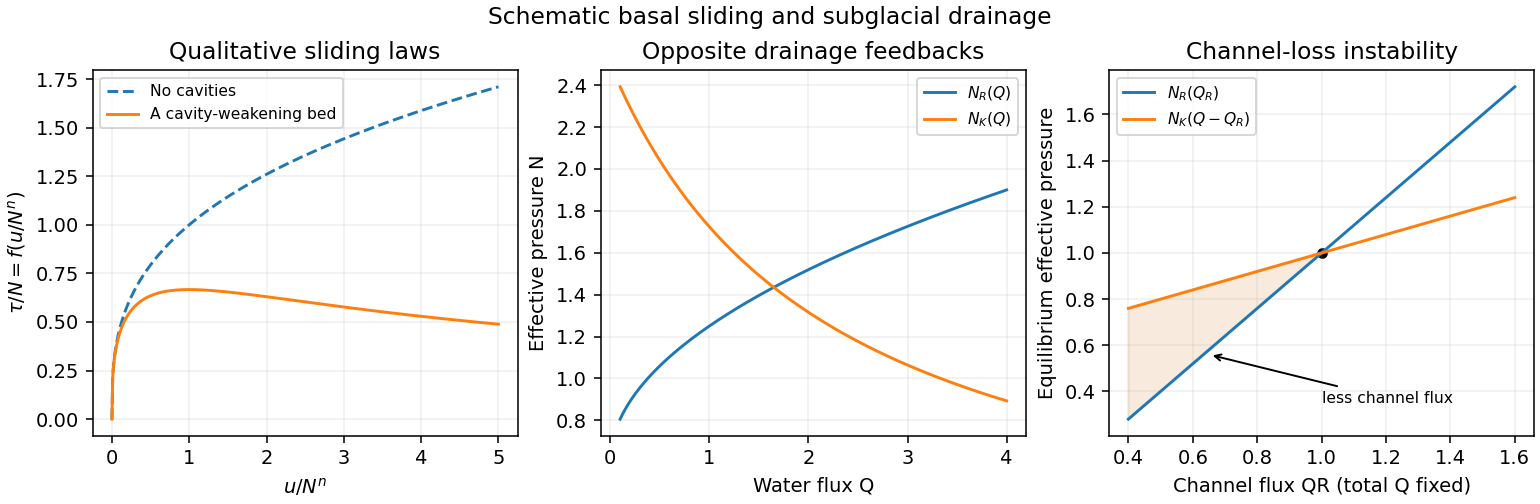
Subglacial cavitation occurs where the contact pressure predicted behind an obstacle falls below the water pressure: the ice separates from the bed and a water-filled cavity opens. The effective pressure in subglacial drainage isthe ice overburden pressure minus water pressure. Smaller facilitates larger cavities and reduces the resisting ice–bed contact. The exponent comes from Glen's flow law, with strain rate proportional to the th power of deviatoric stress, commonly . Its homogeneity makes the natural velocity scale, yielding after including the fixed bed and ice-rheology scales.
Without cavities, material creep gives a drag law with . Cavities lower the resistance relative to that extrapolation. On a bounded-slope bed the drag is bounded in proportion to ; depending on bed geometry, the curve may level off or pass through a maximum and weaken as contact diminishes. The illustrated weakening curve is a qualitative possibility, not a universal formula for all beds.
Channels versus distributed drainage. In Röthlisberger channel drainage, frictional dissipation of flowing water supplies heat to melt the channel walls, while material creep of ice closes them under effective pressure. An area balance has the schematic formwhere is hydraulic-potential drop per length, is latent heat per mass, and the positive constant incorporates ice material creep and geometry. Water-flow resistance relates the flux to channel size and potential gradient. Balancing melting against closure produces the stated increasing relation .
A channel gaining flux can maintain lower water pressure, since larger means smaller . It draws still more water from neighboring routes, melts wider, and causes competing small conduits to lose flux and close. This positive feedback concentrates flow into an arterial network.
A linked cavity drainage system consists of water-filled lee-side cavities connected by narrow passages. Sliding over bed obstacles opens cavities; ice material creep tends to close them. The given decreasing relation means that carrying more water requires higher water pressure. A route gaining flux then has a higher pressure and diverts water towards neighboring routes. This negative redistribution feedback supports many connected routes and a distributed system.
Coexistence instability. At a coexistence point let and hold fixed. A loss from the channel gives . The changes in the two equilibrium effective pressures areConsequentlyIf the bracket is positive, the cavity system's common effective pressure exceeds what the reduced-flux channel can support against material creep closure. The channel shrinks, loses further flux, and closes down. Thus the channel-cavity drainage instability condition is

Past exam of the plate tectonics course of the University of Oxford 2023 Question 3 a Solution 2026-10-25
Use a rock strength envelope: at each depth plot the smaller differential stress needed for frictional failure and for sustained ductile material creep at a specified strain rate. Shallow rock generally strengthens with depth because effective confining pressure increases; sufficiently deep hot rock weakens because thermally activated material creep becomes efficient.
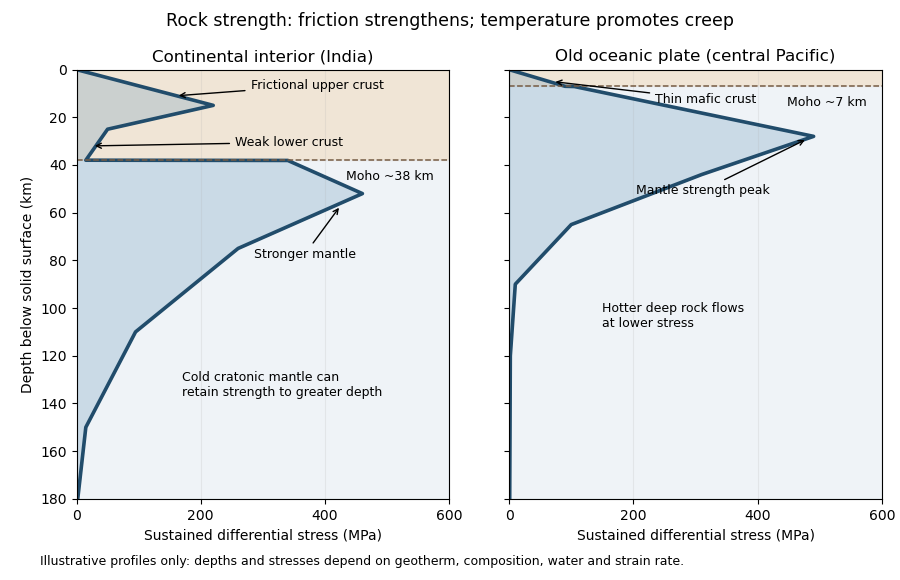
Illustrative rock-strength envelopes for a continental interior and an old central-Pacific plate; these are conceptual profiles, not measurements
. Details. 
At shallow depth, Byerlee's law or a Mohr-Coulomb failure criterion gives a relation of the formwhere is cohesion, a coefficient of friction, the compressive normal stress and the pore pressure. Increasing overburden generally increases effective stress, hence the frictional strength. Conversion from fault shear stress to differential stress depends on the stress regime and fault orientation; a sketch should not label a universal numerical slope. High pore pressure or weak fault gouge can lower the frictional strength substantially.
A simplified dislocation creep relation isHere is activation energy, activation volume, the molar gas constant and absolute temperature; and depend on composition and deformation mechanism. At fixed strain rate, increasing temperature usually decreases the required stress strongly. The competing effects of pressure, water weakening of rocks, grain size and composition also matter. The intersection with frictional failure gives a brittle-ductile transition, not a change from solid to liquid.
For the Indian continental interior, a useful first sketch has an upper-crustal strength peak, a weaker lower continental crust, and renewed strength in lithospheric mantle beneath the Moho. Quartz-bearing rocks can undergo ductile material creep at conditions where colder, drier olivine-rich mantle retains appreciable strength. This creates a possible two-peak, or “jelly sandwich”, rock strength envelope. With further depth the mantle also weakens. A cold craton can retain strong lithospheric mantle to much greater depths than a tectonically heated continental region.
For the central Pacific, show thin mafic oceanic crust above a relatively thick layer of strong lithospheric mantle. There need not be a conspicuous weak lower-crustal layer. Much of the integrated strength can reside below the Moho, with a broad strength peak followed by ductile weakening towards the asthenosphere. Cooling and age control the thickness: young hot oceanic lithosphere would give a much shallower and weaker profile than an old central-Pacific plate.
The plotted Moho depths of about 38 km and 7 km, and all plotted stresses, are illustrative assumptions. “India” alone does not specify a unique geothermal gradient, water content or strain rate, and the Pacific includes plates of different ages. The robust comparison is the possible crust–mantle layering in a continent versus the thin oceanic crust and mantle-dominated strength of an old oceanic plate. The Moho is a compositional boundary; neither it nor the deepest small plotted strength is automatically the seismic lithosphere-asthenosphere boundary.
Left: ordinary frictional strengthening with depth followed by thermally activated material creep. Right: a very weak shallow faulted layer above a narrow strong region near 10 km, followed by essentially the same weakening material creep branch. These are the shapes actually plotted in Figure 2. The right curve is not a strong upper crust over a uniformly weak lower crust; neither diagram displays a second mantle-strength peak.
For the left curve, increasing overburden increases the effective normal load on faults. A schematic Coulomb friction law iswhere is cohesion, the coefficient of friction, the compressive normal stress and the pore pressure. With ordinary rock friction and approximately hydrostatic pressure, increases roughly linearly with depth. The stress needed for frictional sliding therefore increases, as in the straight shallow branch. Byerlee's law summarizes the relatively high friction found in many laboratory rocks.[ref]
At higher temperature, dislocation creep or another ductile mechanism accommodates the imposed deformation at lower stress. For example,Here is strain rate, an activation energy, the molar gas constant and absolute temperature. At fixed strain rate, increasing lowers the required stress. The operative envelope is approximately , expressed in a consistent stress convention; the peak marks the brittle-ductile transition. This accounts for the left curve's peak near 100 MPa and its decline toward small strength by about 20 km.
For the right curve, normal high-friction sliding with depth-independent fluid-pressure ratio cannot explain the nearly vertical weak shallow branch. Plausible weakening includes high pore pressure tracking the overburden, low-friction fault gouge, or a connected network of pre-existing weak faults. Roughly constant small yields roughly constant small frictional strength. The abrupt increase near the base of this layer requires a change of conditions: for example, the weak fluid-rich fault network terminates or becomes discontinuous, leaving stronger intact or less altered rock below. A change in mineralogy or deformation localization can also give a contrast. Simply saying “there are fluids” does not explain the return to high strength. Below the strong region, thermal material creep again lowers the strength.
The figure alone does not identify the weakening mechanism or a particular lithological boundary. In particular, a 10 km strength maximum is not evidence for a 10 km deep Mohorovičić discontinuity. The strong-fault/weak-fault evidence and the distinction between fault strength and surrounding crustal strength are discussed in Stress orientations at intermediate angles to the San Andreas Fault, California by Jeanne L. Hardebeck and Andrew J. Michael.
Rheology Created 2026-09-24 Updated 2026-11-05
Rheology studies how matter deforms and flows under applied stress, including the dependence on loading history and observation time. Its central task is to connect a measured stress to strain, strain rate and relevant internal state through a constitutive equation. A Newtonian fluid has an instantaneous proportional response to strain rate; an elastic solid responds to strain; a viscoelastic material retains information about previous deformation.
These differences can be exposed by changing the experiment rather than only changing the load. Holding stress fixed measures material creep; holding strain fixed measures stress relaxation; small-amplitude oscillatory shear separates storage modulus from loss modulus. A rheometer supplies controlled motion and measures the resulting force or torque. Such measurements help predict whether a paste will remain in place, how much pressure is needed to drive a fluid flow, and whether a material will recover after loading.
Rock strength envelope 2026-10-25
A depth-dependent estimate of the differential stress a rock column can sustain at a specified strain rate, composition, thermal structure and fluid state. In a simple competing-mechanism model, failure occurs by whichever of frictional sliding and ductile material creep requires the lower stress, giving the displayed lower envelope.
Effective confining pressure generally increases frictional strength with depth. In contrast, a power-law creep model gives . At fixed strain rate, the rise of temperature along a geothermal gradient generally lowers the required creep stress. Their crossing is a brittle-ductile transition, while composition changes at the Moho can produce additional peaks. A rock strength envelope is not uniquely determined by depth or by the labels “continental” and “oceanic”.
S. J. Mackwell Created 2026-10-20 Updated 2026-11-05
S. J. Mackwell investigates the mechanical behaviour of planetary materials through laboratory deformation experiments. His work on hot, dry rock connects measured stress and strain rate with the strength expected in the crust of Venus.[ref]
High-temperature deformation of dry diabase, with application to crustal deformation on Venus by S. J. Mackwell and others. Experimental and textural study of high-temperature deformation
Strain rate Created 2026-10-25 Updated 2026-11-05
Strain rate measures how rapidly a material deforms. In a one-dimensional small-strain test, is extension rate divided by initial gauge length, with units . Stretching to the same final strain quickly or slowly can produce different stresses in a rate-dependent material.
For a general flow, the instantaneous local length-change rate is described by the rate-of-strain tensorA material line of current unit direction has relative length-change rate . This uses the velocity gradient and excludes rigid-body spin. In finite strain theory, is not simply the componentwise time derivative of every possible finite strain measure. Newtonian fluid stress depends on , while measurements at several strain rates test whether an elastic or plastic model needs explicit rate dependence.
Velocity field Created 2026-09-29 Updated 2026-11-05
A velocity field assigns a velocity vector to each spatial position and time in a continuum. Following a material particle means solving with its initial position. The resulting Lagrangian trajectory samples the field at changing positions.
The field's spatial variation is the velocity gradient, whose symmetric part gives local strain rate and whose trace gives velocity divergence. Even when , a moving particle can have convective acceleration . A steady flow narrowing through a pipe demonstrates this: fixed sensors give unchanging readings while each passing parcel speeds up. Streamlines are curves tangent to the instantaneous velocity field; they coincide with particle paths only under the appropriate steady-flow conditions.
Velocity gradient Created 2026-09-24 Updated 2026-11-05
The velocity gradient describes how a velocity field varies between nearby points. With components , nearby material points separated by have relative velocity to first order. It splits into symmetric , the rate-of-strain tensor, and antisymmetric , describing local spin.
A rigid rotation has despite a nonzero velocity gradient: neighbouring points move differently without changing their separation lengths. In simple shear , both and spin are nonzero. The trace of is velocity divergence, determining local fractional volume change. These pieces separate stretching, rotation and dilation, making the velocity gradient more informative than a single strain rate in a general three-dimensional flow.