Thermal transpiration is gas transport driven by an imposed temperature difference in a rarefied connection. Gas can move from cold to hot even when the two end pressures start equal. If the reservoirs are closed, redistribution builds a counteracting pressure difference until the net transfer stops. This final stationary state is not global thermal equilibrium: the two temperatures remain different. It explains why a heated pressure sensor can read a different pressure from the vessel to which it is connected. The correction depends on gas, connection geometry and molecular interaction with its surfaces. [ref]
https://arxiv.org/html/1308.6794. Daudé, Elandaloussi and Janssen (2014), thermal-transpiration corrections for diaphragm gauges, introduction
The simple molecular limit is beautiful: equal opposing particle rates need not mean equal pressures. Consider effusion through a thin hole connecting two locally equilibrated reservoirs of the same gas, at . Equating their one-way rates givesAt equal pressure, the hotter reservoir has lower number density; its faster molecules do not fully compensate for that reduction in outgoing particle rate. With and , the ideal zero-transfer ratio is . The hydrodynamic, zero-flow limit instead has equal pressures when other forces are absent. These are limiting models, not an interpolation formula for a glass capillary. [ref]
https://farside.ph.utexas.edu/teaching/355/Surveyhtml/node224.html. Fitzpatrick, Molecular Effusion, equations 5.286–5.287
In a real tube, incomplete exchange of molecular energy with the wall can alter the limiting ratio; a Knudsen number does not specify that exchange. [ref]https://arxiv.org/html/1308.6794. Daudé, Elandaloussi and Janssen, §I, limitations of the ideal Knudsen pressure ratio
Rojas Cardenas, Graur, Perrier and Méolans studied thermal transpiration in helium using a glass microtube of diameter and length in their 2012 experiment. They heated one reservoir, leaving the other near room temperature, and measured tube-end temperatures of and . Three contact thermometers and an infrared camera checked the thermal conditions; the hot reservoir was warmer than the adjacent tube end, so heater temperature was not an adequate substitute for tube-end temperature. Two capacitance diaphragm gauges recorded the reservoir pressures; a third gauge supported calibration. [ref]
https://www.jstage.jst.go.jp/article/jtst/7/3/7_437/_pdf/-char/en#page=4. Rojas Cardenas et al. (2012), An Experimental and Numerical Study of the Final Zero-Flow Thermal Transpiration Stage, §2.1
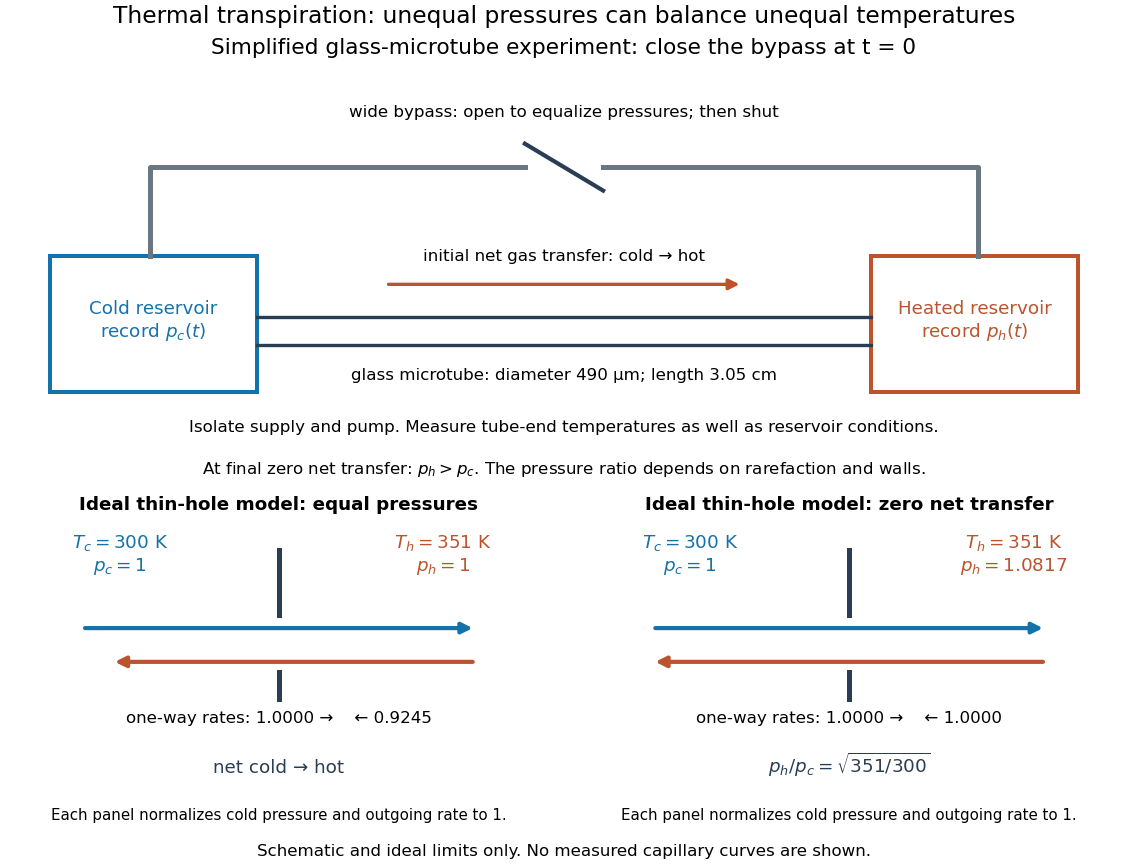
Their earlier 2011 paper explains the measurement sequence. A wide bypass links the reservoirs in parallel with the microtube. After isolating the gas supply and pump, keep the bypass open to equalize pressures with the temperature difference already established. Closing the bypass defines . The hot-side pressure rises and the cold-side pressure falls; ultimately their slopes approach zero at unequal pressures. Repeating at different initial pressures changes the degree of rarefaction without changing the microtube. The 2011 study also compared helium and nitrogen and imposed temperature differences of , and . [ref]
https://doi.org/10.1063/1.3561744. Rojas Cardenas et al. (2011), Thermal transpiration flow: A circular cross-section microtube submitted to a temperature gradient, measurement sequence
The quantities to record are both and , the reservoir volumes, and the temperatures relevant to their particle inventories. In an idealized reservoir of fixed volume and uniform fixed temperature , the ideal gas law gives , so opposite inventory changes test particle conservation. If temperature changes, differentiation instead gives : a thermal drift can imitate particle transfer. The authors' 2011 presentation explicitly checks this thermal correction when extracting an initial mass flow rate from the pressure slope. [ref]
https://www.itep.kit.edu/downloads/12_Rojas.pdf#page=25. Rojas et al., IUVSTA 2011 presentation, mass-flow extraction and thermal correction
The 2012 paper compares the final pressure ratio across near-free-molecular through slip conditions with a kinetic model and empirical corrections. It does not establish the thin-hole square-root law at every measured pressure. [ref]
https://www.jstage.jst.go.jp/article/jtst/7/3/7_437/_pdf/-char/en. Rojas Cardenas et al. (2012), abstract and comparison of final pressure ratios
For a replication, useful additional controls follow from the interpretation: remove the temperature difference to test the null signal; reverse it to test the direction; check gauge zero offsets and leaks; and wait for stable temperatures before closing the bypass. These are suggested controls, not claims that the cited paper performed each one. A reproducible pressure split at zero net transfer makes the failure of a single continuum wall model observable, while the Knudsen number organizes which molecular and apparatus scales are competing.A capacitance diaphragm gauge senses pressure through deflection of a diaphragm that changes a capacitor's capacitance. Its head can have a different temperature from the vessel being measured, allowing thermal transpiration in the connecting tube to change the head pressure. [ref]
https://arxiv.org/html/1308.6794. Daudé, Elandaloussi and Janssen, §I, diaphragm-gauge principle and thermal-transpiration effect
Articles by others on the same topic


Thermal transpiration, also known as thermal creep, is a phenomenon related to the motion of gas molecules in a system where there is a temperature gradient. It occurs when gas molecules in a confined space or small tube move from a region of higher temperature to a region of lower temperature. This movement is influenced by the kinetic energy of the gas molecules, which is greater in the hotter region.