The Knudsen number is the dimensionless ratio of an intermolecular mean free path to a specified characteristic length of the apparatus or flow. The mean free path measures the distance travelled between gas–gas collisions; measures the distance over which boundaries or macroscopic conditions matter. Wall encounters must not be counted as gas–gas collisions in this comparison: doing so would hide the very wall-dominated behavior we want to detect. The same gas can therefore have a small Knudsen number in a large vessel and a large Knudsen number in a tiny opening.
For a dilute hard-sphere gas of identical molecular diameter in thermal equilibrium, use the conventionHere is the number density, the pressure, the absolute temperature, and the Boltzmann constant; the second equality uses the ideal gas law. The collision cross-section is , and the accounts for both partners moving with independent equilibrium velocities. Mixtures and velocity-dependent collision cross-sections require a stated molecular model and mean free path convention; the displayed expression is not an exact formula for every real gas. [ref]
https://farside.ph.utexas.edu/teaching/355/Surveyhtml/node219.html. Fitzpatrick, Mean Free Path, equations 5.209–5.219
[ref]https://arxiv.org/abs/1309.1197. Steve T. Paik, Is the mean free path the mean of a distribution?, dilute hard-sphere equilibrium convention
As a numerical toy example, choose and , without claiming that this is a measured molecular diameter for a particular gas. The formula gives at . It yields for a vessel but for a gap. At the same toy gas has , comparable to the centimetre vessel. Reducing either pressure or apparatus size can thus expose molecular transport.
Choose for the question being asked: a tube diameter compares the mean free path with wall separation, while tube length describes a different geometric scale. For a positive macroscopic field , a local gradient scale can instead be , where its gradient is nonzero. A large vessel can contain a thin region with a large local Knudsen number. Small geometric Knudsen number alone does not guarantee a slowly varying near-equilibrium flow. The time, velocity and space scalings must also be stated when the Knudsen number appears as a coefficient in a Boltzmann equation. [ref]
https://ntrs.nasa.gov/citations/20230013741. NASA, Comparison Between DSMC and CFD for Hypersonic Planetary Entry Simulations (2023), local gradient-length breakdown analysis
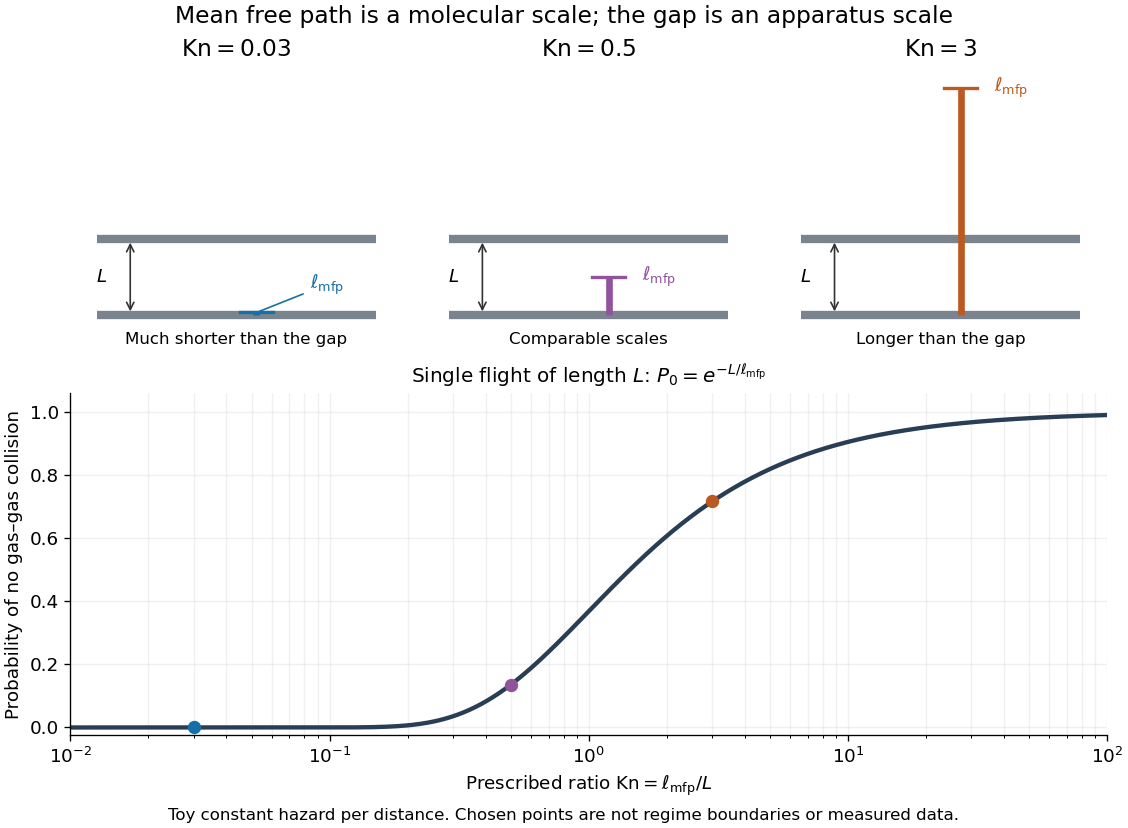
For , frequent gas–gas collisions can establish a local Maxwellian before macroscopic conditions change appreciably. Under this additional near-equilibrium assumption, the hydrodynamic limit of the Boltzmann equation motivates a continuum approximation with Navier-Stokes equations and heat conduction. A no-slip boundary condition is a leading wall approximation, not a statement about individual molecular velocities.
With a small but finite Knudsen number, a useful slip approximation retains continuum bulk equations and corrects wall velocity and temperature. A Navier slip boundary condition can represent the leading tangential velocity correction, but its slip length must come from the relevant gas–wall interaction model. A nearby Knudsen layer still requires kinetic treatment if its detailed structure is wanted. Slip corrections are perturbations; extending them into order-one Knudsen numbers has no general accuracy guarantee. At order-one Knudsen number, wall and intermolecular collisions both matter; this transitional situation calls for a kinetic theory model. At , free molecular flow becomes a useful limiting approximation. These are scale comparisons, with accuracy depending on geometry, flow conditions and the observable, rather than universal sharp numerical boundaries. [ref]
https://ntrs.nasa.gov/api/citations/19860015045/downloads/19860015045.pdf#page=3. Frank G. Collins (1985), Low Density Gas Dynamic Wall Boundary Conditions, introduction
A Knudsen layer is the gas region adjoining a boundary where the molecular distribution departs from the bulk near-equilibrium description over distances of order a few mean free paths. Continuum slip and jump conditions describe an effective boundary for the outer solution; they do not resolve this layer. [ref]
https://doi.org/10.1021/ie9600351. Rosner and Papadopoulos (1996), Jump, Slip, and Creep Boundary Conditions at Nonequilibrium Gas/Solid Interfaces
In free molecular flow, gas–gas collisions are negligible over the trajectories relevant to the observable. Molecules still encounter walls, whose scattering of momentum and energy must be modeled. In a long narrow tube, exceeding the diameter does not by itself prove that every complete transmission path is collision-free: repeated wall reflections can create much longer paths. The approximation must be checked against those paths as well as the width. [ref]
https://farside.ph.utexas.edu/teaching/355/Surveyhtml/node223.html. Fitzpatrick, Molecular Flow, wall encounters in a long tube
Articles by others on the same topic


The Knudsen number (Kn) is a dimensionless quantity used in fluid dynamics and kinetic theory to characterize the flow of gas. It is defined as the ratio of the mean free path of gas molecules to a characteristic length scale, such as the diameter of a pipe or the dimensions of an object through which the gas is flowing.