A thermal distribution of relative velocities weights a nuclear cross-section to determine the reaction rate per volume. Identical reactants require the denominator two to avoid counting each pair twice. Specific deposited power is . Charged-particle quantum tunnelling through a Coulomb barrier produces a Gamow peak, while resonances and plasma screening can alter the rate.
If a charged-particle rate coefficient has with , its logarithmic temperature derivative is . This is a local slope evaluated at fixed composition. It increases as temperature falls, so extrapolating a single power law across a large temperature range can be inaccurate.
The astrophysical S factor separates the dominant Coulomb barrier suppression from a charged-particle nuclear reaction cross-section :Here is relative kinetic energy, is reduced mass, is the fine-structure constant, and are atomic numbers. The astrophysical S factor has units of energy times area. Factoring out a barrier does not remove all nuclear physics: nuclear levels and reaction mechanisms can still make vary strongly.
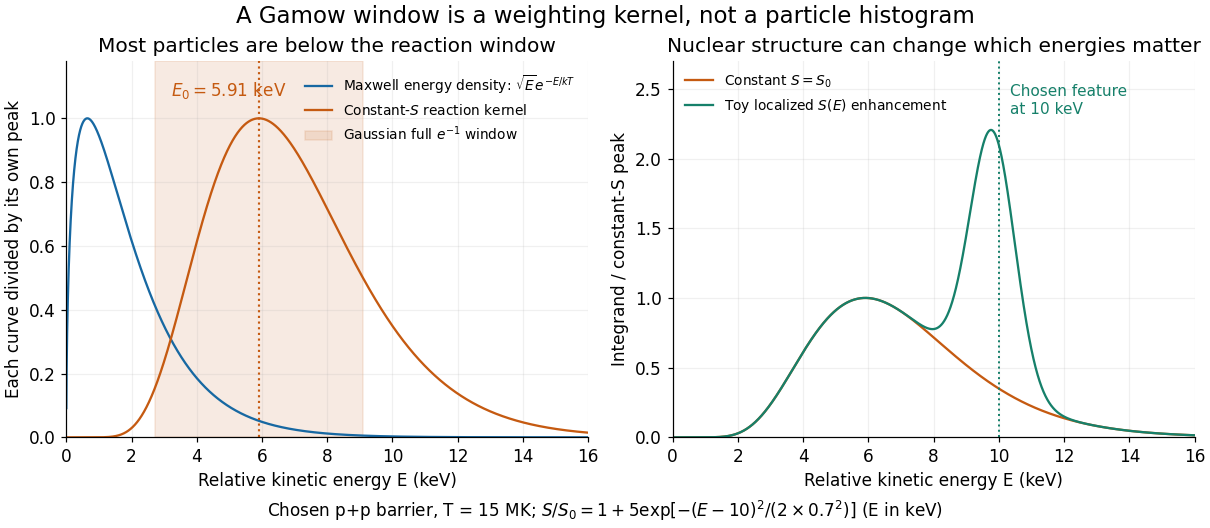
For a dilute nonrelativistic Maxwell-Boltzmann velocity distribution of relative motion, multiplying the relative-energy density by speed and nuclear reaction cross-section cancels the explicit factors of , givingThus the Gamow peak describes a rate-integral kernel, not a histogram of reacting stars or even the unweighted particle population. Plasma screening and departures from the assumed Maxwell-Boltzmann velocity distribution require additional physics.
For a nonresonant charged-particle thermonuclear reaction rate, the thermal high-energy tail favors low while the Coulomb barrier penetration factor favors high . Their product peaks in an intermediate energy window. Resonant reactions such as the Triple-alpha process require an additional resonance treatment.
For a slowly varying nuclear factor and penetration factor , the thermal integral is , where . The Gamow peak occurs at , with and . The Gaussian integral gives . Combined with the Maxwellian prefactor this produces the displayed thermonuclear reaction rate at fixed reactant density. The approximation assumes and excludes strong resonances or rapidly varying nuclear factors.
The Gaussian approximation to a nonresonant thermonuclear rate already gives the saddle and curvature. In its notation , so the same result readsThe full width joins the two points at of the peak of the approximating Gaussian function; it is neither its standard deviation nor its full width at half maximum . These are local Gaussian approximation widths, not exact equal-height endpoints of the asymmetric kernel.
Why keep the astrophysical S factor inside the integral? If is positive and smooth, stationarity of gives a leading peak displacement . The slow-variation test is therefore , together with small curvature corrections. More generally any energy-dependent prefactor shifts the saddle; a temperature-dependent prefactor also changes the local temperature exponent of a thermonuclear reaction. A sharp nuclear feature can invalidate this expansion altogether.
Choose and for an illustrative proton pair. Then , and . The relative Maxwell-Boltzmann velocity distribution has energy-density maximum , far below the reaction kernel's maximum. Now choose the deliberately artificial enhancementNumerical integration raises the rate by about at the same temperature, even though the enhancement is away from . This is a sensitivity experiment, not a claimed proton–proton nuclear level or a physical nuclear line-shape model. It illustrates why extrapolating without checking nearby structure can fail.

Articles by others on the same topic
There are currently no matching articles.